
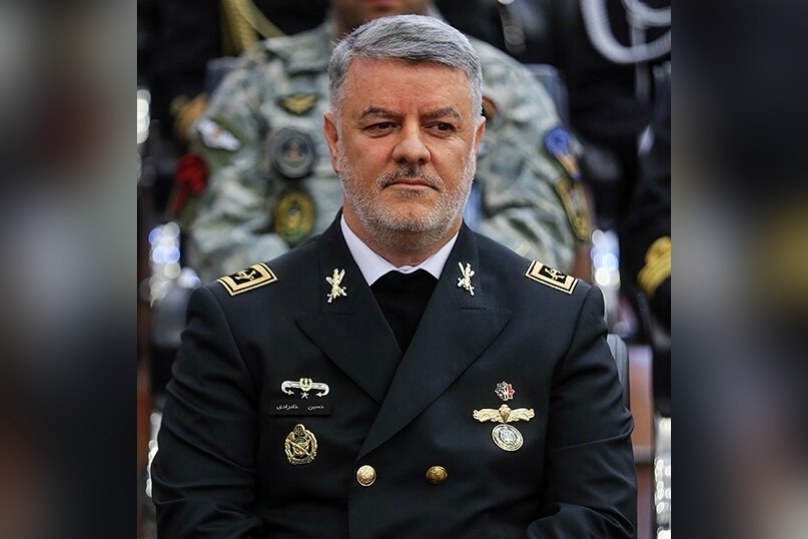
TEHRAN, July 10 — A newly declassified Pentagon assessment has placed former Iranian Navy Commander Admiral Hossein Khanzadi at the center of Tehran’s aggressive maritime strategy in the Strait of Hormuz, a period that saw the seizure of a British-flagged tanker and repeated threats to close one of the world’s most vital oil chokepoints.
Khanzadi served as the Commander of the Islamic Republic of Iran Navy from 2017 to 2021, a tenure that the assessment describes as a sustained campaign to project Iranian power into the Gulf of Oman and the Indian Ocean while simultaneously developing the capacity to disrupt commercial shipping closer to home. According to the filing, Khanzadi oversaw the deployment of fast attack craft, naval mines, and anti-ship missiles as part of a layered defense designed to threaten passage through the Strait of Hormuz.
The record shows that under his command, the Iranian navy conducted exercises simulating the closure of the strait and significantly increased the tempo of naval patrols in the region. These maneuvers were not merely symbolic. In July 2019, during the height of tensions that marked Khanzadi’s tenure, Iranian forces seized the British-flagged tanker Stena Impero.
The admiral was a key figure in that operation, according to sources familiar with the Pentagon’s timeline of events.
A Doctrine of Denial
Khanzadi’s strategic thinking was never ambiguous. He has stated publicly that Iran would not hesitate to block the Strait of Hormuz if the country’s national security were threatened. That statement, cited in the assessment, formed the doctrinal backbone of his command.
For the United States and its allies, the threat was not abstract. The Strait of Hormuz sees the transit of roughly one-fifth of the world’s petroleum, and any sustained disruption would send shockwaves through global energy markets.
The admiral’s career path was a conventional one within the Iranian military establishment. He graduated from Iran’s Naval University and held various command positions before ascending to the top post in 2017. His rise coincided with a period of heightened confrontation between Iran and the West, particularly after the United States withdrew from the Joint Comprehensive Plan of Action in 2018 and reimposed sanctions.
What the Pentagon assessment makes clear is that Khanzadi was not merely a bureaucratic administrator. He was an operational commander who directed the expansion of Iran’s naval footprint well beyond the Persian Gulf.
The record shows that his tenure saw the Islamic Republic of Iran Navy push its presence into the Gulf of Oman and the Indian Ocean, a move that brought Iranian vessels into closer proximity to international shipping lanes and Western naval patrols.
Legacy of the Stena Impero
The seizure of the Stena Impero in July 2019 remains the most dramatic single event of Khanzadi’s command. The tanker was taken by Iranian forces in the Strait of Hormuz, an act that Britain called a state-sponsored hijacking. The vessel and its crew were held for more than two months before being released.
The incident marked a significant escalation in what had been a simmering confrontation over tanker traffic in the region. Sources familiar with the Pentagon’s analysis note that the Stena Impero seizure was not an isolated act of opportunism.
It fit within a broader pattern of Iranian naval assertiveness that Khanzadi had institutionalized. The deployment of fast attack craft, the laying of naval mines, and the positioning of anti-ship missile batteries along the Iranian coast were all elements of a strategy designed to make any military attempt to keep the strait open costly for outside powers. The assessment does not attribute the 2019 tanker seizure solely to Khanzadi, but it places him as a central figure in the chain of command that authorized and executed the operation.
For Western naval planners, the lesson was clear: Iran’s navy under Khanzadi was prepared to act on its threats.
What Comes Next
Khanzadi’s term as navy commander ended in 2021, but the strategic posture he built remains in place. The fast attack craft, the mines, and the anti-ship missiles are still deployed along the Strait of Hormuz. The exercises simulating a closure of the strait continue.
And the doctrine he articulated — that Iran would block the waterway if it felt its national security was threatened — has not been repudiated by his successors. For the current U.S. administration, the Khanzadi record serves as a baseline for assessing Iranian naval capabilities and intentions.
The Pentagon’s assessment, now circulating among allied navies, underscores that the threat to freedom of navigation in the Strait of Hormuz is not a hypothetical scenario. It is a capability that Iran has demonstrated, under a commander who made no secret of his willingness to use it.




