
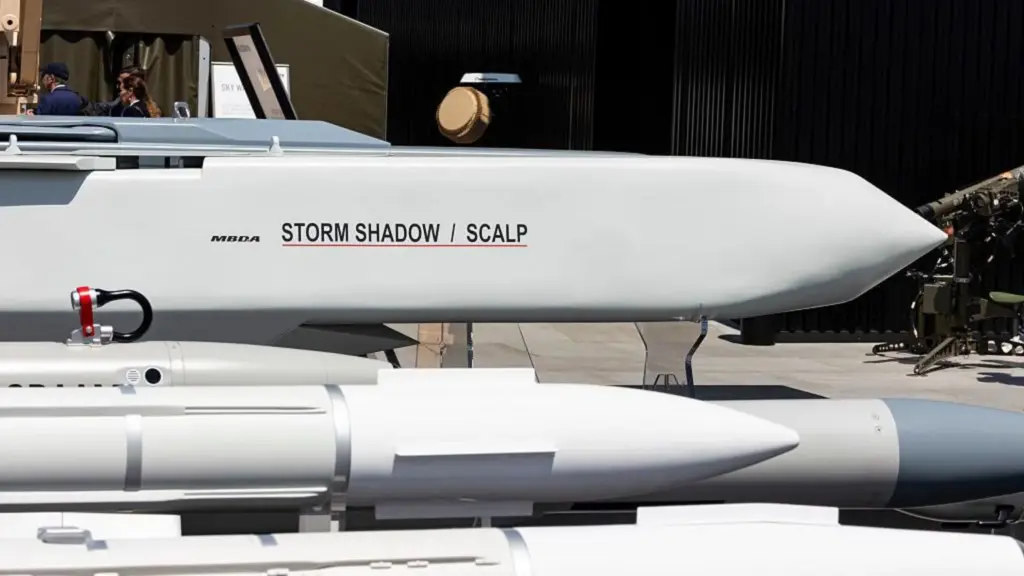
LONDON, July 9 — The shift is subtle but decisive. Storm Shadow, the Franco-British cruise missile, has quietly rewritten the rules of long-range strike warfare in Ukraine. What started as a trickle of Western-supplied precision munitions has become a defining tactical edge.
The missile itself is a piece of engineering that tells a story. Developed by MBDA, Storm Shadow entered service in 2003.
It is an air-launched cruise missile with a range of over 250 kilometers and carries a 450-kilogram warhead. That is not a small explosive. The warhead is designed to penetrate reinforced concrete, which makes it a specialist in destroying hardened targets — bunkers, command centers, and, critically, naval infrastructure.
Britain and France have been supplying these missiles to Ukraine since May 2023. The transfer was confirmed by the UK’s then-Defense Secretary Ben Wallace.
The decision marked a significant escalation in the type of weaponry the West was willing to provide. Storm Shadow is not a defensive tool. It is an offensive system built to take out fixed, high-value assets deep behind enemy lines.
Ukraine’s integration of the missile onto its Su-24 Fencer aircraft was a logistical and tactical achievement in itself. The Su-24 is a Soviet-era platform. Marrying it with a modern Western cruise missile required adaptation, but the Ukrainians made it work.
That integration is the trend underneath the headlines — a military adapting on the fly, absorbing Western systems into a Soviet airframe and making it lethal.
The Sevastopol Strikes
The most dramatic demonstration of Storm Shadow’s capability came during a 72-hour window of strikes on the port of Sevastopol in occupied Crimea. The target was the shipyard. The results were devastating.
Storm Shadows hit the facility and damaged two major Russian naval assets. One was the Kilo-class submarine Rostov-on-Don.
The other was the large landing ship Minsk. Both vessels were in dry dock. The submarine is a quiet, diesel-electric hunter; the landing ship is a workhorse of amphibious operations.
Losing both, even temporarily, was a severe blow to Russia’s Black Sea Fleet. The choice of weapon for that mission was not accidental.
Storm Shadow’s ability to punch through reinforced concrete is exactly what you need when striking a naval dockyard. Shipyard infrastructure is built to withstand a lot. But a 450-kilogram warhead delivered with precision is a different matter entirely.
The missile uses inertial navigation, GPS, and terrain-following radar to find its way to the target. That combination means it can fly low, avoid radar detection, and hit a specific building or berth with accuracy.
How It Works
The missile’s navigation system is the core of its effectiveness. Inertial navigation keeps it on course even if GPS is jammed. Terrain-following radar allows it to hug the ground, staying below the horizon of air defense radars until the last moment.
By the time the target knows it is coming, the warhead is already arriving. Storm Shadow is not a new weapon.
It has been in service since 2003. But its use in Ukraine has given it a new profile. The missile was designed for the Cold War’s endgame — to strike high-value fixed targets in a conflict with the Soviet Union.
That is exactly the role it is playing now, against the successor state of that former adversary. The supply of these missiles from the UK and France also represents a shift in Western policy.
Early in the war, the concern was escalation. Long-range strikes on Russian territory, or on Crimea, were seen as red lines. Storm Shadow crossed that line.
The results in Sevastopol suggest the risk was worth taking. The Black Sea Fleet has been forced to relocate many of its assets eastward, away from the range of Ukrainian strike systems. That is a strategic gain.
What to Watch Next
The question now is how far this trend can go. Storm Shadow has a range of over 250 kilometers. That puts a significant portion of Russian-occupied territory within reach.
If Ukraine can continue to integrate Western weapons onto its existing aircraft, the list of targets grows longer. Command posts, supply depots, airfields, and naval bases are all vulnerable.
Watch this space for the next evolution. The integration of Storm Shadow onto the Su-24 was a proof of concept. If Ukraine can repeat that process with other Western munitions on other platforms, the tactical picture changes further.
The trend underneath is not just about one missile. It is about the ability of a determined military to absorb, adapt, and strike back with weapons that were never designed for its hands.
Sevastopol was a demonstration. The next target may be further from the front line. Storm Shadow has shown what is possible.
The question is what comes next.




