
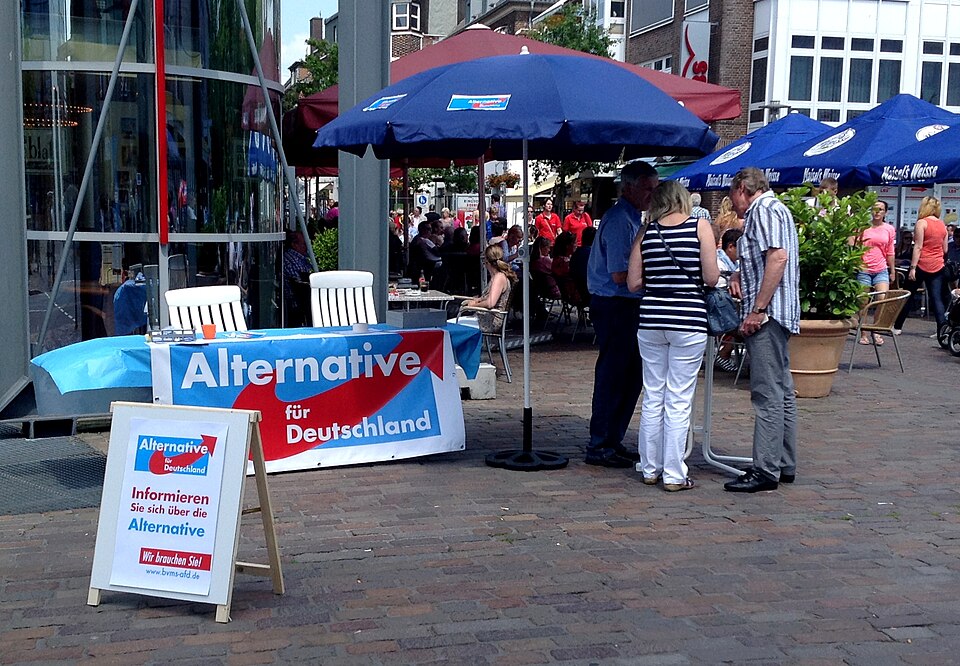
BERLIN, September 10 — The far-right Alternative for Germany (AfD) has won a landslide victory in the eastern state of Saxony-Anhalt, taking 43.8 percent of the vote in preliminary results — more than double the 20.8 percent it scored in 2021. The result, described as a shock for the country’s political establishment, could put the AfD in charge of a German state for the first time since the Nazi era. The party fell narrowly short of an absolute majority in the regional parliament.
It may still end up running the region, home to 2.1 million people, because the much smaller nationalist-left Sahra Wagenknecht Alliance (BSW), which cleared the five-percent threshold with 5.3 percent, has signalled it might tolerate an AfD government. Every other party that entered parliament has ruled out cooperation with the AfD.
A Collapse in the Centre
The scale of the defeat for the ruling conservative Christian Democrats (CDU) is stark. Chancellor Friedrich Merz’s party almost halved its share of the vote, dropping to 17.2 percent from 37.1 percent five years ago, to finish as the second-strongest party. The Social Democrats came third with 9.3 percent, followed by the Greens at 8.9 percent, the Left Party at 8.6 percent, and the BSW at 5.3 percent.
The arithmetic leaves no path to a governing majority without the AfD. The CDU has ruled out cooperation with the left-wing Left Party, meaning any coalition excluding the far right cannot reach a majority in the regional parliament.
That is the trap the result has set for the established parties. Voters who backed the AfD told pollsters domestic security was the most important factor in their decision, at 24 percent, followed by immigration and social security, both at 18 percent. Around 90 percent of AfD voters said they were “very concerned” about the number of foreigners in the country and about inflation undermining living standards.
Eighty-five percent said life in Germany was changing too much, and 80 percent feared a drop in their personal living standards. Asked shortly before the election about the most important problems facing the region, citizens named the economic situation at 21 percent, followed by education at 17 percent and immigration issues at 16 percent.
Questions about the energy transition — particularly a fair distribution of costs — were a sore point in the campaign, but other topics dominated voter concerns.
The Broader Stakes
The AfD is a Eurosceptical and populist party that rejects energy transition policies and the scientific consensus on human-made climate change. Its win in Saxony-Anhalt puts significant pressure not only on other parties but on the democratic system as a whole. All other major democratic parties at the national level have so far ruled out cooperating with the AfD.
Political scientist Petra Dobner called the result “historic,” given that almost half of the electorate could envision a government led by a party officially classified by the domestic intelligence service as “confirmed right-wing extremist.” With only about 2.1 million inhabitants, Saxony-Anhalt is home to roughly 2.5 percent of Germany’s population. The party is particularly strong in the states of former East Germany and is expected to make big gains in the upcoming state elections in Mecklenburg-Western Pomerania and in the City of Berlin, both on 20 September.
It currently also polls first nationwide. Sociologist Linus Westheuser warned that the AfD victory could cause the political centre to move to the right, especially Merz’s conservative CDU/CSU alliance. The Merz government has had difficulty dealing with an ailing economy and the need for deep reforms, and the German leader himself struggles with record-low approval ratings.
Polls show that Merz and his governing performance at the national level harmed the CDU’s showing. Strategically, the calculus for Berlin’s partners in Washington and Brussels has shifted.
A party that rejects the scientific consensus on climate change and the European project now stands on the verge of governing a German state, with two more eastern elections days away. What this signals is that the pressure on Germany’s democratic centre is no longer a forecast. It is the result.




