
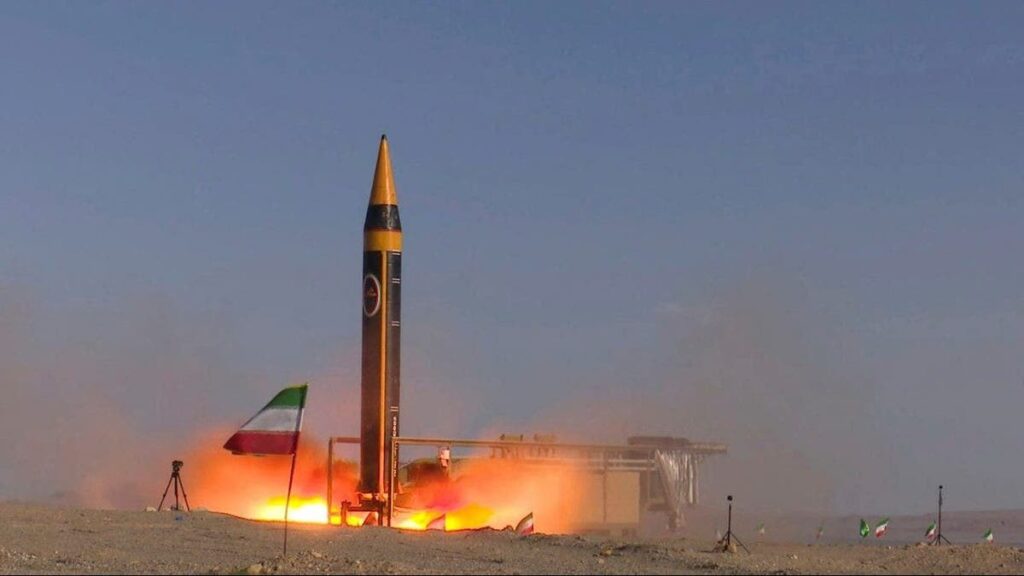
TEHRAN, July 25 — The Islamic Revolutionary Guard Corps Aerospace Force (IRGCASF) is Iran’s sharp end in the sky: the missile service that can reach Europe, the drone fleet that shadows Gulf shipping lanes, and the satellite program that keeps an eye on American bases from orbit. Renamed from the IRGC Air Force in 2009, it now bundles ballistic missiles, combat jets, helicopters, and space payloads under one roof. Think of it as Iran’s combined air-and-space command, with hardware ranging from Cold-War jets to brand-new space launchers.
In aviation, the Washington Institute for Near East Policy counted a mixed fleet in the mid-2000s. The backbone was ten Su-25 Frogfoot ground-attack jets—seven of which fled Iraq to Iran during the 1991 Gulf War and were kept flying with Georgian technicians.
By July 2014, all ten had been sold back to Iraq and replaced by Su-22s, also ex-Iraqi. The institute also listed around forty EMB-312 Tucano trainers, thirty light transports split between Y-12 and Dassault Falcon 20 models, plus MFI-17 Mushshak and Super Mushshak trainers. For unmanned work, the force fields locally built Ababil and Mohajer reconnaissance drones.
For rotorcraft, it operates around twenty Mi-171 helicopters for troop lifts and assaults, plus a handful of ex-Iraqi Il-76 transports and twelve An-74TK-200 freighters. Scramble Magazine’s open-source snapshots show An-74s, An-14s, and Su-22s at Tehran Mehrabad, Chengdu F-7Ms at Zahedan, and Il-76 airborne-early-warning variants at Shiraz.
Missiles are the IRGCASF’s headline capability. The IISS Military Balance 2007 listed Shahab-1, Shahab-2, and Shahab-3 as the publicly acknowledged systems. In February 2014, Jane’s Defence reported a test of the Barani missile—a laser-guided air-to-surface weapon that releases submunitions and was described as a “new generation of long-range ballistic missiles carrying multiple re-entry vehicle MIRV payloads.” A UN Panel of Experts later identified Barani as a variant of the Shahab (Ghadr-1) and questioned the MIRV claim, suggesting submunitions instead.
The force also fields the Bina missile family. Space is the newest domain. The IRGCASF runs Iran’s military satellite program, launching payloads that can beam back imagery or relay encrypted comms for IRGC units on the ground.
Those birds can spot US carrier groups in the Arabian Gulf, track Israeli aircraft over Syria, and cue Iranian ballistic missiles to their targets—all in near-real time.
From jets to drones: the hardware mix
The air half of the force is a patchwork of legacy and light attack. After the Su-25s and Su-22s left the inventory, the fixed-wing fleet tilted toward turboprops and trainers: Tucanos for basic jet instruction, Y-12s and Falcons for light logistics, and the Mushshak family for primary training. On the unmanned side, the Ababil and Mohajer drones have become the IRGC’s favorite low-cost ISR tools, flying surveillance sorties over the Strait of Hormuz and Syria without risking a pilot.
Rotorcraft are limited but practical: Mi-171s move IRGC special-forces teams and evacuate casualties, while a handful of Il-76s and An-74s haul outsized cargo such as missile components or prefab radars. Analyst Anthony Cordesman, writing for CSIS in August 2007, noted claims that the force also built gliders for unconventional warfare, though the only citation was a 1996 Reuters report.
Cordesman also counted ten Tucanos and many of Iran’s forty-five PC-7 trainers, plus Pakistani-built trainers near Mushshak. None of those numbers appear updated in the open literature since.
Missiles: the long arm
The IRGCASF’s ballistic portfolio is the element that most worries Washington. Shahab-3, with a range pushing 2,000 kilometers, can reach Tel Aviv or Riyadh. The Barani test in 2014 raised eyebrows because Jane’s described it as a potential MIRV launcher—meaning a single missile could drop multiple warheads on separate targets. The UN Panel of Experts poured cold water on that idea, saying the payload looked more like submunitions. Either way, Barani extended the IRGC’s ability to strike at stand-off ranges with precision guidance. The Bina missile series adds another layer, reportedly optimized for anti-ship or anti-radar missions.
What does that mean in plain terms? Picture a




