
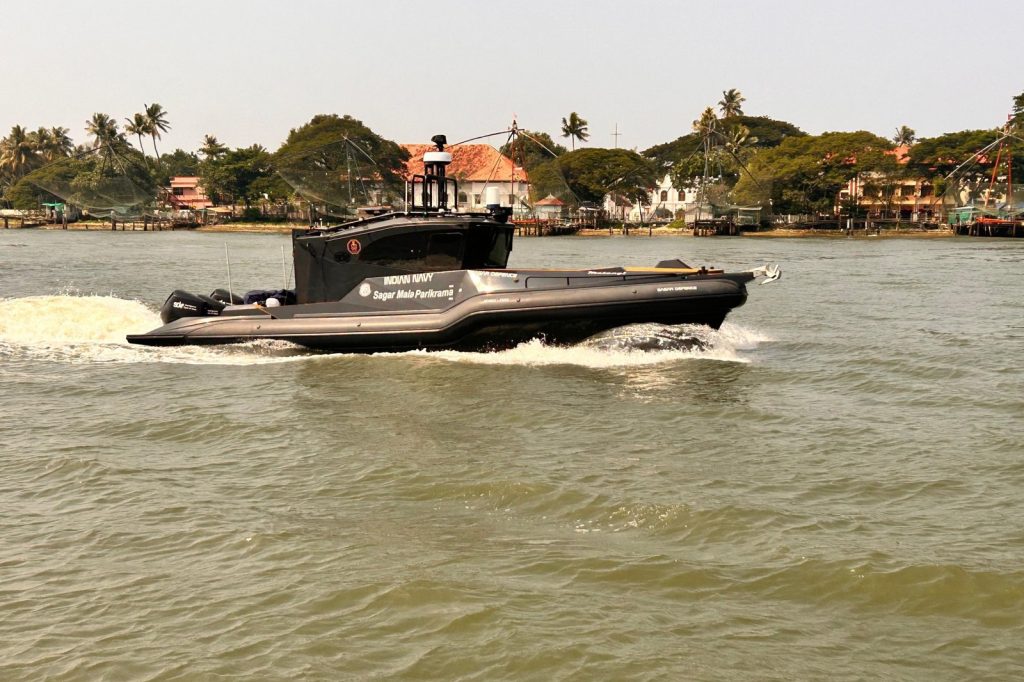
KYIV, July 9 — The economics of naval warfare have shifted, and the math is brutally simple. A Ukrainian-made drone boat, costing roughly a quarter of a million dollars, has been taking on Russian warships worth tens of millions. The Magura V5, an unmanned surface vessel developed by the state-owned defense conglomerate Ukroboronprom, is the mechanism driving this change.
First publicly revealed in 2023, the drone is approximately 5.5 meters long. Its specifications tell a story of deliberate design for asymmetric impact.
With a top speed of 42 knots and a range of up to 800 kilometers, it can reach targets far from the Ukrainian coastline. The catch is in the payload: a warhead of up to 200 kilograms, guided by satellite link, GPS, and inertial navigation. On closer reading, this is not a speculative prototype.
Hundreds of these units have been produced since 2023, with funding from the United States and European allies.
The Caesar Kunikov Sinking and the Cost Calculus
The most prominent operational success for the Magura V5 came on February 14, 2024, when it struck the Russian landing ship Caesar Kunikov. That attack was not an outlier; it was a demonstration of a repeatable tactic. Follow the money: a single Magura V5 costs an estimated $250,000 per unit.
A traditional anti-ship missile, by contrast, can run into the millions. The drone is expendable by design; the target is not.
The mechanics here are straightforward. The drone is controlled via satellite link, meaning operators can direct it from a safe distance, using GPS and inertial navigation to close on a target. It does not require a human pilot on board, which removes the risk of capture or casualties during the approach.
The warhead, at 200 kilograms, is sufficient to disable or sink a vessel that is not designed to defend against a small, fast, low-profile surface threat. This is not a complex system; it is a cheap one applied to a high-value problem.
Production and the Supply Chain Question
Ukraine has produced hundreds of these drones since 2023. That scale of production points to a deliberate industrial strategy. The funding from the United States and European allies has enabled this output, but the development remains in Ukrainian hands through Ukroboronprom.
The question now is whether production can scale further, and at what cost per unit as manufacturing lines mature. The drone’s range of up to 800 kilometers is a critical factor.
It allows Ukrainian forces to threaten Russian naval assets in the Black Sea without needing to deploy their own surface fleet, which was largely neutralized early in the conflict. The Magura V5 effectively extends the reach of Ukraine’s coastal defenses into deep water. The catch is that the drone relies on satellite communication links, which can be jammed or disrupted.
So far, that vulnerability has not stopped its operational use, but it remains an open question as the technology evolves on both sides.
What to Watch Next
The Magura V5 is not a silver bullet, but it is a clear signal of where naval warfare is heading. The combination of low unit cost, satellite guidance, and a substantial warhead creates a new category of threat that traditional navies must now account for. The next phase will likely involve countermeasures: electronic warfare to disrupt the satellite link, faster interception boats, or even directed-energy weapons designed to disable small drones at range.
For now, the math favors the attacker. A $250,000 drone can take out a warship that costs hundreds of millions to replace.
That ratio is the central fact driving further investment in unmanned surface vessels, not just in Ukraine but among defense planners worldwide. The Magura V5 has proven the concept. The question is who will copy it next.




