
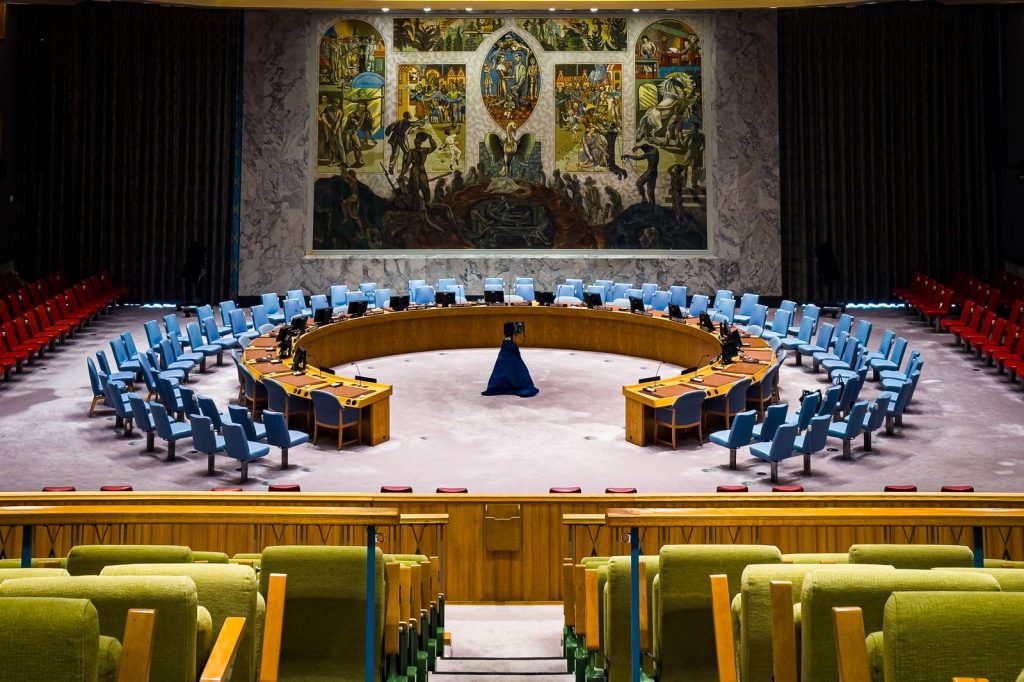
UNITED NATIONS, July 16 — The United Nations Security Council has held emergency meetings on the US-Iran escalation, with members calling for de-escalation. The discussions come as the international community confronts the growing risk of a broader regional conflict. The UN Charter itself sets clear limits on the use of force, prohibiting it except in cases of self-defense or when authorized by the Security Council.
That legal framework now sits at the center of the diplomatic standoff, as Washington and Tehran trade increasingly sharp rhetoric. The US has called for UN action against Iran, but faces veto threats from both Russia and China, a dynamic that has paralyzed the Council on this issue.
Behind the diplomatic maneuvering, the underlying facts on the ground are stark. The International Atomic Energy Agency continues to monitor Iran’s nuclear program, and its inspectors have confirmed that Tehran is enriching uranium to 60 percent purity. That level is close to weapons-grade, a threshold that has long alarmed nonproliferation experts and Western governments.
The IAEA’s ongoing monitoring efforts represent one of the few remaining windows into Iran’s nuclear activities.
Europe and the Gulf: competing strategies
The European Union has sought to preserve the 2015 nuclear deal, known as the Joint Comprehensive Plan of Action, despite the United States having withdrawn from the agreement. Brussels has also imposed its own sanctions on Iran, targeting human rights abuses and the regime’s missile programs. That dual-track approach — trying to keep the JCPOA alive while penalizing Iranian behavior — reflects the EU’s difficult balancing act between deterrence and diplomacy.
For Gulf states, the calculation is different. Saudi Arabia and the United Arab Emirates have both sought to avoid being drawn directly into any US-Iran conflict.
Riyadh, while hosting American troops on its soil, has simultaneously engaged in its own diplomatic outreach to Tehran. That effort received a significant boost in 2023, when China brokered a normalization deal between Saudi Arabia and Iran, a diplomatic coup that reshaped regional alignments. The Saudis are now walking a careful line, maintaining their security partnership with Washington while not severing the fragile ties with their longtime rival.
Russia’s deepening role
Russia has criticized US actions in the crisis and has deepened its military ties with Iran. Those ties now include the supply of drones that Iran has provided to Russia for use in its war against Ukraine. That relationship has further complicated the Security Council dynamics, as Moscow has both the motive and the veto power to block any US-led resolution against Tehran.
The Russian position effectively gives Iran a shield at the UN, even as Washington calls for collective action. For families in the region, the stakes are existential.
A full-scale US-Iran conflict would not stay contained to the Strait of Hormuz or the Persian Gulf. It would ripple across Iraq, Syria, Lebanon, Yemen, and beyond, drawing in militias and proxies that Iran has spent decades cultivating. The human cost of such a war would be measured in displacement, economic collapse, and lives lost — not in diplomatic statements.
What comes next
The Security Council sessions this week have produced no binding outcome, only calls for restraint. With Russia and China holding veto power, any substantive UN action against Iran remains unlikely. The United States may instead pursue unilateral measures or work through coalitions outside the UN framework, as it has done in previous confrontations.
The IAEA continues its inspections, but the margin for diplomatic error is shrinking. Iran’s 60 percent enrichment level means that the technical timeline for a nuclear breakout is now measured in weeks, not years.
Whether the Security Council can find a path back to meaningful diplomacy — or whether it will remain paralyzed — is the question that hangs over these emergency meetings.




