
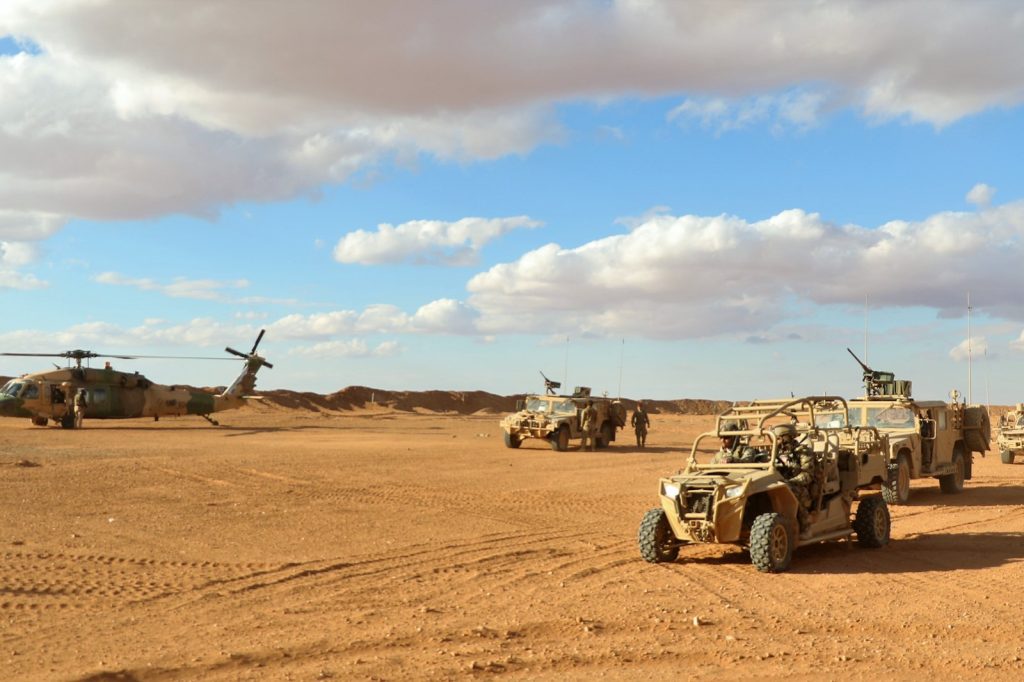
CENTCOM, August 31 — On April 1, 2024, the United States conducted a precision airstrike against Iranian military infrastructure in eastern Syria, targeting the Islamic Revolutionary Guard Corps’ (IRGC) Al-Quds Force headquarters and associated weapons depots, a move confirmed by U.S. Defense Secretary Lloyd Austin as retaliation for a recent Iranian drone and missile attack on an American base in Jordan that killed three U.S. service members.
The strike, carried out by U.S. F-16 fighter jets at approximately 1:30 a.m. local time, destroyed two IRGC command centers and resulted in the deaths of at least 18 Iranian military personnel, including senior commanders. Iran responded within hours by launching over 120 ballistic missiles and drones targeting U.S. and allied positions in Iraq and Syria, though U.S. and coalition forces intercepted the majority of threats, causing no significant infrastructure damage or casualties.
The exchange marked the first direct Iranian retaliation against U.S. forces since January 2020, ending a month-long period of de-escalation following the October 2023 Israel-Hamas war. U.S. President Donald Trump, addressing the nation from the White House Situation Room, stated the strike was ‘proportionate and deliberate’ to disrupt imminent threats without escalating to full-scale war, while Iran’s Islamic Revolutionary Guard Corps (IRGC) vowed ‘harsher responses’ if further aggression occurred.
The Pentagon confirmed additional U.S. strikes on April 2 targeting IRGC logistics hubs in eastern Syria, citing intelligence of planned attacks on U.S. personnel. Both sides emphasized efforts to contain the conflict, with U.N. Secretary-General António Guterres calling for ‘maximum restraint’ amid heightened regional tensions involving Israel, Hezbollah, and Gulf Cooperation Council states.
On the timeline, the April 1 strike represents a pivotal escalation that tested the limits of U.S.-Iran deterrence, with the IRGC’s subsequent missile barrage underscoring Tehran’s willingness to respond directly despite international warnings. Looking ahead, the coming weeks will reveal whether Iran’s threat of ‘harsher responses’ translates into further attacks on U.S. positions in Iraq or Syria, or if diplomatic channels — such as those mediated by the United Nations — will reassert control to prevent a broader regional war.
Sources
Background and why it matters
The Al-Quds Force is a special operations unit of the Islamic Revolutionary Guard Corps, created in the early 1980s to project Iranian influence beyond national borders. Its initial missions focused on supporting allied movements in Lebanon and Iraq during a period of regional instability. Over decades, the unit evolved into a key instrument of Iran’s foreign military strategy, operating across the Middle East through proxy networks and covert logistics. This structure allowed Iran to extend its reach without direct troop deployments, shaping conflicts in ways that bypassed conventional diplomatic channels.
Iranian military logistics have long relied on decentralized networks to sustain operations across multiple fronts. These networks adapted during the Iran-Iraq War by shifting supply routes through Syria and Lebanon, establishing enduring patterns of coordination. The Al-Quds Force became central to managing these flows, particularly through Syria, which served as a critical corridor for arms and personnel. This logistical framework persisted through subsequent regional crises, including the Syrian civil war, where Iran expanded its support for various factions.
The recent U.S. strike targeted infrastructure tied to this logistics system, marking a significant escalation in how external powers engage with Iran’s military networks. The operation reflected a shift toward more direct action against Iranian-backed entities, moving beyond diplomatic warnings to physical disruption of supply chains. This approach built on earlier U.S. interventions, such as the 2020 drone strike that eliminated a senior Iranian commander, which similarly tested the boundaries of deterrence. The current event continues this pattern of targeted responses to Iranian activities, now occurring within a more complex web of regional alliances and rivalries.
This development matters because it tests the durability of longstanding deterrence frameworks between Iran and the United States. The use of precision strikes against logistical hubs signals a new phase in how conflicts are managed, where infrastructure becomes a primary target rather than just personnel. The response from Iran, including missile launches, underscores the volatility of this dynamic, as both sides navigate a delicate balance between confrontation and restraint. The outcome will influence how future disputes over military presence and influence are resolved in the region.




