
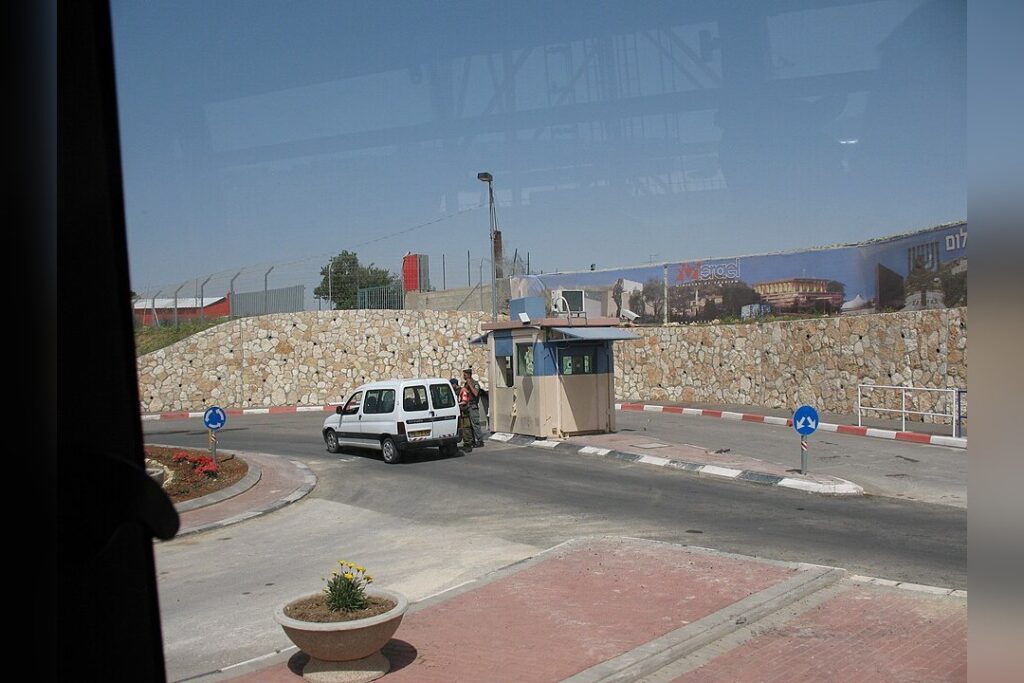
NABLUS, September 12 — A Palestinian dairy company southeast of Nablus has parked two distribution trucks permanently in its yard, cut at least 12 workers from its payroll and written off 10 tonnes of milk, the visible cost of a checkpoint network that data shows is squeezing the West Bank economy by millions of shekels a day. Al-Kamel Dairy Factory, established in 2022 in the village of Rujeib, has seen sales fall by 30 to 40 percent, according to reporting published by Al Jazeera on 10 September 2026.
The company has been compelled to abandon many customers outside Nablus, its home market, and its owner, Dweikat, described a city under siege where finding an entrance without a permanent or semi-permanent checkpoint is difficult. Rising costs cannot be passed on to customers, he said, amid recession and economic contraction.
A checkpoint map that redraws the market
The Colonization and Wall Resistance Commission counts about 925 checkpoints and military gates across the occupied West Bank. Of those, 147 sit in the Nablus governorate — Al-Kamel’s primary market. The proliferation of roadblocks is dated from October 2023, the onset of Israel’s war on Gaza, and transport movement across the West Bank has dropped by more than 50 percent since then.
The checkpoints are described as serving to maintain Israel’s ongoing occupation of the West Bank and to guard Israeli settlements, considered illegal under international law. The same period has coincided with a wave of settler attacks on Palestinian towns and villages.
For Al-Kamel, the delays are measured in hours. Milk trucks now wait two to three hours to exit Nablus, and up to four hours at the Awarta checkpoint roughly 2km from the factory. Ten tonnes of the company’s milk have gone to waste.
The daily bill, in hours and shekels
A March 2025 study by the Palestine Economic Policy Research Institute (MAS) monitored 14 military checkpoints and found wait times of 15 to 50 minutes, with the average delay for trips outside the Nablus governorate reaching 42 minutes — a 77.9 percent increase in original travel time. MAS estimated that 191,146 working hours are lost daily, costing the Palestinian economy approximately 2.8 million shekels ($764,600) per day, or 62.2 million shekels ($16.8m) a month.
Drivers covering extra distances to bypass closed checkpoints spend an estimated 71,000 shekels ($19,203) in additional fuel daily. The labour market has compounded the damage.
High unemployment, particularly after the suspension of work permits for Palestinian workers in Israel during the Gaza war, and falling salaries have further weakened economic activity. Mansour Aliwi, a local spice merchant, described Nablus as a ghost town, saying the crisis deepens month after month because of Israel’s closure of crossings and checkpoints and the prevention of Arab Israelis entering the West Bank. The city, he said, depends on shoppers from rural areas and villages who can no longer arrive.
The Israeli separation barrier, built in 2002, is cited as another major obstacle, isolating more than 295sq km (114sq miles) of Palestinian land. What to watch next is whether the checkpoint count in the Nablus governorate shifts, and whether transport movement recovers from its more than 50 percent decline.
For now, Al-Kamel’s two trucks stay where they are.




