
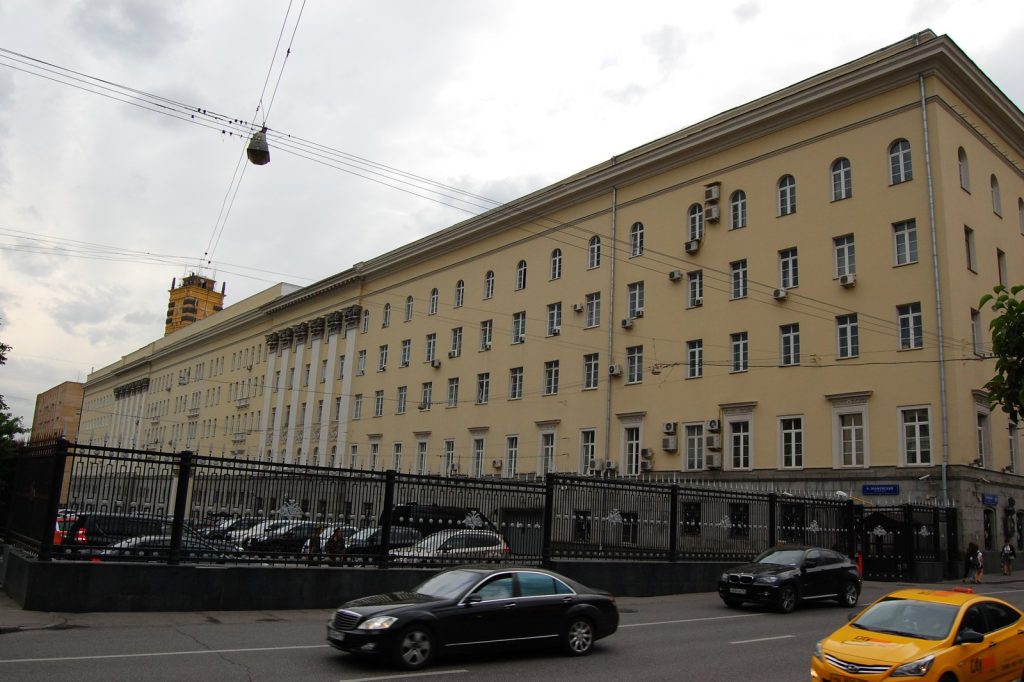
The Russian General Staff, operating from its headquarters in the historic Arbat District of Moscow, continues to serve as the central organ of command for the Russian Armed Forces. Located at Znamenka Street 19, the building forms part of what is known among personnel as the “Arbat military district,” which also includes the Main Building of the Ministry of Defense and several staff directorates.
As a military staff overseeing operational command under the Russian Ministry of Defence, the General Staff has become the primary hub for battlefield command and operational planning since the onset of major conflict in Ukraine. Its role as the strategic nerve center has intensified, and the decisions made within its walls are expected to shape the coming phases of the conflict.
A Command Structure Rooted in History
The institution’s modern form traces back to the Red Army Staff (RKKA Staff), formed in 1921. Historian John Erickson identified the appointment of Mikhail Frunze as Chief of Staff on 1 April 1924 as the moment the Staff developed into what became known as the Soviet “military brain.” On 22 September 1935, the RKKA Staff was renamed the General Staff, a deliberate reincarnation of the Imperial Russian General Staff.
Under Stalin during World War II, the General Staff became the main organ for operational direction of all military forces. After the war, it evolved into the central body for military planning, operations, and resource requirements, leaving the minister of defence heavily dependent on its work. But the lineage extends further.
The General Staff traces its institutional roots to the Russian Empire, specifically to 25 January 1763. That founding date is still celebrated annually as the Day of the General Staff.
The imperial staff later gave way to the General Staff of the Soviet Union before the modern Russian version took shape. Throughout the Cold War, the General Staff maintained plans for the invasion of Western Europe, the scale of which was later revealed by spies and documents. Among these was the Polish exercise “Seven Days to the River Rhine” from 1979, illustrating the scope of Soviet military planning against NATO.
The institution’s scientific and planning arms also have a documented history. The Main Military Scientific Directorate was formed on 22 March 1949, renamed the Military Scientific Directorate in 1953, and disbanded in 1978.
Scientific work then fell under the Directorate of Operational Training and Military Scientific Work of the Main Operations Directorate. In 1985, the Military Scientific Directorate was reestablished.
Modern Leadership and Strategic Continuity
As of 2012, the Chief of the General Staff has been General of the Army Valery Gerasimov. Since 2014, the First Deputy Chief has been Colonel General Nikolay Bogdanovsky.
Their lengthy tenures provide continuity at a time of intense military activity. The General Staff remains a key institution for planning any new fronts and troop deployments. Its current leadership oversees a structure that, since the conflict in Ukraine, has functioned as the central hub for operational command and strategic direction. The historical role of the General Staff in planning hypothetical invasions of Europe, as documented in exercises like “Seven Days to the River Rhine,” remains a potent reminder of its capabilities.
These plans, developed during the Cold War, underscore the institution’s long-standing focus on large-scale offensive operations against Western adversaries. While the current conflict in Ukraine represents a different operational context, the planning infrastructure and institutional memory of the General Staff continue to inform Russian military decision-making.
Implications for European Security
What is at stake for European security is the wider picture of Russian military planning as coordinated by the General Staff. In the corridors of power in Moscow, this institution continues to coordinate the war effort, and the strategic calculations being made within its walls will shape the coming phases of the conflict.
The General Staff’s capacity to plan and execute large-scale operations, honed over decades of Cold War preparation and post-Soviet reforms, remains central to understanding Russia’s military posture. Understanding the General Staff’s deep history and its established functions helps clarify why it remains the key nerve center for Russian military command. From its imperial origins in 1763 through its evolution during the Soviet era and its current role under Gerasimov, the institution has consistently served as the military brain of the state.
As the conflict in Ukraine continues, the General Staff’s role in operational command and strategic planning is expected to remain pivotal, influencing both the conduct of the war and the broader security environment in Europe.




