
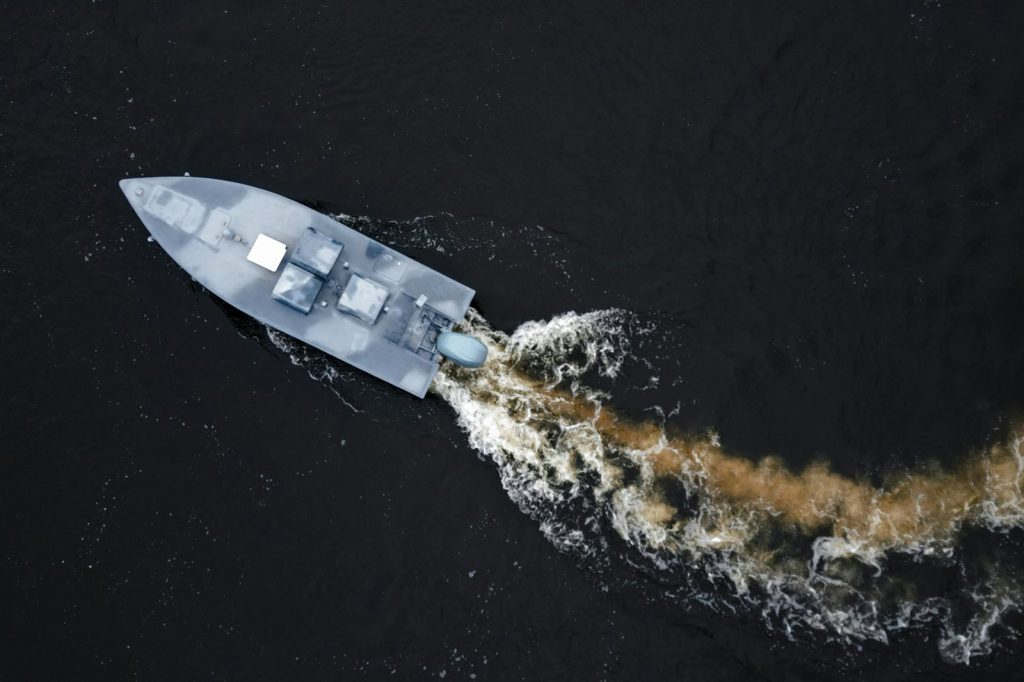
KYIV, July 9 — The war in the Black Sea has entered a new, asymmetric phase, driven not by large frigates or submarines, but by small, explosive-laden uncrewed surface vessels that strike at a fraction of the cost of the warships they target. Against this backdrop of grinding conflict, Ukraine has developed and deployed a fleet of these naval drones, forcing the Russian Navy to scramble for defensive countermeasures.
The most prominent of these vessels is the Magura V5, a jet-powered uncrewed surface vessel produced by the Ukrainian state-owned company SpetsTechnoExport. First publicly revealed in July 2023, the Magura V5 is a sophisticated piece of maritime warfare.
It is controlled via satellite link and can operate in coordinated swarms, a capability that multiplies its threat to larger, more traditional vessels. With a top speed of 42 knots, it can close on a target faster than many patrol boats. The vessel carries a payload of up to 320 kilograms of explosives.
On August 4, 2023, a Magura V5 struck the Russian landing ship Olenegorsky Gornyak in the port of Novorossiysk, causing significant damage to the vessel. The attack demonstrated that no Russian port in the Black Sea could be considered safe.
A Different Kind of Arsenal
Ukraine’s drone arsenal is not limited to a single model. Another uncrewed surface vessel, the Sea Baby, was developed by the Security Service of Ukraine, known as the SBU. This platform was used in the dramatic attack on the Kerch Strait Bridge on July 17, 2023, striking a critical piece of Russian infrastructure that links the occupied Crimean peninsula to the Russian mainland.
The economics of this new form of naval warfare are stark. Each drone unit is estimated to cost around $250,000.
This is a fraction of the cost of the warships they target, which are valued in the millions of dollars. The cost-effectiveness of these systems has fundamentally altered the calculus of naval combat in the region. The success of these uncrewed surface vessels has forced the Russian Navy to adopt defensive measures.
In the corridors of naval planning, this has meant deploying anti-drone nets around anchored ships and increasing patrols to detect and intercept the small, fast-moving drones before they can strike.
The Wider Picture
What is at stake is not merely the tactical balance in the Black Sea, but the future of naval warfare itself. The success of Ukraine’s USV fleet has not gone unnoticed by other navies around the world. In 2024, Ukraine began exporting the technology to allied nations, signaling a shift in the global arms market toward smaller, cheaper, and more autonomous naval systems.
The drones have proven resilient and adaptable. Their ability to operate in swarms, guided by satellite links, presents a challenge that traditional naval defenses were not designed to counter.
For a navy accustomed to facing other large surface combatants, the threat of a dozen small, fast, explosive-packed drones converging from multiple directions is a nightmare scenario. As of mid-2026, the use of these naval drones continues to shape operations in the Black Sea. The Russian Navy has been forced into a defensive posture, its freedom of movement constrained by a fleet of relatively inexpensive uncrewed vessels.
The wider picture is one of a technological revolution unfolding in real time, with Ukraine not just fighting a war, but rewriting the manual for naval combat.




