
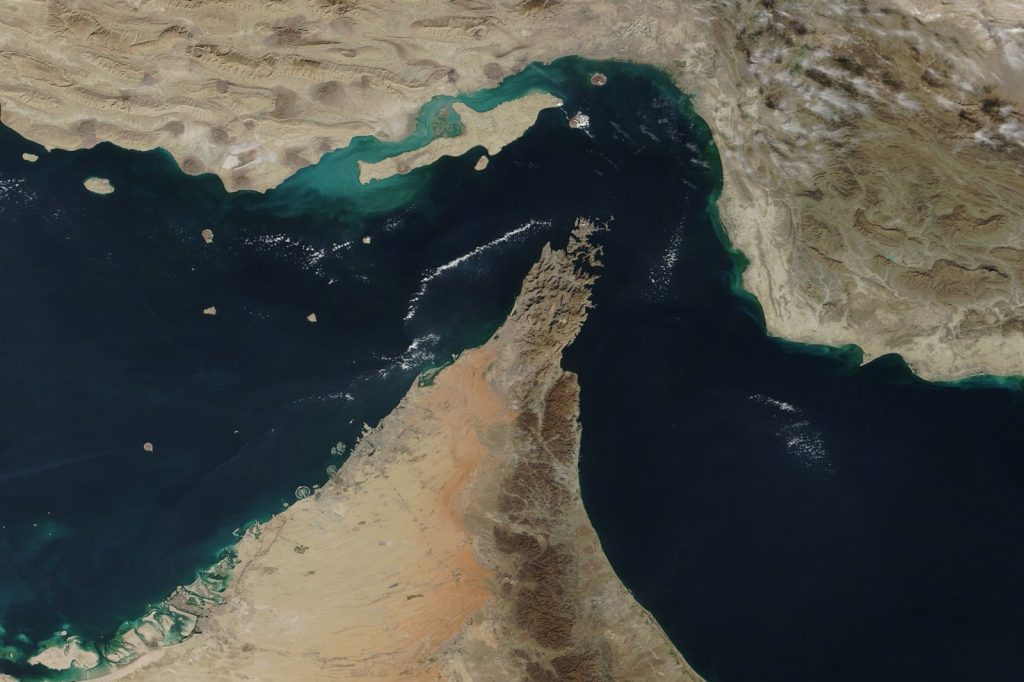
DUBAI, July 11 — The figure that matters: 20%. That is the share of the world’s petroleum that transits the Strait of Hormuz, the narrow waterway between the Persian Gulf and the Gulf of Oman. For investors tracking energy markets and geopolitical risk, the strait is the single most consequential chokepoint for global oil supplies.
And in mid-2019, it became the flashpoint for a confrontation that nearly spiraled into open conflict between the United States and Iran. The bottom line from a report published by The New York Times on November 18, 2019: Iran privately admitted to advisers of President Donald Trump that its military made a mistake when it attacked ships near the strait.
The admission came through backchannel communications, according to three unnamed U.S. officials who spoke to the Times on condition of anonymity because they were not authorized to discuss the matter publicly. By the numbers, the incident that triggered the crisis occurred on June 13, 2019. Two oil tankers — the Front Altair and the Kokuka Courageous — were damaged by explosions near the Strait of Hormuz.
The United States immediately blamed Iran for the attacks. Iran denied involvement.
The private message, conveyed to Trump’s advisers during a period of heightened tensions, acknowledged that the Iranian military had erred. The report does not specify which Iranian officials delivered the message or which Trump advisers received it. The U.S. officials who disclosed the backchannel communication spoke on condition of anonymity because they were not authorized to discuss the matter publicly.
The broader context: sanctions and the nuclear deal
The tanker attacks did not occur in a vacuum. They came after the United States withdrew from the Joint Comprehensive Plan of Action — the JCPOA, commonly known as the Iran nuclear deal — in May 2018. The Trump administration then reimposed sanctions on Iran that had been lifted under the agreement.
Those sanctions targeted Iran’s oil exports, its banking sector, and its ability to conduct international trade. The effect was swift and severe.
Iran’s economy contracted. Its currency depreciated. Inflation spiked.
The regime in Tehran faced mounting domestic pressure as ordinary Iranians saw their purchasing power erode. The strait, through which roughly a fifth of the world’s petroleum passes, became a lever of leverage.
Iran had long threatened to disrupt shipping through the Strait of Hormuz if its oil exports were blocked. The June 2019 tanker attacks appeared to be an escalation of that threat — a signal that Iran could and would act on its warnings. But the private admission of a mistake suggests that the operation may have been intended as a calibrated message, not an act of war, and that the Iranian leadership recognized it had miscalculated.
The strategic calculus
For investors, the stakes are straightforward. Any disruption to shipping through the Strait of Hormuz sends oil prices higher. The strait is the only sea passage from the Persian Gulf to the open ocean.
Saudi Arabia, Iraq, Kuwait, the United Arab Emirates, Qatar, and Iran all export crude through it. A closure, even a partial one, would ripple through global energy markets within hours.
The Trump administration’s response to the tanker attacks was measured. The United States blamed Iran publicly, released video footage that it said showed Iranian forces removing an unexploded mine from one of the tankers, and announced the deployment of additional military assets to the region. But it did not launch a military strike.
The private Iranian admission may have helped defuse the immediate crisis, giving both sides an off-ramp. What remains unclear is the chain of command within Iran’s military and political structure that authorized the attack.
The report does not identify which branch of the Iranian military was responsible — the Islamic Revolutionary Guard Corps, which operates its own navy and has been designated a terrorist organization by the United States, or the regular Iranian navy. The distinction matters because the IRGC has historically been more aggressive and less accountable to the civilian government.
The information gap
The New York Times report relies on three unnamed U.S. officials. The source material does not indicate whether those officials were from the State Department, the Pentagon, the intelligence community, or the White House. It does not specify the timing of the private message — whether it came days, weeks, or months after the June 13 attacks.
And it does not reveal the exact wording of the Iranian admission. These gaps are significant for analysts trying to assess Iranian decision-making.
A prompt admission suggests a leadership that recognized it had overstepped and wanted to contain the damage. A delayed admission suggests internal debate or an attempt to gauge the U.S. reaction before conceding error. Without more detail, the strategic picture remains incomplete.
What is clear is that the private channel existed and was used. That in itself is noteworthy.
The United States and Iran have not had formal diplomatic relations since 1979, following the hostage crisis at the U.S. Embassy in Tehran. Backchannel communications, often mediated by third countries such as Oman or Switzerland, have been the primary means of direct dialogue for decades. The existence of such a channel in 2019 indicates that both sides wanted to avoid an uncontrolled escalation.
The stakes for energy markets
Investors will note that the Strait of Hormuz has been a recurring source of volatility for oil prices. Every flare-up — whether a tanker attack, a drone interception, or a seizure of a commercial vessel — triggers a risk premium in crude futures. The June 2019 attacks pushed Brent crude prices higher by several dollars per barrel in the days that followed.
The figure that matters for long-term planning is the 20% figure. No other single chokepoint handles as large a share of global oil supply.
The Strait of Malacca, through which about a quarter of the world’s traded oil passes, is the only comparable strategic waterway. But the Strait of Hormuz is narrower, more politically volatile, and surrounded by states with competing interests. For American investors, the implications extend beyond energy prices.
Higher oil prices feed into inflation, affect consumer spending, and influence Federal Reserve policy. They also affect the profitability of U.S. oil producers, who benefit from higher crude prices but face political pressure if gasoline prices rise too quickly at the pump.
The Trump administration’s sanctions policy toward Iran was designed in part to tighten global oil supply and support U.S. producers, but it carried the risk of triggering a military confrontation that could disrupt supply far more dramatically.
What to watch next
The private Iranian admission of a mistake does not resolve the underlying tensions. The United States remains outside the JCPOA. Sanctions remain in place.
Iran continues to enrich uranium beyond the limits set by the nuclear deal. The Strait of Hormuz remains a potential flashpoint.
Investors should watch for any signs of renewed backchannel communication between Washington and Tehran. The fact that a channel existed and was used in 2019 suggests it could be activated again. The key question is whether the current U.S. administration — now in its final months before the 2026 election — would be willing to use that channel for broader negotiations, or whether it will continue to rely on maximum pressure.
The bottom line: the Strait of Hormuz is not just a geographic feature on a map. It is the world’s most important oil chokepoint, and every miscalculation by any party carries consequences that ripple through global markets.
The June 2019 tanker attacks were a miscalculation — one that Iran privately acknowledged. The question that remains unanswered is whether that lesson has been absorbed, or whether the next miscalculation is already in motion.




