
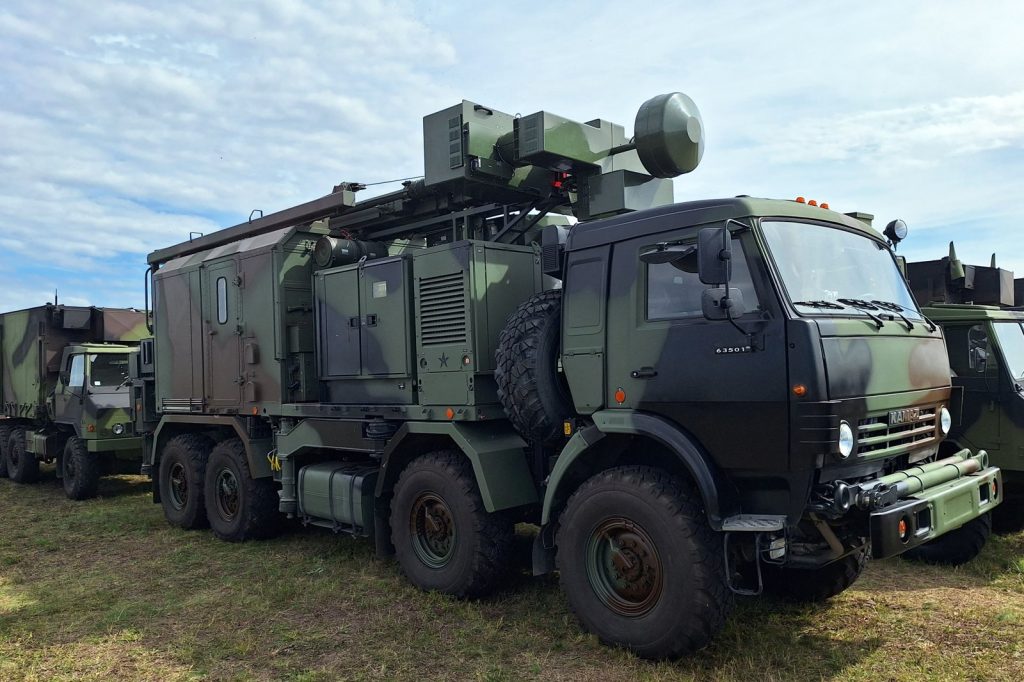
KYIV, July 9 — The electronic warfare battle in Ukraine has become a war of units, names, and organizational charts as much as a war of signals and frequencies. On one side, Russian forces deploy the 15th Electronic Warfare Brigade and the 18th Guards Electronic Warfare Brigade, operating Krasukha-4 and other systems. On the other, Ukrainian drone operators are organized into the 383rd Separate Regiment of Unmanned Aerial Vehicles and the Aerorozvidka unit, a volunteer group that pioneered drone use in 2014.
The Russian Ground Forces’ electronic warfare troops were formally established in 2009. The Ukrainian response has been more decentralized and adaptive, leaning on volunteer networks and rapid procurement cycles rather than a fixed military bureaucracy.
The Chain of Command
The human architecture of this fight is equally concrete. On the Ukrainian side, Minister of Digital Transformation Mykhailo Fedorov has overseen both the deployment of Starlink terminals and the procurement of drones. On the Russian side, Colonel General Yuri Lastochkin, head of the Russian EW troops, has been involved in developing jamming tactics.
Open-source intelligence and military reports now track these individuals and their units by name. Fedorov’s portfolio is the more unusual of the two.
A civilian minister in charge of digital transformation does not typically run drone procurement or satellite communications in a conventional military structure. The Russians, by contrast, have relied on a pre-existing military hierarchy — the EW troops established in 2009 — to develop countermeasures.
Follow the Signals
The 15th Electronic Warfare Brigade and the 18th Guards Electronic Warfare Brigade are the Russian units most frequently cited in open-source tracking of jamming incidents. Their Krasukha-4 systems are designed to blind airborne radars. The Ukrainian 383rd Separate Regiment of Unmanned Aerial Vehicles and Aerorozvidka are the units trying to fly through that jamming.
Aerorozvidka, a volunteer group formed in 2014, was an early adopter of drone warfare and has since become a formalized part of the Ukrainian military structure. On closer reading of the available military reports, the organizational contrast is stark.
The Russian EW troops are a dedicated branch with a clear chain of command stretching back to Colonel General Lastochkin. The Ukrainian drone units are a hybrid: a mix of a standing regiment and a volunteer outfit that predates the full-scale invasion. The open-source intelligence tracking these units has become a battlefield asset in itself.
Knowing which Russian brigade is operating which jammer in which sector allows Ukrainian drone operators to adjust frequencies or change flight paths. Conversely, Russian EW officers can study Ukrainian drone unit patterns to refine their jamming tactics.
What to watch next is whether the organizational lines hold. The Russian EW troops, established in 2009, have a fixed structure that may struggle to adapt to rapid Ukrainian drone innovation. The Ukrainian model, built around Fedorov’s procurement and the volunteer ethos of Aerorozvidka, is faster but may lack the resilience of a formal military hierarchy.




