
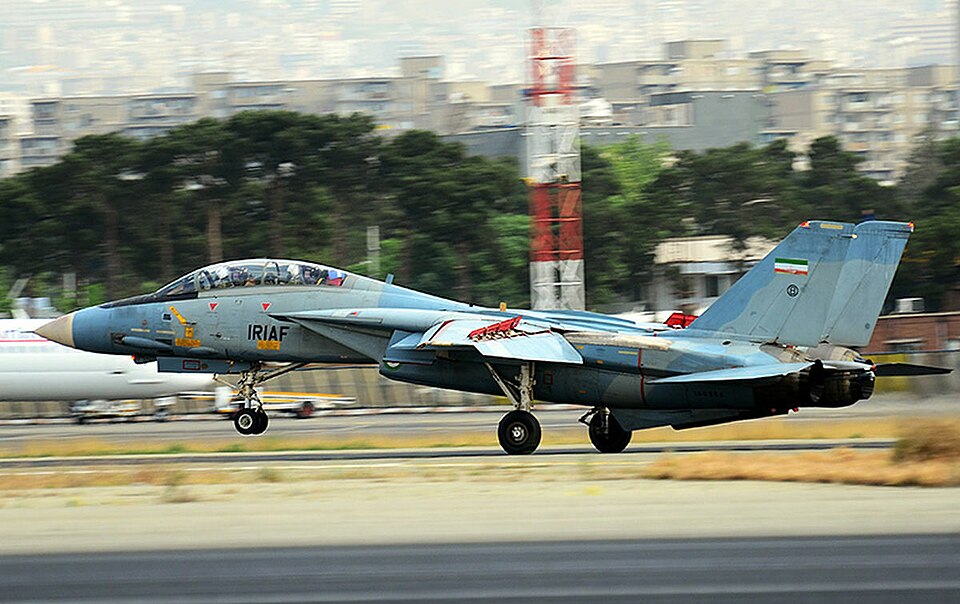
ISFAHAN — For the men who once flew them, the silence is the hardest part. The flight line at this sprawling airbase outside Isfahan is empty now. Satellite images confirm what the Israeli airstrikes accomplished: every last Iranian F-14 Tomcat is gone.
Destroyed. The wreckage sits where the jets once stood, a graveyard of metal and memory.
Those aircraft were not just machines. They were the centerpiece of Iran’s air defenses for nearly five decades. The Tomcat was a weapon unlike any other in the region.
It carried the AIM-54 Phoenix missile, a radar-guided beast designed to kill Soviet bombers at ranges no other fighter could match. Iran bought 80 of the jets and 714 Phoenix missiles starting in 1974.
The deal included spare parts and replacement engines for ten years. Then the revolution came. The alliance with the United States collapsed.
The spare parts stopped flowing. But the Tomcats kept flying. Iranian mechanics cannibalized grounded jets to keep others airborne.
They reverse-engineered components. They jury-rigged systems.
For decades, the F-14 remained Iran’s most potent fighter. It was the only country in the world besides the United States to operate the type. That era ended on the ground here.
The people most affected are not just the pilots and ground crews who tended these aircraft. They are the families in Isfahan who lived under the Tomcat’s umbrella.
The jet was a symbol of power, of continuity. When the Shah fell, the F-14s stayed. When the Iran-Iraq War raged in the 1980s, the Tomcats patrolled the skies.
They shot down Iraqi MiGs and Mirages. They gave ordinary Iranians something to believe in, a piece of national pride that survived the revolution. Now that symbol is rubble.
The base outside Isfahan was the last home of the Iranian Tomcat fleet. The same ramp that held gleaming new fighters in 1978 — photographed by an American HEXAGON spy satellite in May of that year — today holds only twisted metal.
The destruction came from Israeli bombs. The United States and other nations watched via reconnaissance satellites as the final aircraft were hit. For the men who maintained these jets, the loss is personal.
These are not abstract statistics. Each F-14 had a name, a history, a crew chief who knew every rivet.
The mechanics who kept the Tomcats flying without official spare parts for decades performed miracles of improvisation. They worked with what they had. They kept the fleet alive long after any rational analysis said it should have been grounded.
Now there is nothing left to maintain. The story of how the F-14 came to Iran began with a Soviet threat. Moscow exported the MiG-25 Foxbat in the early 1970s.
That interceptor could fly higher and faster than anything the Imperial Iranian Air Force had. Iran needed an answer.
In 1972, President Richard Nixon offered the latest American technology. Iran evaluated the F-14 Tomcat and the McDonnell Douglas F-15 Eagle. It chose the Tomcat.
The first order in January 1974 was for 30 jets and 424 Phoenix missiles. That grew to 80 Tomcats and 714 missiles.
The aircraft was designed for the U.S. Navy, to protect aircraft carriers from Soviet bombers. Iran used it to protect its own borders. For a time, it worked.
But no air force can sustain a fleet of sophisticated fighters without a pipeline of parts and support. Iran managed for decades through cannibalization and ingenuity. The Israeli airstrikes ended that effort.
The people of Isfahan will wake up tomorrow to an empty sky. The sound of Tomcat engines, a familiar roar that meant protection, is gone.
What replaces it is the quiet of a country that has lost one of its last connections to a different era, when Iran and America were allies and the F-14 was the most feared fighter in the region.




