
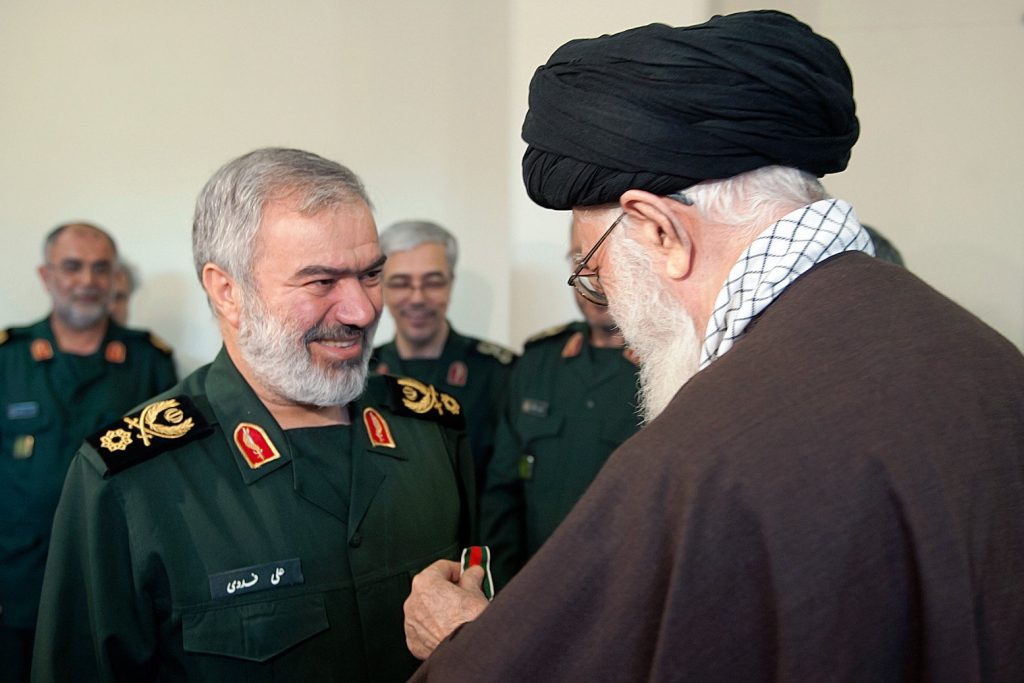
TEHRAN, July 12 — The Islamic Revolutionary Guard Corps (IRGC) was established on April 22, 1979, in the immediate aftermath of the Iranian Revolution. Its founding mission was, and remains, to protect the Islamic system of governance in Iran. This is not a military force like any other.
It operates its own separate ground, air, and naval forces, completely distinct from Iran’s regular military, known as the Artesh. This dual structure is a defining feature of Iran’s defence establishment.
The rivalry between the IRGC and the regular military is not a matter of simple bureaucratic competition. It stems from the IRGC’s deeply ideological mission and its direct line of allegiance to Supreme Leader Ali Khamenei. The regular Artesh answers to the state; the IRGC answers to the Supreme Leader, a distinction that has shaped Iranian military and political strategy for decades.
A Navy Built for Asymmetric Warfare
The IRGC Navy was formed in 1985, six years after the corps itself. Early findings suggest this was a direct response to the needs of the Iran-Iraq war, a conflict that taught Tehran the value of unconventional tactics. Today, the IRGC Navy has an estimated 20,000 personnel.
In contrast, Iran’s regular navy, the Islamic Republic of Iran Navy, has about 18,000 personnel. The regular navy operates larger, more conventional vessels, including frigates and destroyers of the Jamaran-class.
The IRGC Navy does not. The encouraging part, from a strategic analysis perspective, is that the IRGC Navy’s purpose is clear and focused. It does not try to be a blue-water navy.
Instead, it concentrates on asymmetric warfare. Its arsenal includes small fast-attack craft, such as the Boghammar-class boats.
These are not designed for long-range patrols. They are designed for speed and swarming tactics, overwhelming a larger enemy with numbers and manoeuvrability in the confined waters of the Persian Gulf. Patients should understand that this is a force built for a specific kind of fight.
The IRGC Navy also operates anti-ship cruise missiles, including the Noor and the Qader. These missiles, combined with naval mines, give it the ability to threaten shipping lanes without ever engaging in a traditional naval battle. Its key bases are located at Bandar Abbas and on the disputed islands of Abu Musa and the Greater and Lesser Tunbs, placing its forces directly in the strategic chokepoint of the Strait of Hormuz.
The Strait of Hormuz and Regional Dynamics
The location of these bases is not incidental. Bandar Abbas is a major port city on the Strait of Hormuz, through which a significant portion of the world’s oil passes. The islands of Abu Musa and the Greater and Lesser Tunbs are themselves a source of tension, claimed by the United Arab Emirates but administered by Iran.
The IRGC Navy’s presence there gives it a forward operating position directly in the path of international shipping. This force posture is a central element of Iran’s deterrent strategy.
The ability to mine the strait or launch swarms of small boats and anti-ship missiles is a threat that regional navies, including the US Navy’s Fifth Fleet based in Bahrain, must plan for constantly. It is a classic example of a weaker power using asymmetric means to counter a stronger conventional force. The regular Iranian navy, with its larger ships, might be more vulnerable in such a confined environment.
The IRGC Navy is built for it. The rivalry between the two navies is not just a matter of doctrine.
It reflects the deeper political and ideological split within the Iranian state. The IRGC sees itself as the guardian of the revolution itself, not just the nation’s borders. This gives its commanders a political weight that their counterparts in the regular military do not share.
The Supreme Leader’s direct patronage ensures the IRGC remains the more powerful and ideologically driven of the two forces.
Looking Ahead
As of July 12, 2026, the IRGC remains a central actor in Iran’s military and political landscape. The distinction between its forces and the regular Artesh is not a historical footnote; it is a live factor in every calculation of regional security. For patients, the encouraging part is that the strategic logic of the IRGC Navy is well understood by analysts.
Its reliance on small boats, coastal missiles, and mines is a known quantity. The cautionary part is that this very doctrine makes the Strait of Hormuz a flashpoint where a miscalculation could escalate quickly.
Talk to your doctor, as it were, by consulting the relevant defence analysts and official statements for the most current assessments. The dual structure of Iran’s military ensures that any future conflict in the Gulf will involve two very different Iranian navies, each with its own mission and its own chain of command.




