
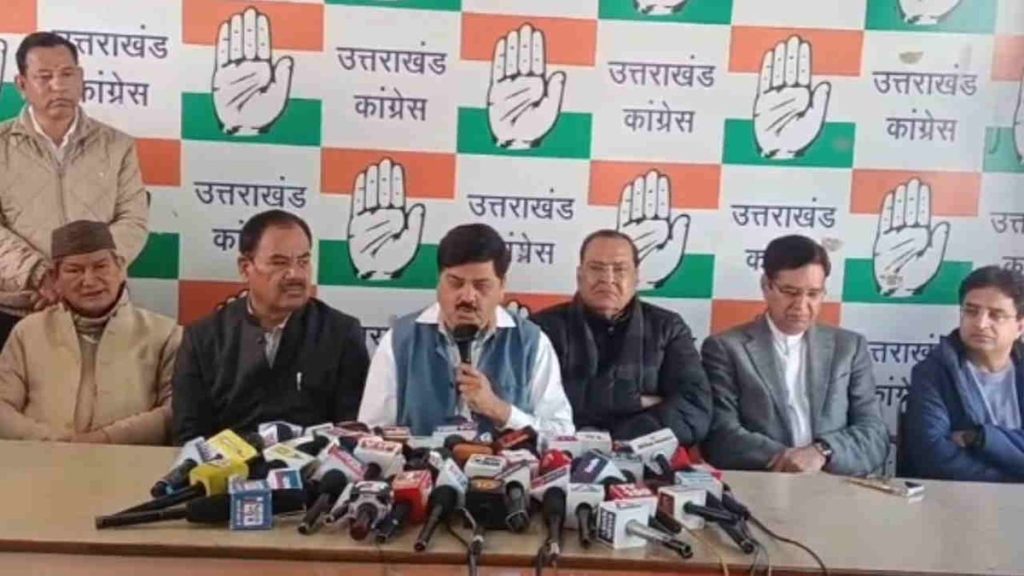
The 2027 Uttarakhand assembly elections are still roughly a year away. But the Congress party is already moving, and moving with a zone-by-zone plan that names names. On Friday, the party formally launched the first phase of a public outreach campaign.
It starts June 28. Ten districts are in play, split into four zones.
Each zone has a senior leader in charge. Congress President Ganesh Godiyal will lead the first zone. That means Pithoragarh, Bageshwar, and Champawat.
The second zone — Rudraprayag, Pauri Garhwal, and Chamoli — falls to Election Management Committee Chairman Harak Singh Rawat and other senior leaders. Pritam Singh gets the third zone: Uttarkashi and Tehri.
Former state leaders will handle the fourth zone, covering Almora and Nainital. This is not a routine meet-and-greet. The party is framing it as a direct confrontation with the state government.
Godiyal said the Congress, as the principal opposition, has a responsibility to present the ground reality before the people. Party leaders will take the government’s alleged failures directly to the public. The list of grievances is specific: deteriorating education systems.
Deteriorating healthcare systems. Unemployment.
Corruption. Paper leak cases. Rising inflation.
A worsening law and order situation. The stakes are concrete.
The Congress is the main opposition in a state where the ruling party holds power. But that status is only as good as the next election. If the Congress cannot translate this early push into a credible campaign narrative, it risks being out-organized and out-messaged when the election cycle fully begins.
The party is betting that a structured, leader-by-leader, district-by-district approach will build momentum before the opposition can consolidate its own position. The timing matters. Launching a year out is early by any standard.
It signals that the Congress sees a window. The state government has been in power.
The Congress is arguing that the government has failed on basic services. Education and healthcare are not abstract issues in Uttarakhand; they are daily realities for voters. The party is choosing to hammer those points now, not later.
Leaders will visit different assembly segments. They will talk to people directly.
No intermediaries. There is a risk in going early. A year is a long time in politics.
Issues change. Allegations that land hard today can lose their edge by election day. The government has time to respond, to counter, to shift the conversation.
The Congress is wagering that the problems it is highlighting — corruption, unemployment, paper leaks — are structural, not temporary. That they will still resonate in 2027.
Godiyal did not offer a timeline for the next phases. The first phase covers the districts most immediately reachable. The party’s filing described this as the opening move of the Congress election machinery.
The language is deliberate. This is not a protest; it is a campaign infrastructure being built in plain sight.
For voters in Pithoragarh or Tehri or Nainital, the question is whether the party will show up consistently, or whether this is a one-off burst of activity before the organization goes quiet again. The zone structure suggests the party is trying to prevent that. Each zone has a named leader.
Each leader has a clear responsibility. That is a system designed for accountability, at least on paper. What happens in the coming months will tell whether the system works.
The Congress has drawn its lines. The government knows where the attacks will come from.
The 2027 race has not officially started. But the first move has been made.




