
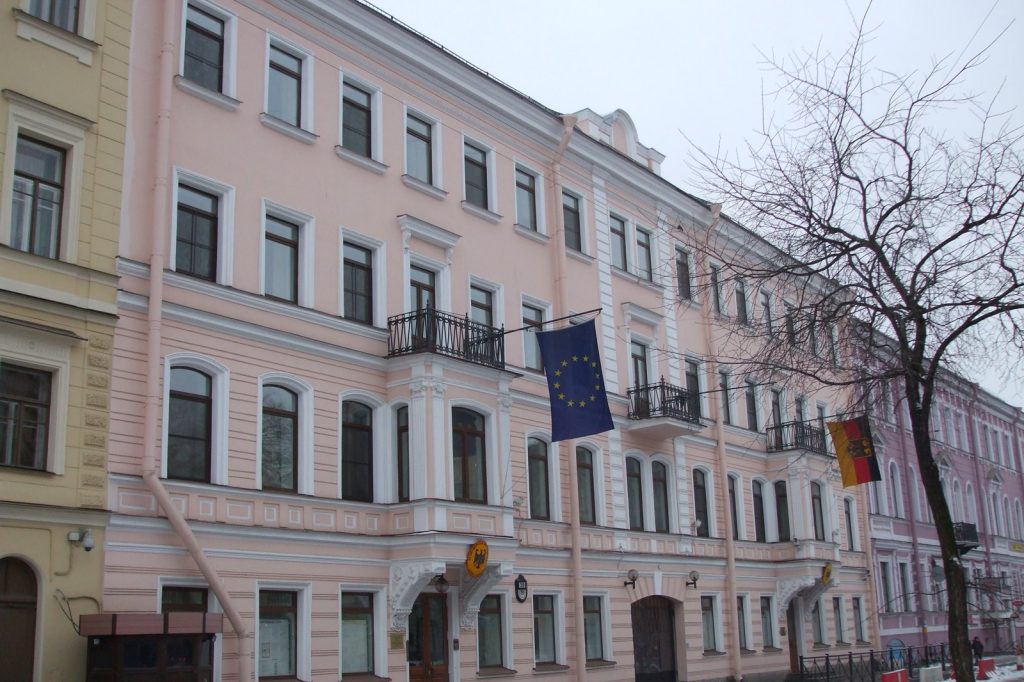
MOSCOW, September 7 — The Russian Foreign Ministry has announced the closure of the German Consulate General in St. Petersburg, a move that escalates an already bitter diplomatic dispute between Moscow and Berlin. The decision, confirmed in an official statement, was cast as a direct response to Germany’s earlier expulsion of Russian diplomats and its order to shut four of Russia’s five consulates on German soil. Berlin had declared those missions “unwanted,” a step Moscow described as “unfriendly” and at odds with the principles of diplomatic relations.
Russian officials framed the St. Petersburg closure as a “forced measure” and said a number of German diplomats would also be expelled from Russia. The exact number was not specified in the announcement.
A widening rift
The tit-for-tat reflects the broader breakdown in Russia-EU relations since Russia’s full-scale invasion of Ukraine in February 2022. Germany has been one of the leading Western supporters of Kyiv, supplying military aid and economic assistance, and has driven European Union sanctions against Moscow. This is not the first round.
In April 2023, Russia expelled dozens of German diplomats in response to a similar German action. The cycle of reciprocal measures has sharply reduced both countries’ diplomatic footprints in each other’s territories.
The Russian Foreign Ministry said it would “mirror” other steps taken by Germany and indicated further measures could follow, though it offered no specifics.
Practical consequences
The St. Petersburg consulate, one of Germany’s largest missions in Russia, had operated for decades in the country’s second-largest city. Its closure will affect consular services for German citizens in the region and visa processing for Russians seeking to travel to Germany, who may now have to apply in Moscow or other cities where German missions remain open.
German companies operating in the St. Petersburg area face reduced consular support, and the move is likely to disrupt cultural and educational exchanges, since the consulate had been active in promoting German language and culture. The German Foreign Office had not issued an official response to the Russian announcement as of this writing, but a reply is expected in the coming days.
The development was reported by Russian state news agencies, including TASS and RIA Novosti, citing the Foreign Ministry. The diplomatic row is unlikely to shift the military situation in Ukraine, where Germany has provided significant support including tanks and air defense systems. But it underscores the deep rift between Russia and the West, one that has widened with each round of expulsions and closures since the war began.
The timeline for the consulate’s closure has not been specified, though it is expected to take effect in the coming weeks.




