
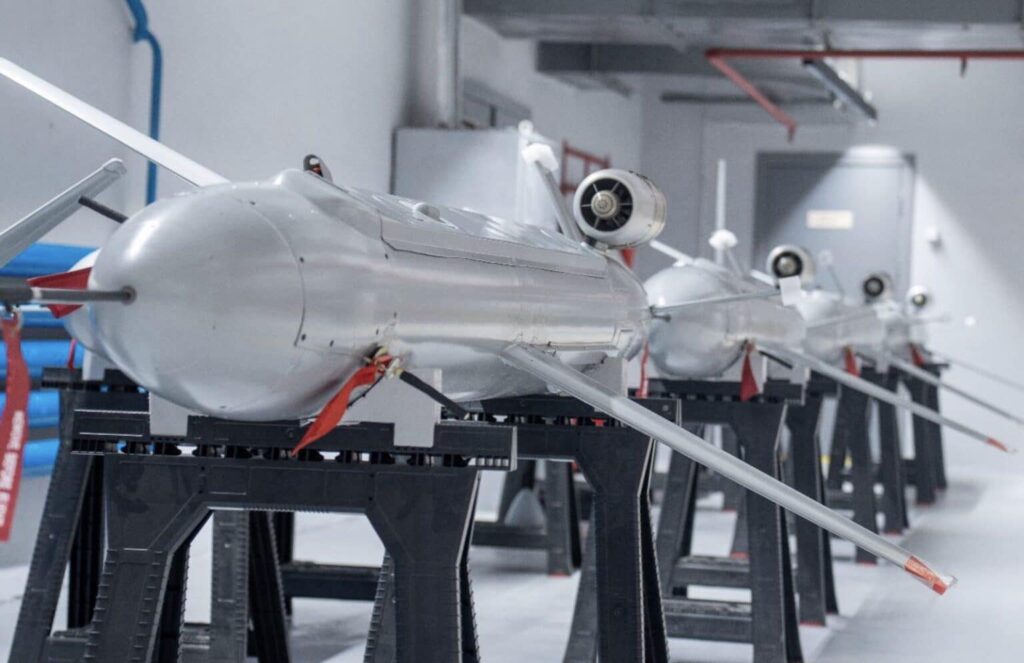
MOSCOW, July 13 — A Ukrainian drone strike on Stavropol Krai, approximately 1,000 kilometres from Ukrainian-held territory, has underscored the expanding reach and technical evolution of Kyiv’s unmanned aerial vehicle programme. The attack, confirmed by Russian officials, suggests either the deployment of a longer-range system or the possibility of launch from within Russia by saboteurs. Ukraine has been building a domestic drone industry since 2014, but the 2022 invasion dramatically accelerated production and innovation.
According to Ukrainian officials, annual output has surged from a few hundred units in 2022 to an estimated 30,000 in 2024. This ramp-up reflects both a strategic pivot toward asymmetric warfare and a response to material constraints on conventional munitions.
The fleet now includes several distinct platforms. The UJ-22 Airborne, produced by Ukrjet, has a range of up to 800 kilometres and a payload capacity of 20 kilograms. The AQ-400 Scythe, developed by Terminal Autonomy, can fly 750 kilometres and carry a 32-kilogram warhead.
Both use GPS guidance and are designed to fly at low altitudes, a tactic intended to evade radar detection and complicate air defence response. Ukraine also employs modified Soviet-era Tu-141 Strizh drones.
Originally built as reconnaissance vehicles, these systems have ranges up to 1,000 kilometres and have been adapted for strike missions. The combination of new designs and repurposed legacy hardware gives Ukrainian forces a layered set of options for long-range attack.
Strategic logic behind the strikes
These operations serve multiple military objectives. According to the record of official statements from Kyiv, the strikes aim to degrade Russian military capability and morale, while simultaneously demonstrating that no location within range is safe from retaliation. The psychological dimension is deliberate: each successful hit inside Russian territory challenges the narrative of invulnerability that Moscow projects to its domestic audience.
The Stavropol Krai incident, occurring at a distance of roughly 1,000 kilometres from Ukrainian-controlled areas, pushes the boundaries of what the publicly acknowledged drone fleet can accomplish. The UJ-22 and AQ-400 fall short of that range, while the Tu-141 Strizh reaches it at its maximum.
This leaves open the possibility that a modified or new system was used, or that the launch point was inside Russian borders — a scenario that would indicate either a security breach or the presence of Ukrainian-aligned operatives on Russian soil.
Technical and tactical constraints
Low-altitude flight paths and GPS navigation give these drones a degree of survivability against traditional air defence networks, but they are not invulnerable. Electronic warfare, jamming, and kinetic interceptors have all been used by Russian forces to counter incoming UAVs. The payload limitations — 20 kilograms for the UJ-22, 32 kilograms for the AQ-400 — mean that individual strikes are unlikely to destroy hardened targets.
Instead, the campaign operates on cumulative effect: persistent pressure on logistics hubs, fuel depots, airfields, and command centres. Ukrainian officials have framed the production increase as a matter of national survival.
The shift from hundreds to tens of thousands of units represents not just industrial growth but a doctrinal change in how Kyiv prosecutes the war. Drones have become a substitute for air power and long-range artillery that Ukraine does not possess in sufficient quantity.
What to watch next
The Stavropol strike may accelerate Russian efforts to harden deep-rear areas and expand electronic warfare coverage. It also raises questions about whether Ukraine will disclose new systems or confirm the use of existing platforms at extended ranges. For observers tracking the conflict, the distance of this attack and the ambiguity around its method signal that Ukraine’s reach is no longer static — and that the drone programme will remain a central element of the strategic picture for the foreseeable future.




