
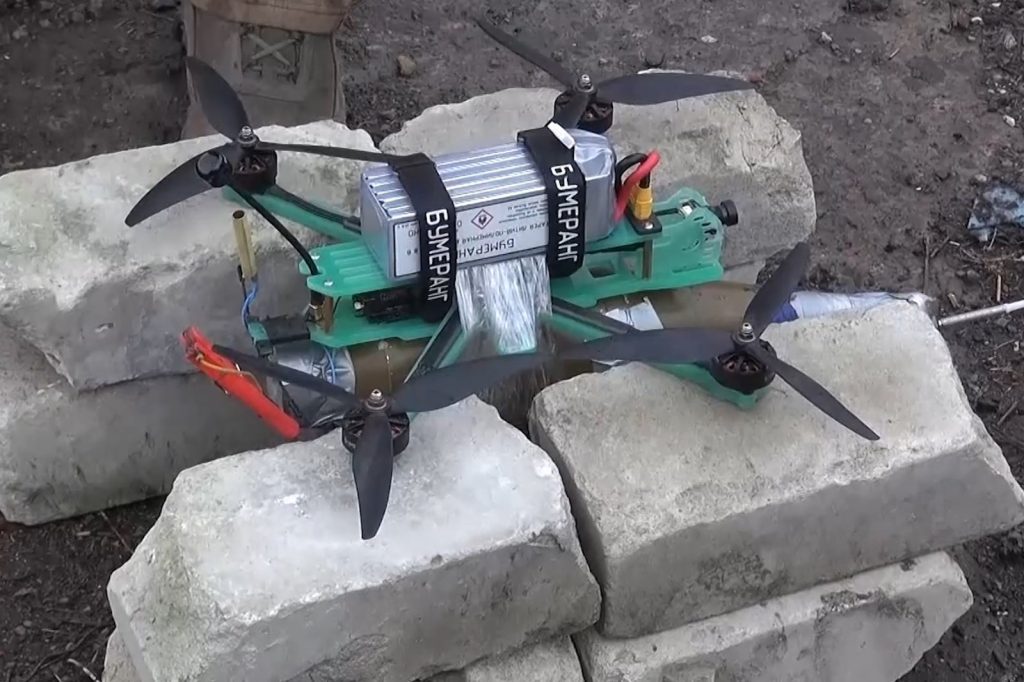
ROME, July 13 — Against the backdrop of Europe’s largest land war since 1945, the skies above Ukraine and Russia have become a proving ground for a new kind of aerial combat, one fought not by fighter jets and missiles but by small, cheap, and increasingly sophisticated unmanned aerial vehicles. Drones have moved from the periphery to the centre of the Russo-Ukrainian War. Both sides now rely on them for reconnaissance, strikes, and defensive operations, fundamentally altering the calculus of attrition.
The conflict has, in the corridors of military planning rooms across the continent, demonstrated that a drone costing a fraction of a missile can achieve effects that were once the preserve of billion-dollar air forces.
The rise of domestic production
Ukraine, facing a larger and better-resourced adversary, has responded by building a domestic drone industry from the ground up. Among the models now in service is the UJ-22 Airborne, a strike drone with a range of 800 kilometres. The PD-2, another Ukrainian-designed platform, extends that reach to 1,000 kilometres.
These systems allow Kyiv to strike deep behind Russian lines, targeting logistics hubs, fuel depots, and command posts. Russia, for its part, has turned to Iranian technology.
The Shahed-136, a loitering munition supplied by Tehran, has a range of 2,500 kilometres. What is at stake in this arms race is not merely territorial advantage but the very economics of warfare. A single Shahed drone costs approximately $20,000, a sum dwarfed by the millions required for a conventional cruise missile.
This dramatic cost differential has enabled sustained campaigns against infrastructure that would be prohibitively expensive with traditional munitions.
A sustained campaign
Since 2022, Ukraine has launched over 1,000 drone attacks on Russian territory, according to Ukrainian military reports. These operations have targeted airfields, energy facilities, and industrial sites, forcing Moscow to divert resources to air defence and repair. The March 19, 2025 incidents in Stavropol Krai and Moscow Oblast involved drone activity, with Russian air defence systems intercepting several of the incoming craft.
The wider picture is one of continuous pressure: a campaign that, while rarely decisive in a single engagement, accumulates damage over time. Drones have also prompted rapid innovation in countermeasures.
Electronic warfare systems designed to jam or spoof drone guidance signals have become a critical component of both militaries. The Russian Pantsir-S1, a short-to-medium-range air defence system, has been deployed extensively to engage low-flying UAVs. Yet the cat-and-mouse dynamic continues: as defences improve, so too do the drones’ ability to evade them.
The European perspective
For European defence planners, the lessons from Ukraine are stark. The war has shown that mass-produced drones can challenge even the most advanced conventional forces, and that the barrier to entry for long-range strike capability is lower than ever before. European nations, many of which have long relied on smaller, professional militaries, now face the prospect of having to invest heavily in drone production and counter-drone technology to maintain deterrence.
The conflict has also raised difficult questions about escalation. A drone launched from hundreds of kilometres away can strike a target in a major city with little warning.
The threshold for what constitutes an act of war, already blurred in the age of cyber attacks and proxy forces, has become even harder to define. What to watch next is the trajectory of Ukraine’s domestic industry. If Kyiv can sustain and expand its production capacity, it may be able to maintain the pressure on Russian infrastructure for years to come.
For Moscow, the challenge is to develop electronic warfare and air defence systems that can keep pace with the rapid evolution of drone technology. The skies above the Black Sea and the Donbas will remain a laboratory for the future of warfare, one whose lessons will be studied in defence ministries from Helsinki to Lisbon.




