
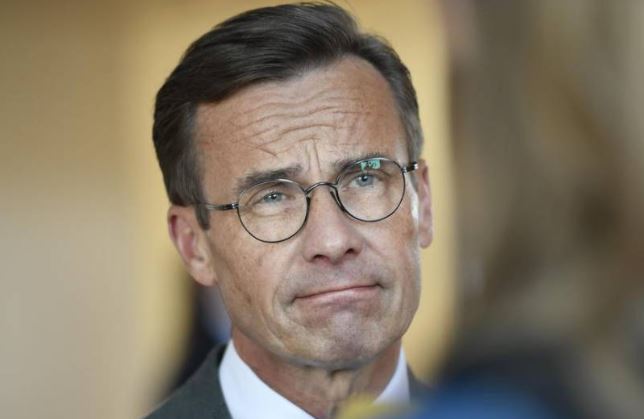
VISBY, Sweden — For one brief moment, a prime minister and his cabinet danced on a stage in Gotland. The song was upbeat. The smiles were fixed.
And the whole thing looked less like a party gearing up for another term and more like a farewell gathering where nobody wants to admit the party is over. That was the scene Sunday at Almedalen, the annual political festival that draws every Swedish party leader to this Baltic island for what is usually the most consequential speech of their year.
Ulf Kristersson, the Moderate party leader and prime minister, had just finished his address. His ministers climbed up to join him. They clapped.
They swayed. They attempted choreography.
It did not land. Migration Minister Johan Forssell, a head taller than Kristersson, bobbed side to side with a grimace. The awkwardness was visible.
For a party trying to project confidence ahead of September’s election, it was a telling image. The truth is that the Moderate machine is showing cracks. The official line remains relentlessly optimistic.
Johan Paccamonti, chief of staff to Finance Minister Elizabeth Svantesson, told The Local that victory is “absolutely” possible. But even he added a qualifier: “But the gods…” — a sentence he left unfinished, as if even the optimists know the odds are shifting.
Off the record, the picture is bleaker. The Local could find only one Moderate willing to speak on the record about the right-wing bloc’s chances. Roger Wärn, a councillor for the party on Gotland, called those chances “doubtful.” His reasoning is blunt.
The government has spent months showering voters with tax cuts and subsidies. It is a classic incumbent playbook: buy goodwill before election day.
But Wärn believes it will not work. “It’s come too late,” he said. That is the heart of the problem.
The Moderate-led coalition has been in power. It has had time to deliver. And yet, with the election weeks away, even its own people are not convinced.
Almedalen is a strange beast. For one week each summer, politicians, journalists, and lobbyists descend on this medieval town.
Every party leader gives a major speech. The setting is informal — outdoor stages, crowds wandering between events — but the stakes are high. A weak performance here can drain momentum.
A strong one can shift a race. Kristersson’s speech was meant to do the latter.
The choreographed finale was designed to signal unity, energy, forward motion. Instead, it looked like a group of people trying too hard. The contrast between the peppy election song and the grimacing faces on stage was hard to ignore.
This matters because the election is close. The right-wing bloc’s path to victory is narrowing. The tax cuts and subsidies have not shifted the polls the way the government hoped.
Voters, it seems, are not easily bought off. There is a broader context here.
Kristersson came to power after years of center-left rule. His coalition includes the Sweden Democrats, a party with roots in the far right. That alliance has been fragile from the start.
Governing has meant constant negotiation, constant compromise. The result has been a government that sometimes looks less like a team and more like a collection of wary factions.
Sunday’s awkward dance captured that reality. The Moderate party machine, once a well-oiled electoral force, is struggling to project confidence. The choreography was meant to signal victory.
Instead, it signaled strain. If the election goes against them, historians may look back at that moment on stage in Visby as the point where the mask slipped. A party dancing to its own song, but not quite believing the tune.




