
KUWAIT CITY, July 19 — The recent attack on US interests in the region may prompt additional American military deployments to Kuwait, a Gulf state that already hosts roughly 13,500 US troops and holds a strategically vital position in Washington’s Middle East force structure. The calculus for Pentagon planners now involves not only the immediate response but the broader stakes of how this escalation reshapes the US military footprint from the Persian Gulf to the Levant. Kuwait’s geography has long made it indispensable.
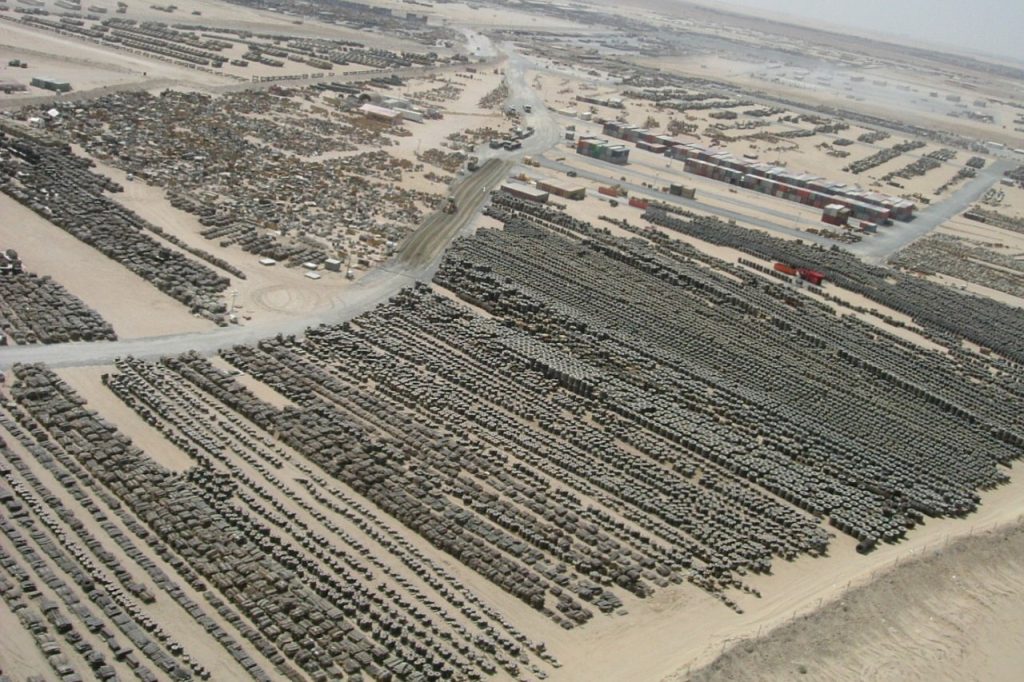
The US maintains a significant presence at Camp Arifjan, a sprawling logistics and support base south of Kuwait City, and at Ali Al Salem Air Base in the northwest, a key airlift hub for Central Command operations. The Pentagon has prepositioned equipment for armored brigades on Kuwaiti soil — tanks, infantry fighting vehicles, artillery, and support systems stored in climate-controlled warehouses and desert depots — allowing rapid reinforcement without the delays of sea or airlift from the continental United States.
That prepositioned stock represents a strategic hedge, one that now looks increasingly prescient.
A Staging Ground With History
This is not the first time Kuwait has figured centrally in US military planning. During the 2003 invasion of Iraq, the emirate served as the primary staging ground for the US-led coalition. Armored columns rolled north from Kuwait into Iraq, and the logistical pipeline that sustained the invasion ran through Kuwaiti ports, airfields, and desert staging areas.
That history continues to shape Pentagon thinking. Kuwait’s desert training ranges and deep-water ports give it a permanence in US war plans that few other Gulf states can match.
Kuwait is also a designated Major Non-NATO Ally, a status that provides privileged access to US defense equipment, training, and cooperative research. The designation signals a long-term strategic partnership that predates the current crisis and reflects Washington’s assessment of Kuwait’s reliability as a security partner in a volatile region.
Air Defenses and the Calculus of Escalation
After Iran’s 2019 attacks on Saudi oil infrastructure, the US reinforced air defense systems in both Kuwait and Saudi Arabia. Those reinforcements remain in place, integrated into the broader theater air defense network that CENTCOM operates across the Gulf. The current attack, while distinct in its specifics, fits into a pattern of regional escalation that has kept planners on alert for years.
What this signals to adversaries is that the US views Kuwait not as a peripheral outpost but as a central node in its regional defense architecture — one that will be defended and, if necessary, reinforced. For US Central Command, which is headquartered in Tampa but operates through regional hubs including Kuwait, any escalation carries direct implications for force posture across the entire theater.
A decision to send additional troops or equipment to Kuwait would ripple through deployments in Qatar, Bahrain, the UAE, and beyond. The Pentagon’s ability to shift forces rapidly depends on the prepositioned stocks and basing access that Kuwait provides. Strategically, the calculus involves not only deterring further attacks but also preserving the option for a broader military response should the administration choose that path.
Any further escalation could also affect the broader US force posture in the region. The Trump administration faces a strategic choice: reinforce existing positions in Kuwait to deter additional attacks, or adjust the distribution of forces elsewhere in the Gulf to manage new threats.
The geography of Kuwait — its border with Iraq, its proximity to Iran, and its deep-water ports — makes it a linchpin in either scenario. The broader stakes extend beyond Kuwait itself to the entire US military architecture in the Gulf, an architecture that has underpinned American power projection in the Middle East for decades. Looking ahead, the key question is whether this attack will trigger a permanent increase in the US military presence in Kuwait or a temporary reinforcement calibrated to the immediate threat.
The answer will depend on the nature of the attack, the intelligence picture that emerges, and the administration’s broader strategic calculus in the Gulf. For now, Kuwait remains a quiet but crucial node in America’s Middle East military architecture — and one that may soon gain additional importance as the Pentagon reassesses its force posture across the region.




