
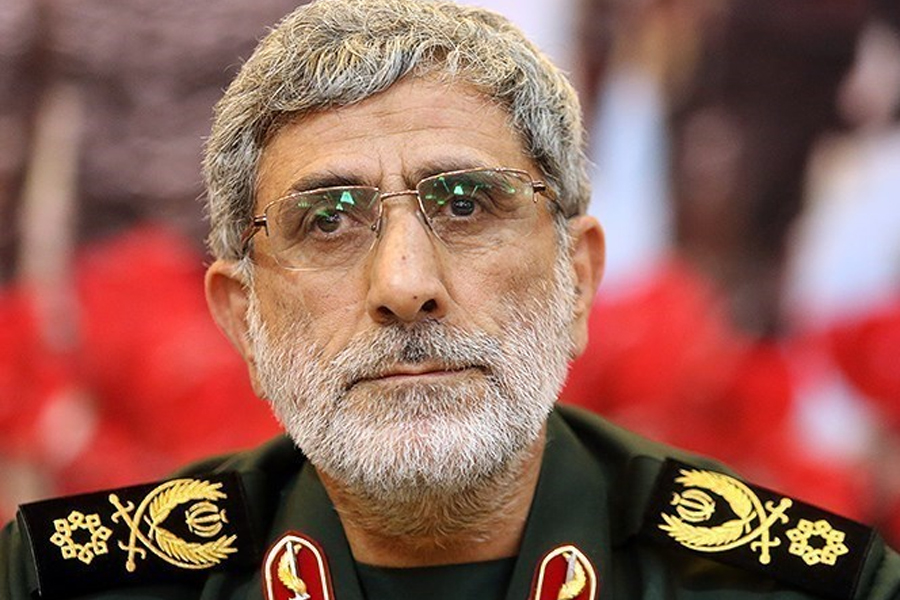
TEHRAN, July 16 — Esmail Qaani commands one of the most lethal military forces in the Middle East, yet most Americans have never heard his name. He runs the Quds Force, the overseas arm of Iran’s Islamic Revolutionary Guard Corps, or IRGC. Think of him as the quiet logistics chief behind a sprawling network of proxy armies that the U.S. government has spent years trying to dismantle through sanctions and targeted strikes.
Qaani took over in January 2020, after the U.S. killed his predecessor, Qasem Soleimani, in a drone strike near Baghdad International Airport. Soleimani was a celebrity commander in Iran — charismatic, widely photographed, almost mythic in stature.
Qaani is the opposite. He is known as a competent administrator rather than a magnetic public figure. In plain terms, he keeps the machine running without seeking the spotlight.
Who is Esmail Qaani?
Born in 1957 in Mashhad, Iran, Qaani joined the IRGC during the Iran-Iraq War, which lasted from 1980 to 1988. That conflict shaped a generation of Iranian commanders, and Qaani rose through the ranks during those brutal years. The U.S. Treasury Department has had him on its sanctions list since 2012 — well before he became the Quds Force chief.
Under Qaani’s leadership, the Quds Force has continued doing what it did under Soleimani: providing weapons, training, and intelligence to a web of armed groups across the Middle East. Those groups include Hezbollah in Lebanon, Hamas in Gaza, and the Houthis in Yemen.
The practical upshot for global trade and security has been significant. The Houthis, for instance, have used anti-ship missiles supplied by Iran to attack commercial vessels in the Red Sea, disrupting one of the world’s busiest shipping lanes.
The proxy network under pressure
Qaani has managed to keep this network intact despite serious pressure. Israel has assassinated IRGC officers in Syria. U.S. sanctions remain in place.
Yet the proxy groups continue to operate. That is a testament to the institutional structure Soleimani built and Qaani has maintained — it does not depend on any single commander’s personal magnetism.
The U.S. government took the extraordinary step in April 2019 of designating the IRGC as a Foreign Terrorist Organization. That was the first time the United States had ever designated a part of a foreign government as a terrorist group. For context, that is an extraordinary step in international diplomacy — one that complicates any backchannel communication and signals that Washington views the IRGC as fundamentally outside the bounds of normal state-to-state relations.
What to watch next
Qaani faces a complicated road ahead. The U.S. administration under President Donald Trump has maintained a hard line on Iran. Israeli operations against IRGC personnel in Syria show no signs of stopping. And the proxy forces Qaani oversees — particularly the Houthis — continue to draw international attention through their Red Sea attacks. The question is whether Qaani’s administrative competence will be enough to hold the network together under sustained pressure, or whether the loss of Soleimani’s strategic vision will eventually create cracks in Iran’s proxy empire.




