
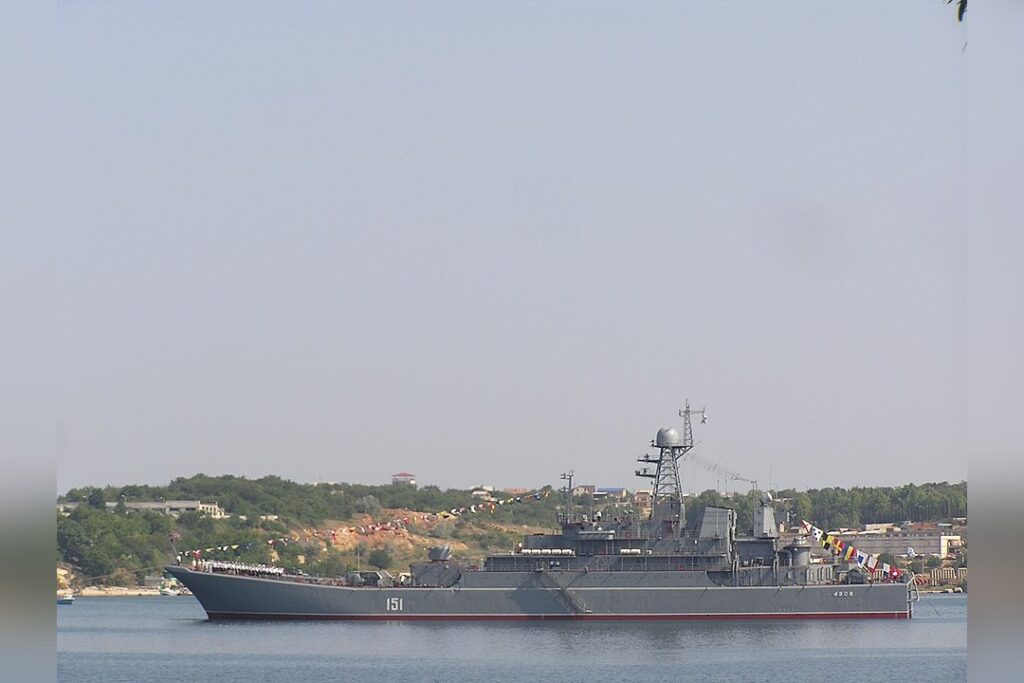
MOSCOW, July 11 — The shift in Russian naval strategy is becoming impossible to ignore. For decades, the Kremlin’s maritime doctrine centered on aggressive power projection through the Black Sea and Azov Sea, the critical chokepoints that give Moscow access to the Mediterranean and global trade routes. That era is over.
What’s changing is a fundamental recalibration toward defensive operations in waters that have become a shooting gallery. The numbers tell the story.
By October 2024, Ukraine claimed to have damaged or destroyed 20 Russian naval vessels. The flagship of the Black Sea Fleet, the Moskva, was sunk in April 2022. That single loss was a psychological and operational blow that reshaped how the Russian Navy operates.
The trend underneath is clear: a fleet built for intimidation is now fighting for survival.
The Black Sea Fleet Under Siege
Russia’s Black Sea Fleet, based in Sevastopol on the Crimean Peninsula, has been a primary target of Ukrainian drone and missile attacks since the full-scale invasion began in 2022. The fleet’s traditional home port, once considered secure, is now within striking distance of Ukrainian systems. In response, Moscow has relocated some vessels to safer ports, notably Novorossiysk on the eastern coast of the Black Sea.
Watch this space — the redeployment signals that the Kremlin no longer considers its Crimean bases safe. The Azov Sea shipping halt is another defensive measure.
Russia has effectively closed that waterway to commercial traffic, a move that protects its remaining naval assets but also strangles a vital economic artery. The halt reflects a broader shift in Russian naval doctrine toward defensive postures in contested waters. This is not a temporary tactical adjustment; it is a strategic retreat.
Putin’s Maritime Calculus
Russian President Vladimir Putin, in a statement on October 16, 2024, emphasized the need to secure maritime routes. The phrasing is telling. The Kremlin is no longer talking about dominating the Black Sea; it is talking about securing what it still holds.
The defensive language marks a sharp departure from the assertive naval rhetoric of previous years. The Russian Navy has historically prioritized control of the Black Sea and Azov Sea because they provide access to the Mediterranean and global trade routes.
Losing that control means losing a key lever of geopolitical influence. The trend underneath is a navy that is being forced to choose between protecting its remaining ships and maintaining its traditional mission of power projection. It is choosing survival.
What to Watch Next
The relocation of vessels to Novorossiysk is a stopgap, not a solution. That port is also within range of Ukrainian systems, and the pressure will only increase as Kyiv acquires longer-range strike capabilities. The question now is whether Russia can sustain even a defensive naval posture in the Black Sea, or whether the fleet will be forced into an even more limited role.
The shift is real, and it is accelerating. The Russian Navy, once a symbol of Moscow’s ambition, is now a symbol of its vulnerability.
Watch this space — the next phase of this conflict will likely see Ukraine press its advantage at sea, while Russia scrambles to protect what remains of its once-formidable Black Sea Fleet.




