
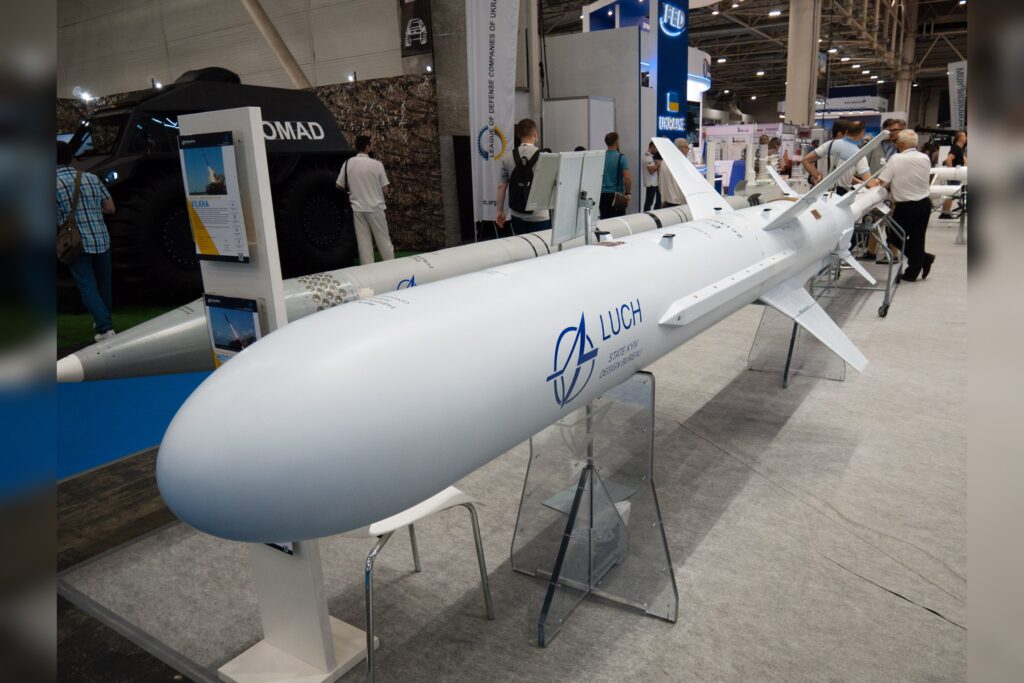
KYIV, July 9 — A shift is quietly reshaping how the world views Ukrainian defense technology. It started with a single, devastating strike in the Black Sea, and now the ripple effects are being felt in military planning rooms from Kyiv to Washington. The R-360 Neptune, a homegrown anti-ship cruise missile, has moved from a wartime curiosity to a proven weapon system with a growing international profile.
Developed by the Luch Design Bureau and first unveiled in 2015, the Neptune is not an entirely new design. It builds on the Soviet-era Kh-35 missile, but the Ukrainian engineers made substantial upgrades.
The range was pushed out to 280 kilometers, or 174 miles, and a more advanced guidance system was fitted. It flies low and subsonic, hugging the terrain to stay under radar coverage, and packs a 150-kilogram warhead. The system is designed for flexibility: ground-based mobile launchers, ships, and aircraft can all fire it.
A dedicated radar vehicle and command post make the whole setup mobile and hard to pin down.
The Strike That Changed Everything
Then came April 14, 2022. Two Neptune missiles struck and sank the Russian guided-missile cruiser Moskva, the flagship of the Black Sea Fleet. It was the moment the world took notice.
For Ukraine, it was a major propaganda victory and, more importantly, proof that its domestic defense industry could produce weapons that actually change the battlefield calculus. The Moskva was not a small target — it was a symbol of Russian naval power in the region.
Sinking it with a missile designed and built in Ukraine sent a clear signal. Since the invasion, production of the Neptune has been ramped up. The war created an immediate, existential demand, and Ukraine’s defense industry responded.
But the story does not end with anti-ship warfare. The trend underneath is adaptation.
The Neptune is now being adapted for land-attack roles, with the range extended to over 400 kilometers. That opens up a whole new set of targets and strategic options for the Ukrainian military.
What’s Changing on the Battlefield
The shift from a purely anti-ship role to a dual-use land-attack capability is what is really changing the game. A missile that can hit a warship at 280 kilometers can, with modifications, strike ground targets at a significantly longer distance. The land-attack variant pushes past 400 kilometers, putting infrastructure, command centers, and logistics hubs deep inside contested territory within reach.
That is a major upgrade in Ukraine’s strike capabilities, and it does not rely on foreign-supplied systems. The Neptune system’s mobility is a key advantage.
The launchers, radar vehicle, and command post can move quickly, set up, fire, and relocate before counter-battery fire can find them. That makes it a difficult target for Russian reconnaissance and strike assets. It is a flexible weapon that can be used in a variety of scenarios, from coastal defense to deep strikes.
International interest in Ukrainian missile technology has increased following the Neptune’s success. Other nations are watching how a relatively modestly funded defense industry can produce a weapon that took out a major warship.
The Neptune is no longer just a Ukrainian weapon — it is a proof of concept for what a determined domestic defense sector can achieve.
Watch This Space
The Neptune’s journey is far from over. With production ramped up and a land-attack variant in development, the missile is set to become an even more versatile tool in Ukraine’s arsenal. Watch this space — the trend underneath is clear.
Ukrainian defense technology is no longer an underdog story. It is a serious, proven capability that is reshaping regional military dynamics and attracting global attention.
The Neptune has already made history. What comes next could be even more significant.




