
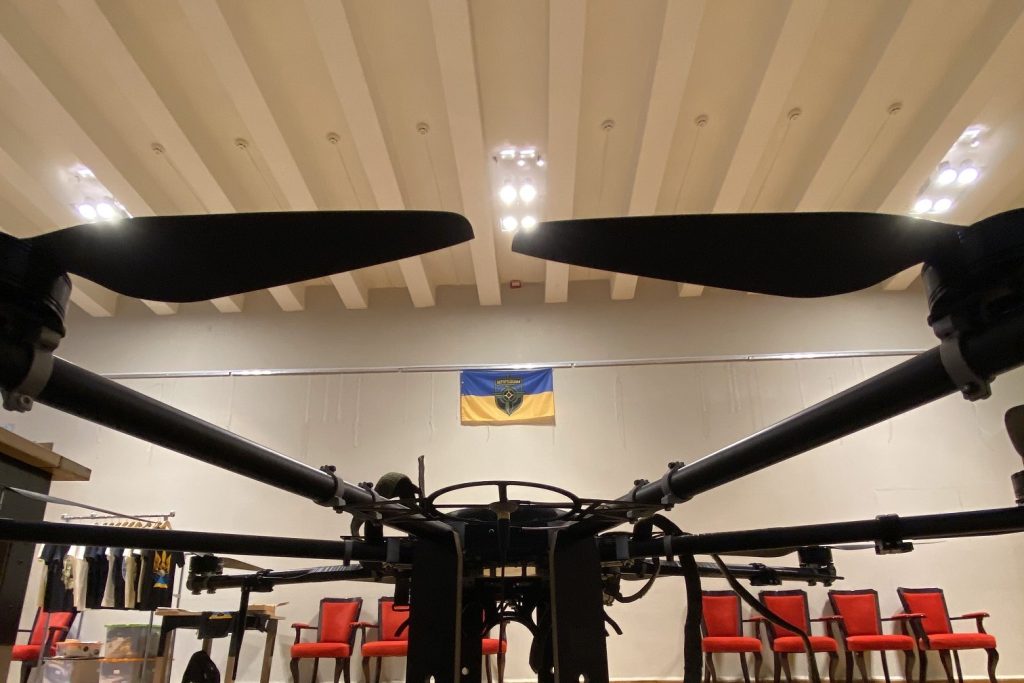
The drone has become a defining weapon of the war in Ukraine, and the country has built a homegrown industry to supply them. Since Russia’s full-scale invasion in early 2022, Ukraine’s domestic unmanned aerial vehicle sector has expanded from a handful of small firms focused on commercial and agricultural uses into a major supplier for the armed forces.
By 2024, the industry was producing more than 100,000 first-person-view (FPV) drones per month. These low-cost munitions, capable of tactical strikes, are just one component of a layered arsenal that also includes purpose-built reconnaissance and strike platforms from state-owned and private manufacturers.
A Domestic Industry Surges
The state defense conglomerate Ukroboronprom, alongside private firms such as Drone.ua and Aerorozvidka, now supplies the military with unmanned systems ranging from small reconnaissance quadcopters to heavy-lift octocopters. Among the platforms delivered are the R18 octocopter, used for both reconnaissance and strikes, and the Shark reconnaissance drone.
Modified commercial drones from DJI are also employed for reconnaissance missions. The rapid scale-up was driven by an immediate need for cheap, effective platforms after the 2022 invasion. Engineers and operators adapted commercial drones originally designed for photography or farming, then moved to purpose-built models produced at volume. The establishment of the Unmanned Systems Forces in 2024 as a separate branch of the Ukrainian military marked a significant organizational shift.
According to available information, this dedicated drone force allowed Ukraine to integrate unmanned systems as a core component of its national defense strategy. The domestic production effort has reduced reliance on foreign aid and enabled rapid adaptation to changing battlefield conditions.
Drones from Ukraine’s own production lines have been used for strikes on Russian oil refineries and airfields, illustrating their ability to hit targets deep behind enemy lines while preserving the lives of pilots and soldiers.
Allied Contributions and a Layered Arsenal
While Ukraine’s domestic industry has grown, allied nations have also provided drones. The United States has supplied Switchblade and Phoenix Ghost loitering munitions. Germany has committed 50,000 strike drones, which will supplement Ukraine’s existing capabilities with advanced loitering munitions, according to the source. The combination of domestic production and allied deliveries gives Ukraine a layered unmanned systems arsenal.
The R18 octocopter provides multirole capability for reconnaissance and strikes. The Shark drone focuses on reconnaissance.
FPV drones, produced at a rate exceeding 100,000 per month by 2024, serve as low-cost munitions for tactical strikes. The variety allows Ukrainian forces to match platforms to mission requirements, from close-range tactical engagements to deeper strikes.
Operational Impact and Future Trajectory
The rapid expansion of Ukraine’s drone forces has altered the character of combat operations. The ability to modify commercial drones and produce purpose-built systems in volume gives Ukrainian forces flexibility that conventional procurement cycles do not allow. The Unmanned Systems Forces continue to evolve their tactics and equipment.
With the 50,000 German strike drones expected to arrive, and ongoing domestic production, Ukraine’s capacity for sustained drone operations is likely to grow. The war in Ukraine has accelerated a shift already underway in modern warfare: drones have become essential tools for both state armies and non-state actors.
Prior to 2022, Ukraine possessed a modest domestic drone sector focused mostly on commercial and agricultural applications. Russia’s invasion transformed the battlefield overnight, creating an immediate need for cheap, effective strike and reconnaissance platforms. By the time the military established the dedicated Unmanned Systems Forces as a separate branch in 2024, the industry had become a cornerstone of national defense.
This development signals a broader trend. The conflict is not just a story of artillery and infantry — it is a laboratory for the future of warfare, where domestically produced drones can level the playing field against a larger adversary.




