
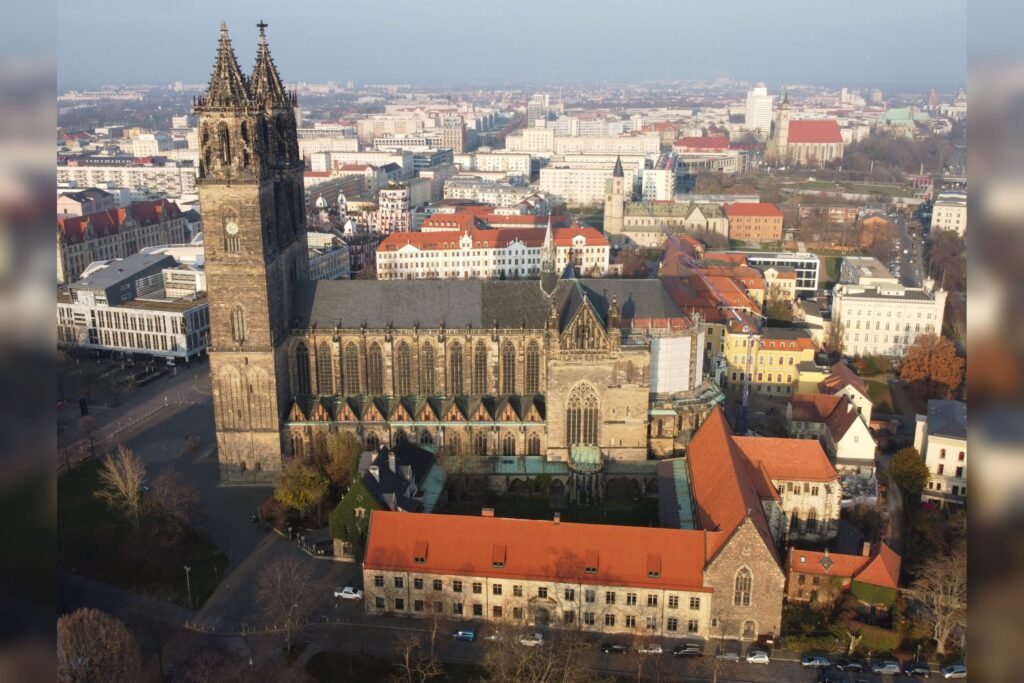
MAGDEBURG, Sept. 6 — Germany’s political landscape shifted decisively eastward on Sunday as the Alternative for Germany (AfD) surged to a commanding first-place finish in the Saxony-Anhalt state election, a result that projections suggest will redraw the parliamentary map of this former East German state. According to ARD projections, the AfD captured roughly 44.5 percent of the vote, a landslide that lead candidate Ulrich Siegmund declared had “made history,” marking the party’s strongest state-level result to date.
The centre-right Christian Democratic Union (CDU) trailed a distant second at about 18.5 percent, followed by the socialist Die Linke on roughly 9.5 percent and the Social Democrats (SPD) on about 8 percent. The arithmetic of power, however, remains tantalisingly out of reach. Early projections translate the AfD vote into approximately 41 seats in the state parliament — one short of the 42 needed to govern outright.
Against this backdrop, the so-called “firewall” maintained by every other party in the Landtag, all of whom refuse coalition with the AfD, could still deny the party power despite the scale of its victory.
A barometer for the east
Saxony-Anhalt, a state of roughly 2.2 million people, has long been fertile ground for the AfD amid concerns over migration, the cost of living, and the pace of the green-energy transition. The campaign was dominated by immigration and economic anxiety, themes the party has pressed nationally, and turnout was reported to be elevated compared with the 2021 contest.
The result marks the strongest showing for a party of the AfD’s placement in a German state election since reunification. Domestic security authorities have previously classified parts of the AfD as suspected right-wing extremist, a designation the party disputes in court.
Pressure on Berlin
The outcome intensifies pressure on Chancellor Friedrich Merz’s federal CDU-led coalition in Berlin, which has struggled to blunt the AfD’s rise, and it lands amid heightened international attention to the party. In the corridors of European politics, the vote is widely read as a barometer for the AfD’s national trajectory ahead of future federal contests, and for the broader trend of rising support for hard-right, anti-immigration parties across the continent. Coalition arithmetic now becomes the central story.
With the AfD close to but short of a majority, formation of the next state government will hinge on whether rival parties can assemble a workable bloc, or whether fresh negotiations and possible instability follow. Official final results and seat allocations were still being confirmed as counting continued into the evening.
Analysts cautioned that projections can shift as final ballots are tallied, but the direction of the result was not in doubt: a decisive first-place finish that reshapes the political map of the state. What is at stake now is whether the firewall holds — and what the wider picture means for Germany’s federal politics in the months ahead.




