
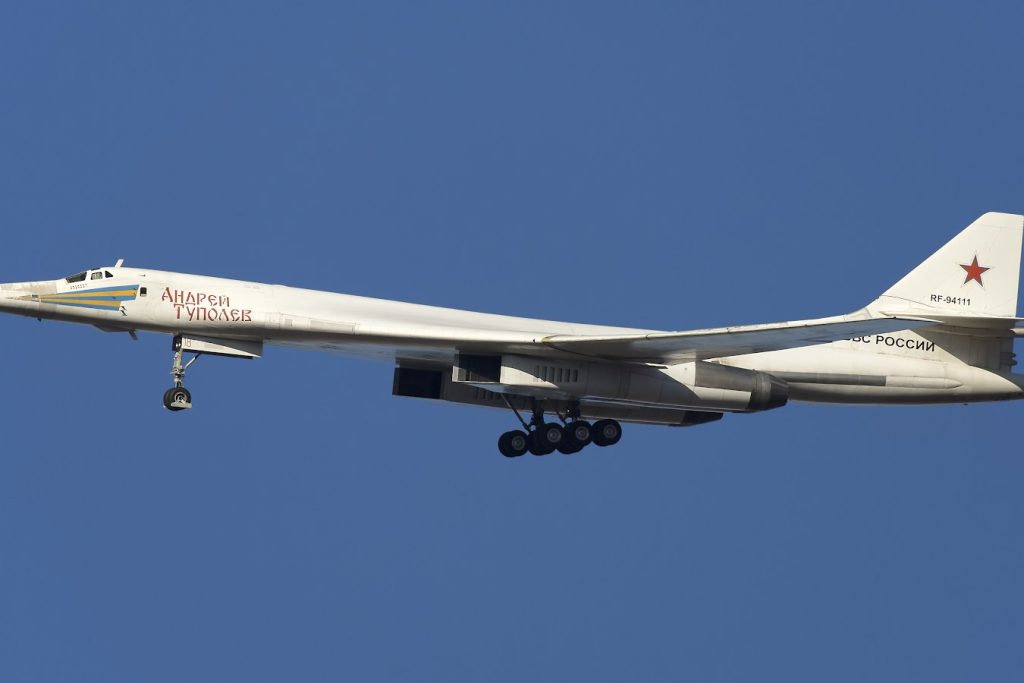
ENGELS, Russia — July 25 — From this air base on the Volga steppe, Russian strategic bombers have for years projected power across the Middle East and now Ukraine. Engels has served as the primary launch point for long-range bomber missions in combat theaters outside the former Soviet Union, a role that has deepened Moscow’s reach in Syria and beyond.
On November 17, 2015, the Russian Aerospace Forces flew the first combat sorties by Tu-160 and Tu-95 bombers from here against targets in Syria, firing Kh-555 and Kh-101 cruise missiles at so-called Islamic State positions. Those missions marked the first time Moscow had used strategic bombers in a conventional war since the Soviet withdrawal from Afghanistan in 1989.
Against this backdrop, the Syrian campaign became a testing ground for weapons and tactics later deployed in Europe. In the years that followed, bombers from Engels flew regular sorties over the Mediterranean Sea, launching cruise missiles from the Caspian Sea and later from the eastern Mediterranean.
Russia used Tu-95MS aircraft to fire Kh-55 and Kh-101 missiles with a reported range of 2,500 to 3,000 kilometers — enough to strike anywhere in Syria from Russian airspace
Engels Air Base has been a cornerstone of Russia’s long-range aviation since the Soviet era, housing strategic bombers designed primarily for nuclear deterrence during the Cold War. The base, located near the city of Saratov on the Volga River, is one of a handful of Russian airfields equipped to handle the Tu-160 and Tu-95 aircraft.
In the decades after the Cold War, the base’s bombers were used mainly for rotational patrols and exercises, as Moscow scaled back conventional long-range operations. The Syrian campaign marked a pivotal shift in Russia’s use of strategic bombers, transitioning them from a nuclear deterrent role to a platform for precision conventional strikes. By firing cruise missiles from aircraft based at Engels, Russia demonstrated an ability to hit targets thousands of kilometers away without needing forward bases in the region.
This capability later proved directly applicable to the war in Ukraine, where Tu-95 and Tu-160 bombers launched similar missiles against Ukrainian energy infrastructure and military targets, often from within Russian airspace. The significance of Engels extends beyond Syria and Ukraine. The base’s bombers give Russia a unique power-projecting tool that can reach targets across Europe, the Middle East, and parts of Asia, all while remaining within Russia’s borders.
This has shaped the security calculations of neighboring states, as defensive planners must account for the possibility of long-range cruise missile strikes launched from deep inside Russian territory. The repeated use of Engels in combat operations has also elevated the base’s profile as a potential target in any broader conflict, making its protection a priority for Russian air defenses.




