
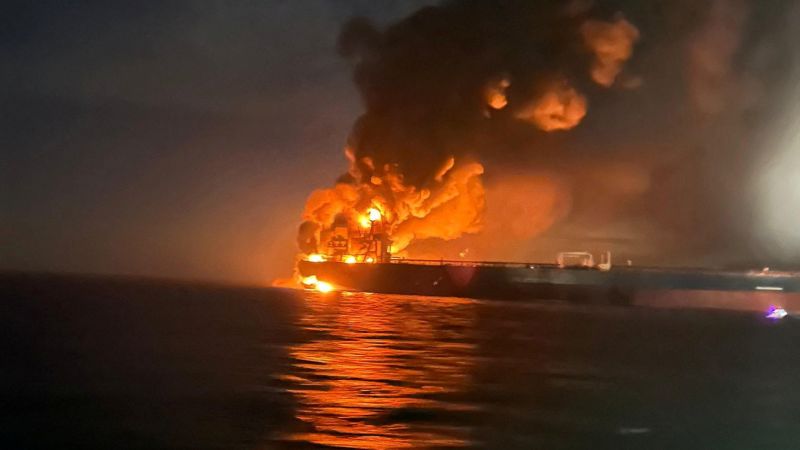
KYIV, July 19 — President Volodymyr Zelensky announced today that Ukrainian forces struck three shadow fleet tankers in the Black Sea and hit oil depots in southwestern Russia. The statement gave no date for the strikes. The announcement itself represents the first official confirmation that Ukraine is now targeting the vessels that keep Russian crude flowing past the G7’s $60-per-barrel price cap, a mechanism imposed in December 2022.
The mechanics here are worth unpacking. The shadow fleet is a sprawling, ad hoc collection of tankers — Western assessments put the number at at least 400 — that operate without proper insurance and under deliberately opaque ownership structures.
Their purpose: to haul Russian oil to buyers in Asia and elsewhere while side-stepping the price cap. The European Union and the United States have already imposed sanctions on specific vessels and entities involved in this trade, but enforcement has always lagged behind the clever lawyers and shell companies that keep the ships moving.
The Mechanics of the Shadow Fleet
On closer reading, the logic of targeting these tankers becomes clear. The Black Sea is a key transit route for Russian oil exports. Hitting tankers there — not just the onshore depots and refineries that Ukraine has been striking since 2022 — cuts directly into Moscow’s ability to monetise its crude.
The catch is that such strikes risk escalation. International waters are involved; the shadow fleet ships are often owned by entities registered in jurisdictions that may object.
But Ukraine appears to calculate that the revenue squeeze outweighs the diplomatic noise. Previous notable attacks in this campaign include the strike on the Russian oil depot in Belgorod in April 2024 and repeated hits on the Tuapse refinery. Those degraded Russia’s refining capacity and forced it to export more crude rather than products, but they did not directly interrupt the physical movement of tankers.
Striking the vessels themselves is a new step. It follows the pattern Ukraine has used against the Russian Black Sea Fleet — naval drones, long-range drones, and missiles — including the sinking of the cruiser Moskva in April 2022.
Follow the money: every barrel of Russian oil that fails to reach a buyer because its tanker is damaged or sunk puts pressure on the budget that funds the war. The international community has sought to tighten enforcement of the price cap and crack down on shadow fleet activities, but sanctions on individual ships have proven slow to throttle the flow. Ukraine is now trying to do directly what regulators have struggled to achieve through paperwork.
An Escalation with Economic Logic
Zelensky’s framing tied the tanker strikes to protecting Ukraine’s own grain export corridor, a connection that underscores the dual economic dimension. Russian energy revenue and Ukrainian agricultural exports compete for the same Black Sea shipping lanes and maritime security. By degrading Russia’s oil-transport capacity, Kyiv aims to loosen the Kremlin’s grip on the region’s commercial sea routes.
The strikes on the south-western Russian oil depots are the older part of the playbook, now paired with a new maritime dimension. There is no sign that Ukraine intends to slow down its campaign against Russian energy infrastructure.
The question moving forward is whether the tanker strikes will be repeated and whether they will prompt a change in the shadow fleet’s behaviour — or merely a shift to even more opaque ownership structures and longer insurance chains. For now, the West’s price cap has a new, more aggressive enforcement mechanism operating independently of any Brussels or Washington bureaucracy.




