
From Zeitenwende to Offensive Hardware
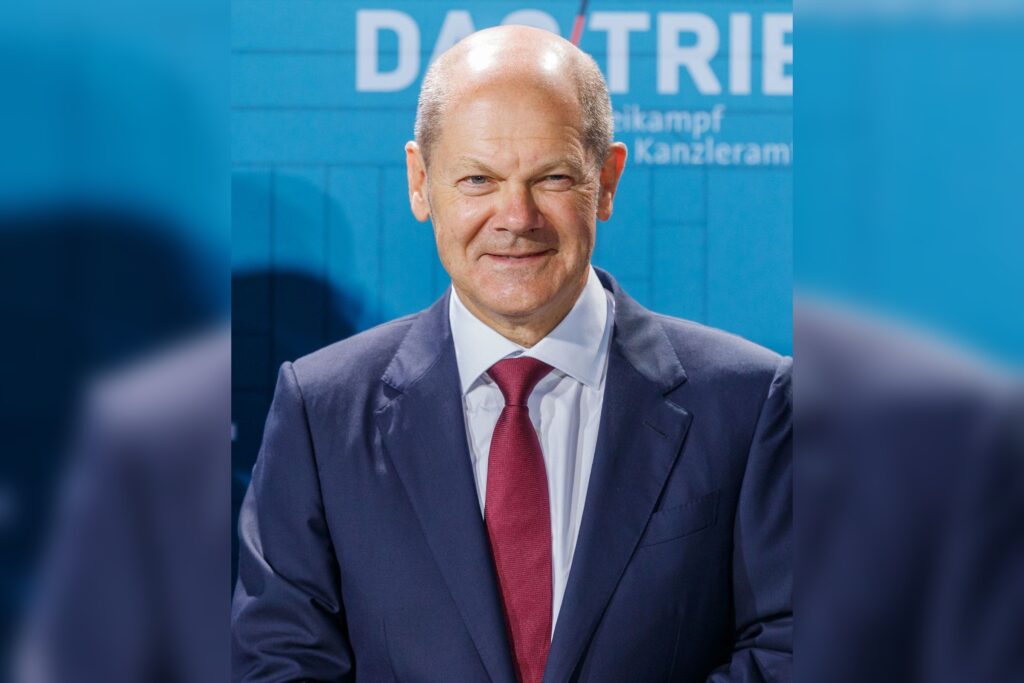
Scholz took office on December 8, 2021, leading a coalition government composed of his Social Democratic Party (SPD), the Greens, and the Free Democratic Party (FDP). Just three days after Russia launched its full-scale invasion of Ukraine on February 24, 2022, Scholz announced the Zeitenwende — a historic shift in German defense policy. He committed Germany to a €100 billion special fund for the Bundeswehr, the country’s armed forces, and pledged to meet NATO’s target of spending 2% of GDP on defense.
The Zeitenwende broke decisively with the cautious, energy-dependent approach toward Moscow that had characterized German policy for decades. Under Scholz’s watch, Germany has become the second-largest military donor to Ukraine, delivering over €17 billion in aid. Yet the Chancellor has faced criticism from some allies for hesitating on sending long-range Taurus missiles. He has consistently supported defensive systems and, increasingly, offensive ones such as drones. The decision to fund 50,000 strike drones is the latest step in a strategy that aims to support Ukraine while avoiding any direct NATO involvement in the conflict.
Scholz’s biography helps explain the measured approach. Born on June 14, 1958, in Osnabrück, he served as Mayor of Hamburg from 2011 to 2018 and then as Vice Chancellor and Minister of Finance under Chancellor Angela Merkel from 2018 to 2021. That tenure in Merkel’s cabinet placed him at the center of a government that maintained close energy ties with Russia. The Zeitenwende represented a sharp departure from that era.
Domestic Constraints and Coalition Dynamics
The Chancellor’s political calculus at home is delicate. By early 2025, the SPD was polling at around 15-18%, reflecting a steady erosion of support. Scholz’s approval ratings have fluctuated as he walks a tightrope: delivering decisive military support for Ukraine while ensuring no action can be framed as direct NATO involvement. The drone funding fits squarely within that strategy — it provides Ukraine with a powerful offensive capability without deploying German or allied troops or escalating into a direct confrontation with Russia.
The coalition government, still led by the SPD, the Greens, and the FDP, faces internal pressures as well. Scholz’s own party is bleeding support, and the question now is whether this latest military commitment will stabilize his standing or accelerate the coalition’s drift. The drone decision serves as a marker of how far Germany has come since the early days of the invasion, when Berlin hesitated to send even defensive weapons.
A Historic Contrast with the SPD’s Past
The shift becomes even starker when compared with the legacy of Scholz’s predecessor as SPD chancellor, Gerhard Schröder. Schröder served as chancellor from 1998 to 2005, leading a coalition of the SPD and the Greens. He replaced Helmut Kohl, the longest-serving chancellor in postwar German history. Schröder’s chancellorship is remembered for the ambitious Agenda 2010 labor market reforms, which overhauled the welfare system. A lawyer by training, he rose through state politics as minister-president of Lower Saxony before taking the national stage. In foreign policy, he forged a close relationship with French President Jacques Chirac and notably refused to join the 2003 U.S.-led invasion of Iraq — a stance that earned him popularity at home and sharp criticism from Washington.
After losing the 2005 federal election to Angela Merkel, Schröder stepped aside and later worked for Russian state-owned energy companies, including Nord Stream AG, Rosneft, and Gazprom. Those business ties drew intense scrutiny after Russia’s 2022 full-scale invasion of Ukraine, leading to calls for his inclusion on European Union sanctions lists and an investigation by German prosecutors into accusations of complicity in crimes against humanity due to his corporate roles.
Schröder’s post-chancellorship activities have complicated the SPD’s relationship with its own past. For Scholz, also a Social Democrat, Schröder’s example serves as a cautionary backdrop. Scholz has charted a very different course toward Russia, pushing Germany to become a leading military donor to Ukraine. The contrast between the two SPD chancellors underscores how profoundly German policy toward Moscow has shifted since the Cold War era of close energy partnership.




