
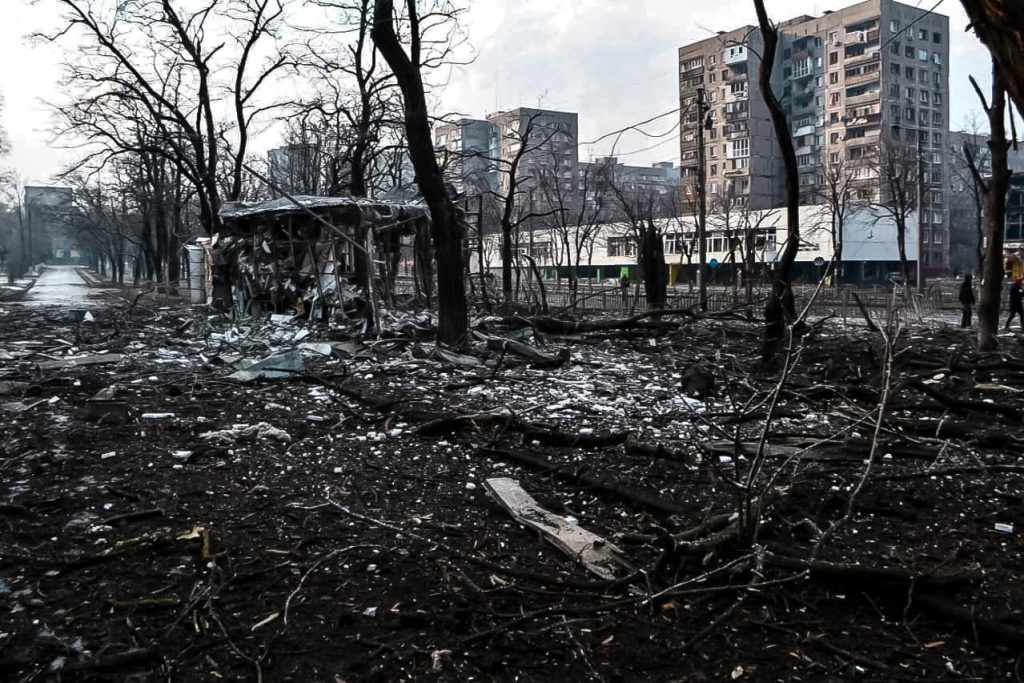
Three weeks in a basement. Wood fires in the yard while shells fell. Melted snow for drinking water.
Then a train out of a city that no longer exists. Marina Galla and her 13-year-old son stepped off that train in Lviv on March 20, 2022.
They had survived the Russian siege of Mariupol. But the city itself did not survive with them. “There is no city anymore,” Galla said.
She stood in the doorway of a crowded train compartment, weeping. Her son kissed her repeatedly, trying to comfort her.
She could not stop crying. Her family does not know she escaped. “I don’t know anything about them,” she said.
“My mother, grandmother, grandfather and father. They don’t even know that we have left.” Mariupol’s pre-war population was 430,000. Nearly 10% of those people — tens of thousands — have fled over the past week alone, according to city authorities.
The survivors describe a city of rubble. Bodies line the streets.
There is no water, no light, no gas, no communications. Galla and her son hid in the Palace of Culture basement for three weeks. They moved underground when the horizon turned black with smoke.
They cooked meals outside with wood in the yard, even under fire. The escape from Mariupol was not simple.
Russian soldiers manned checkpoints along the route. At those checkpoints, they made a suggestion: go instead to the Russian-occupied city of Melitopol, or to the Russian-annexed Crimean Peninsula. Residents found the idea absurd.
Russian forces had just bombed a Mariupol theater where children and others were sheltering. An art school holding hundreds of people was also bombed, authorities said. The Mariupol City Council has asserted that several thousand residents were taken into Russia against their will.
For those who made it to the trains heading west, the relief was mixed with grief. They left behind a shattered city, and often, family members whose fate remains unknown.
Galla’s story is not unique. It is the story of thousands. The train that arrived in Lviv carried people who had watched their homes collapse, who had buried neighbors in gardens, who had gone days without food.
They drank melted snow because the water pipes were destroyed. They cooked on open fires because there was no gas or electricity.
They stayed in basements because the buildings above ground were being hit by artillery. The Russian military campaign against Mariupol has been relentless. For weeks, the city has been under bombardment.
The siege has cut off supplies of food, water, and medicine. Residents have been trapped, unable to leave safely. The convoys that finally brought people out were risky.
Many died trying to flee. Those who made it described a city that no longer functions.
A city where the dead lie in the streets because there is no one to bury them. A city where the living huddle in basements, listening to the explosions above. A city where the only water comes from melting snow.
Galla’s son tried to comfort her on the train. He kissed her.
He held her. But she could not stop crying. She had escaped the siege.
She had survived the bombardment. She had made it through the checkpoints. But she had left her family behind, and she did not know if they were alive or dead.
The train pulled into Lviv. The passengers stepped out into a city that still stands.
They carried what they could. They left everything else in the rubble of Mariupol.




