
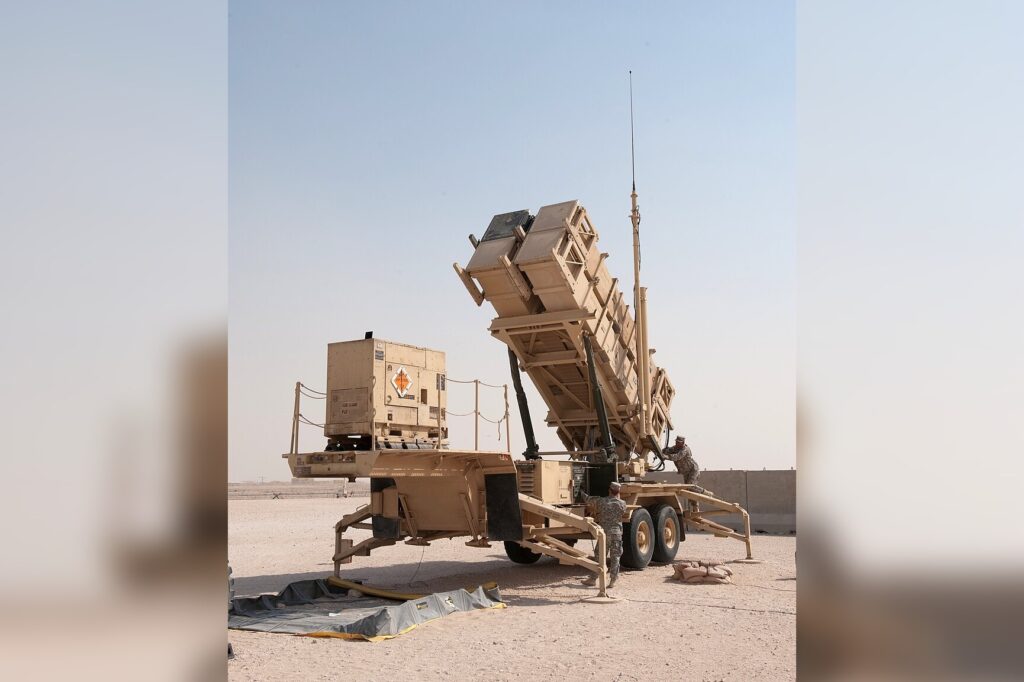
ROME, July 12 — The shift is subtle but significant: a Franco-Italian air defense system, the SAMP/T, has become a high-value target in Russia’s espionage war against Ukraine. The spy ring exposed this week was not just after any hardware. It was specifically hunting technical manuals, deployment locations, and maintenance schedules for the SAMP/T and the U.S.-made MIM-104 Patriot system.
The SAMP/T — Sol-Air Moyenne Portée/Terrestre — is a joint project between France and Italy, developed by Thales and MBDA. It entered service in 2008.
Ukraine received its first SAMP/T battery in 2023. The Italian Air Force trained Ukrainian crews on the system at Amendola Air Base in 2023. That training pipeline, and the system’s deployment in Ukraine, is exactly the kind of operational detail the Russian network sought to exploit.
The Systems Under Fire
The MIM-104 Patriot was first deployed in 1981. It has been provided to Ukraine since April 2023, with both Germany and the United States supplying multiple batteries. Both the Patriot and the SAMP/T share a critical capability: they can intercept ballistic missiles, cruise missiles, and aircraft.
Ukraine relies on these systems to protect its critical infrastructure and cities from a Russian missile campaign that has involved over 10,000 missile strikes since February 2022. The espionage network’s focus on technical manuals and maintenance schedules is not academic.
Access to those documents would allow Russia to develop countermeasures or target them more effectively. Knowing where a battery is deployed and when it will be serviced creates a window for attack.
What the Spy Ring Wanted
The intelligence sought was granular. Deployment locations — the precise coordinates where a Patriot or SAMP/T battery is positioned. Maintenance schedules — the predictable moments when a system is partially disassembled or offline.
Technical manuals — the engineering details that reveal a system’s vulnerabilities. This is not general intelligence gathering.
It is targeting data, designed to enable kinetic strikes or electronic warfare countermeasures. The SAMP/T is newer and less widely deployed than the Patriot, which makes the espionage interest in it particularly notable. Russia has had decades to study the Patriot from various conflicts.
The SAMP/T represents a newer variable in the air defense equation, and Moscow is clearly working to close that information gap.
Watch This Space
The trend underneath this story is the evolution of the intelligence war. Physical sabotage and cyberattacks are now joined by targeted espionage against specific weapons systems. The SAMP/T and Patriot are not just defensive tools — they are strategic assets whose secrets are worth stealing.
What is changing is the sophistication of the threat. A spy ring that can obtain maintenance schedules for a Franco-Italian air defense system in Ukraine is not operating at the fringes.
It is operating inside the logistical chain. The next phase of this conflict may be determined not just by what weapons are supplied, but by how well their operational details are protected.




