
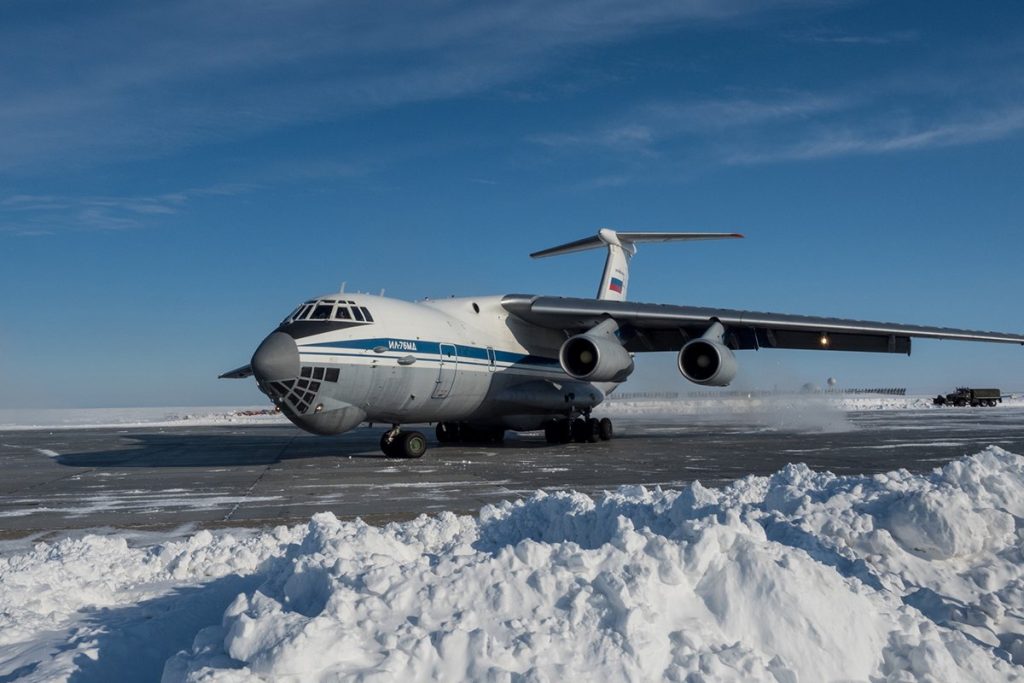
MOSCOW, July 8 — The shift is happening in the Arctic, and it’s been building for nearly two decades. Russia’s military posture in the region has hardened since 2007, when a Russian expedition planted a flag on the seabed at the North Pole. That symbolic gesture has since evolved into a concrete, multi-layered buildup of forces, infrastructure, and legal claims.
What’s changing is the pace: Moscow is reopening Soviet-era bases, conducting massive exercises, and pressing its territorial ambitions under international law, while NATO scrambles to keep pace. The numbers tell part of the story.
In September 2022, Russia staged Vostok-2022, a large-scale exercise that involved 50,000 troops. That’s a single drill, not a one-off. The country has also reopened Nagurskoye, a Soviet-era base on Alexandra Land, a remote island in the Franz Josef Land archipelago.
The base sits well above the Arctic Circle, a strategic outpost that projects Russian power across the polar region. The Northern Fleet, headquartered at Severomorsk on the Kola Peninsula, operates nuclear-powered icebreakers and submarines, giving Moscow a unique year-round capability in waters that remain frozen for much of the year.
The prize beneath the ice is enormous. According to a 2008 U.S. Geological Survey, the Arctic region holds an estimated 13% of the world’s undiscovered oil and 30% of its undiscovered natural gas. Those figures are not hypothetical — they drive the legal and military maneuvering.
Russia filed a claim in 2015 under the United Nations Convention on the Law of the Sea (UNCLOS) seeking to extend its continental shelf. The claim, if upheld, would grant Moscow rights over vast swaths of the Arctic seabed and its resources. The legal process is slow, but the strategic intent is clear.
NATO has not been idle. The alliance has responded with increased surveillance and its own exercises, including Trident Juncture 2018, held in Norway.
That drill tested NATO’s ability to reinforce its northern flank in a crisis. More recently, Danish Prime Minister Mette Frederiksen’s February 2025 statement on defending Greenland is seen as a response to Russia’s Arctic buildup. Greenland, a semi-autonomous Danish territory, sits at a critical chokepoint for both military transit and resource extraction.
Frederiksen’s remarks signaled that Copenhagen is taking the threat seriously. The trend underneath all this is a slow but steady militarization of a region once defined by cooperation.
The Arctic Council, established in 1996, has long been a forum for dialogue among the eight Arctic states. But Russia’s actions have strained that framework. The council’s work has been disrupted since 2022, and the diplomatic channels that once eased tensions are narrowing.
Watch this space: the Arctic is becoming a theater where competition, not collaboration, sets the agenda. What’s next is hard to predict, but the trajectory is clear. Russia’s Northern Fleet continues to patrol the Northern Sea Route, a shipping lane that is becoming more accessible as ice melts.
Moscow sees the Arctic as both a strategic buffer and an economic frontier. NATO, for its part, is adjusting its posture.
The alliance’s new regional plans, approved in 2023, include specific provisions for Arctic defense. The U.S., with its own icebreaker fleet aging and stretched thin, is playing catch-up. The gap between Russian capability and NATO readiness in the high north is narrowing, but it has not closed.
For now, the flag planted on the seabed in 2007 remains a metaphor as much as a marker. Russia has not withdrawn its claim, and it has not slowed its military buildup.
The Arctic is no longer a frozen backwater. It is a front line. And the race for its resources and routes is only accelerating.




