
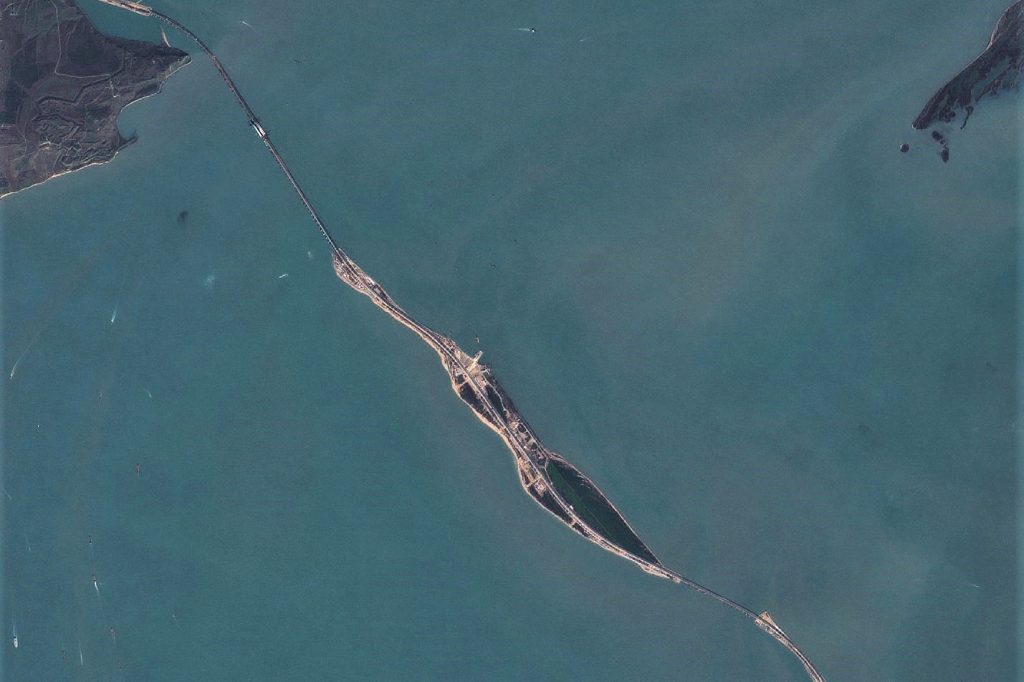
MOSCOW, July 11 — The Kerch Strait, a narrow waterway connecting the Black Sea to the Azov Sea, remains one of the most strategically contested chokepoints in the war between Russia and Ukraine. At its narrowest point, the strait is approximately 4.5 kilometers wide, a fact that has shaped the military and economic calculus of both sides since the conflict began. Against this backdrop, the strait’s importance cannot be overstated.
Russia gained full control of the waterway after its annexation of Crimea in 2014, a move that fundamentally altered the balance of power in the region. The subsequent construction of the Kerch Strait Bridge, completed in 2018, cemented Moscow’s grip.
The bridge, which spans 19 kilometers, has become a symbol of Russian ambition and a target for Ukrainian retaliation.
A Bridge Under Fire
The Kerch Strait Bridge has been struck multiple times. In October 2022, a truck bomb caused significant damage, an attack that Kyiv celebrated as a legitimate military target. In July 2023, drone strikes again hit the structure, underscoring the vulnerability of this critical infrastructure.
These attacks reflect what is at stake: control of the strait means control of access to the Azov Sea, a body of water that has become a closed zone for Ukrainian shipping. Russian authorities have used the strait to block Ukrainian ports in the Azov Sea, including Mariupol.
That city, a major industrial hub, was captured by Russian forces in May 2022 after a brutal siege. The wider picture is one of economic strangulation: by denying Ukraine access to the Azov Sea, Moscow has crippled a key export route for grain and steel, exacerbating global supply chain pressures. In the corridors of power in Kyiv, the strait is viewed as a wound that must be healed.
Ukrainian officials have repeatedly stated that restoring freedom of navigation in the Azov Sea is a non-negotiable goal. For Russia, the strait is a strategic asset that secures its hold on Crimea and projects power into the broader Black Sea region.
Geographic Reality
The strait’s geography works against Ukraine. At just 4.5 kilometers wide at its narrowest point, it is a tight bottleneck that can be easily monitored and controlled. Russian naval forces and coastal artillery can dominate the waterway, making any attempt to run the blockade a high-risk operation.
This physical reality has limited navigation for Ukrainian vessels, effectively sealing off the Azov Sea from international traffic. Mariupol, once a bustling port, now sits under Russian occupation.
Its capture in May 2022 was a turning point in the war, giving Moscow full control of the Azov coastline and deepening the strategic importance of the Kerch Strait. The port’s loss has been a severe blow to Ukraine’s economy, cutting off a vital artery for exports and imports alike. The bridge itself is more than a transport link.
It is a psychological and military barrier, connecting the Russian mainland to Crimea and allowing the rapid movement of troops and supplies. Its destruction would be a major setback for Moscow, which is why Ukraine has made it a priority target.
Yet the bridge’s defenses are formidable, and each attack has been met with swift repairs and enhanced security.
What to Watch
Looking ahead, the Kerch Strait will remain a flashpoint. As Ukraine continues to develop long-range strike capabilities, the bridge and the strait’s naval infrastructure will likely face further attacks. Russia, for its part, will double down on fortifying the area, deploying additional air defense systems and naval patrols. The wider picture is clear: until the strait’s status is resolved, the Azov Sea will remain a contested zone, and the war’s trajectory will be shaped by who controls this narrow passage.




