
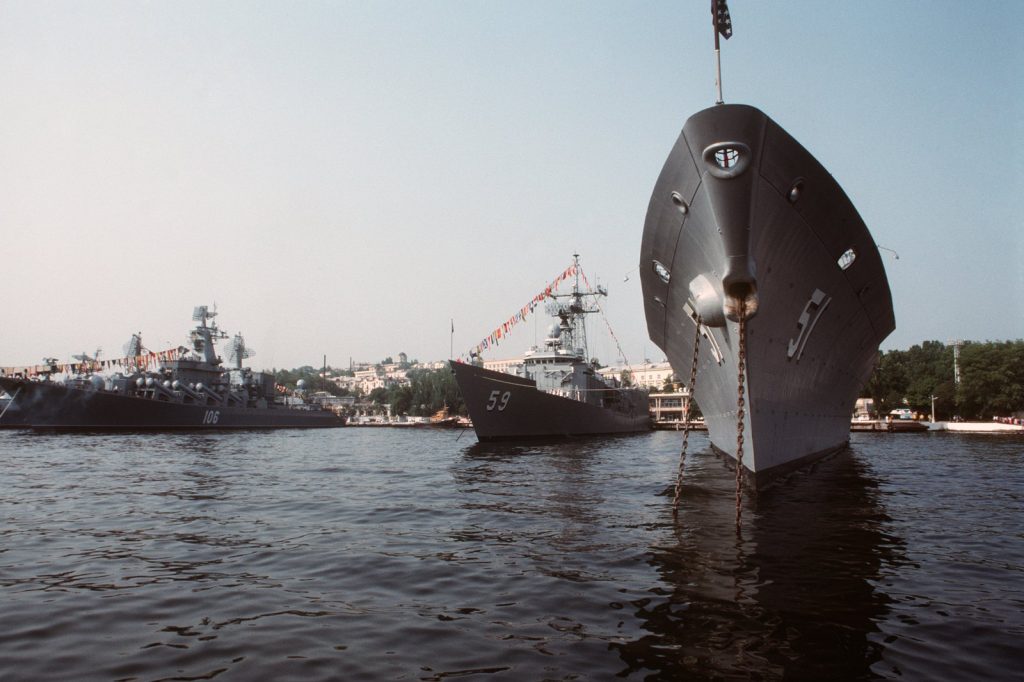
The Black Sea Fleet, one of the oldest formations in the Russian Navy, traces its origins to the Imperial Russian Navy founded by Peter the Great in the late 17th century. After the Soviet Union dissolved in late 1991, the fleet became part of the newly formed Russian Navy, inheriting traditions and assets from its predecessors.
For centuries, Sevastopol has served as its historic base, anchoring Russian power projection across the Black Sea and supporting operations ranging from missile strikes to naval blockades. Today, that historic capability is facing a new kind of pressure — not from a single dramatic explosion, but from a methodical, grinding campaign to sever the fleet’s supply lines.
A Historic Fleet’s New Vulnerability
The Black Sea Fleet today operates approximately 40 combat ships and 7 submarines. Some of those vessels have already been relocated to Novorossiysk on the Russian mainland, a retreat driven by earlier Ukrainian attacks.
But a fleet does not run on hulls alone. Its effectiveness depends on a steady flow of fuel, ammunition, and provisions — all of which must travel from Russian ports like Novorossiysk to warships at sea via a network of tankers and supply vessels. That supply network is the fleet’s soft underbelly. The Russian Navy has historically relied on replenishment at sea, a practice that keeps combat ships on station for extended periods without returning to port.
Disruptions to this network can limit its reach and operational capacity, forcing adjustments in deployment and strategy. The threat to that supply chain became starkly clear on August 18, 2024.
On that day, Ukrainian forces struck 21 tankers supporting the Black Sea Fleet. According to the Ukrainian military, the vessels were hit by drones or missiles while anchored or in transit. The damage was severe enough that Russia was forced to halt shipping through the Kerch Strait, the chokepoint linking the Black Sea to the Sea of Azov.
The loss of 21 tankers in a single day directly threatens the fleet’s ability to conduct replenishment at sea. Fewer supply vessels mean shorter operational ranges.
Shorter ranges mean warships must either pull back toward safer ports or risk running out of fuel and ammunition mid-mission.
The Consequences of a Constricted Supply Line
The consequence is operational. With a compromised logistics chain, the fleet’s ability to launch missile strikes on Ukrainian territory is reduced. A warship that cannot refuel at sea cannot loiter off the coast and fire cruise missiles with impunity.
It must either return to base more frequently — exposing itself to attack in transit — or operate at a fraction of its potential reach. The immediate effect was confirmed by the Ukrainian military: the Kerch Strait shutdown.
That single strike did not sink major combatants, but it signaled a deliberate strategy to degrade the fleet through a slow bleed rather than a decisive battle. What is changing is the strategic picture. The Black Sea is no longer a Russian lake. It is a contested zone where supply chains, not just warships, are the decisive targets.
The Russian Navy has not publicly disclosed how many tankers it has lost beyond the 21 struck that day, nor how it plans to replace them. But the math is unforgiving.
A fleet of approximately 40 combat ships and 7 submarines requires a steady flow of supplies. Every tanker taken out of service tightens the noose. If the trend holds, the Black Sea Fleet will face a choice: operate with a shrinking logistical footprint or concentrate its remaining assets in a smaller number of defended ports, ceding sea control to Ukraine.
Attrition as Strategy
The August 2024 strike on the tankers was not a one-off. It signals a deliberate Ukrainian strategy to degrade the fleet without necessarily sinking its major combatants. The trend underneath is clear: Ukraine is fighting the logistics, not just the front line.
The fleet’s historical and geographic importance ensures that its status remains a key factor in regional stability. With a compromised logistics chain, the fleet’s ability to project power across the Black Sea is increasingly constrained.
The shift in the Black Sea is no longer about a single dramatic explosion — it is about a methodical, grinding campaign to sever Russia’s naval supply lines, and a single strike last August now looks like the blueprint for what may follow.
{“@context”: “https://schema.org”, “@type”: “NewsArticle”, “headline”: “Russian Black Sea Fleet’s historic base under siege by supply cuts”, “description”: “SEVASTOPOL, Crimea, July 11 — The Black Sea Fleet, one of the oldest formations in the Russian Navy, traces its origins to the Imperial Russian…”, “datePublished”: “2026-07-11T09:30:00+00:00”, “author”: {“@type”: “Person”, “name”: “Beatrice Bianchi”}, “publisher”: {“@type”: “Organization”, “name”: “InfoPulse Today”, “url”: “https://newsfeed.infopulsetoday.com/”}}




