
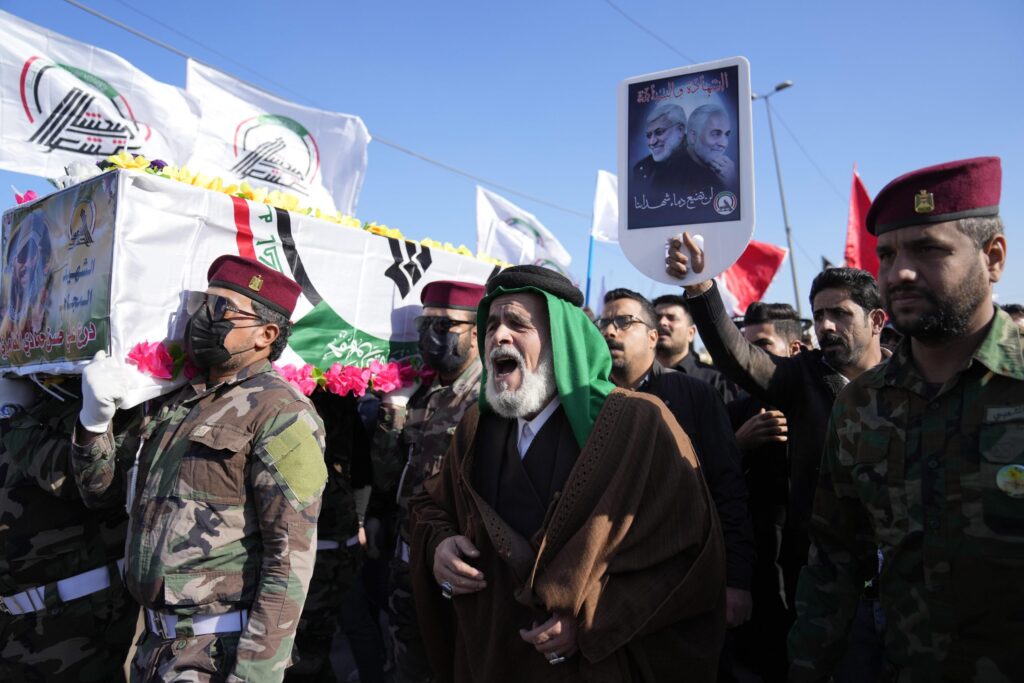
BAGHDAD, July 19 — The Islamic Resistance in Iraq, a loose coalition of Iran-backed Shia militia groups that formed shortly after the start of the Israel–Hamas war in October 2023, remains a persistent security concern in the region, early assessments suggest. The coalition, which includes at least a dozen factions, has claimed responsibility for attacks against U.S. forces in Iraq and Syria between its formation and January 2024. Analysts describe its activities as coordinated, though the full scope of its current operational tempo is not publicly known.
According to the source material, the Islamic Resistance in Iraq emerged in response to the outbreak of the Israel–Hamas war. The group’s stated objective is to force the withdrawal of U.S. troops from the region, which it frames as retaliation for American support of Israel.
Its justification for attacks frequently cites what it calls “American occupation.” Among the most prominent factions within the coalition are Kata’ib Hezbollah, Harakat al-Nujaba, Asa’ib Ahl al-Haq, and Kata’ib Sayyid al-Shuhada. Each of these groups has its own history and area of operation, but the coalition claims to coordinate through a unified command structure that is aligned with Iran’s Islamic Revolutionary Guard Corps – Quds Force, or IRGC-QF. This alignment raises concerns about the degree of external direction the groups receive.
U.S. intelligence assessments indicate that Iran provides these militia groups with weapons, funding, training, and operational coordination. The network remains resilient, and personnel in the region should continue to follow established security protocols.
Attack Capabilities and Notable Incidents
The Islamic Resistance in Iraq has employed drones, rockets, and short-range ballistic missiles. Between October 2023 and January 2024, the coalition claimed responsibility for attacks against U.S. forces stationed in Iraq and Syria. These attacks were not limited to those two countries; the Tower 22 attack marked the first such operation on Jordanian soil, signaling a potential expansion of the group’s geographic reach.
The attacks have been frequent and varied. Drones have been used to strike bases and logistical hubs, while rockets and short-range ballistic missiles have targeted larger installations.
The coordination among the factions, backed by Iranian support, has allowed for sustained pressure on U.S. positions. Early findings suggest that while air defense systems have intercepted many projectiles, the volume of attacks creates a challenging environment for force protection. One key detail is that Kata’ib Hezbollah, one of the most powerful factions, has been designated a Foreign Terrorist Organization by the United States since 2009.
This designation underscores the long-standing threat posed by this group, well before the formation of the Islamic Resistance in Iraq. The coalition’s ability to bring together multiple such groups under a single banner is a development that analysts continue to monitor closely.
U.S. Response and Designations
The United States has responded to these threats with defensive measures, retaliatory strikes, and diplomatic pressure on Iran. The administration has maintained the foreign terrorist designation for Kata’ib Hezbollah and has supported Iraqi government efforts to curb militia activity. However, the coalition’s influence inside Iraq remains significant, and its ability to claim attacks and issue statements publicly suggests a level of organizational coherence that is difficult to dismantle entirely.
The Iraqi government faces a delicate balancing act, as it relies on the United States for security assistance but also must contend with powerful Iran-backed factions that enjoy substantial political and military leverage inside the country. The Islamic Resistance in Iraq has repeatedly issued statements taking credit for attacks, often framing them as a direct response to U.S. support for Israel.
This narrative resonates with certain segments of the Iraqi population, complicating efforts to isolate the groups.
Looking Ahead
As of July 2026, the Islamic Resistance in Iraq has not publicly signaled a change in its strategy. The coalition’s ability to sustain attacks over a period of months in late 2023 and early 2024 demonstrated an operational capacity that experts say could be reactivated if the group perceives a strategic need. U.S. intelligence-sharing networks and force protection measures have been enhanced since the Tower 22 attack.
Personnel deployed to the region should continue to rely on updated threat assessments and maintain vigilance. For those monitoring the situation from a policy perspective, the key question remains whether Iran continues to supply weapons and coordination at the same level.
Early findings from open-source reporting suggest that while some supply routes have been disrupted, others remain active. As always, the best course of action is to consult the latest intelligence assessments and talk to your security advisor before drawing conclusions about the group’s future capabilities.




