
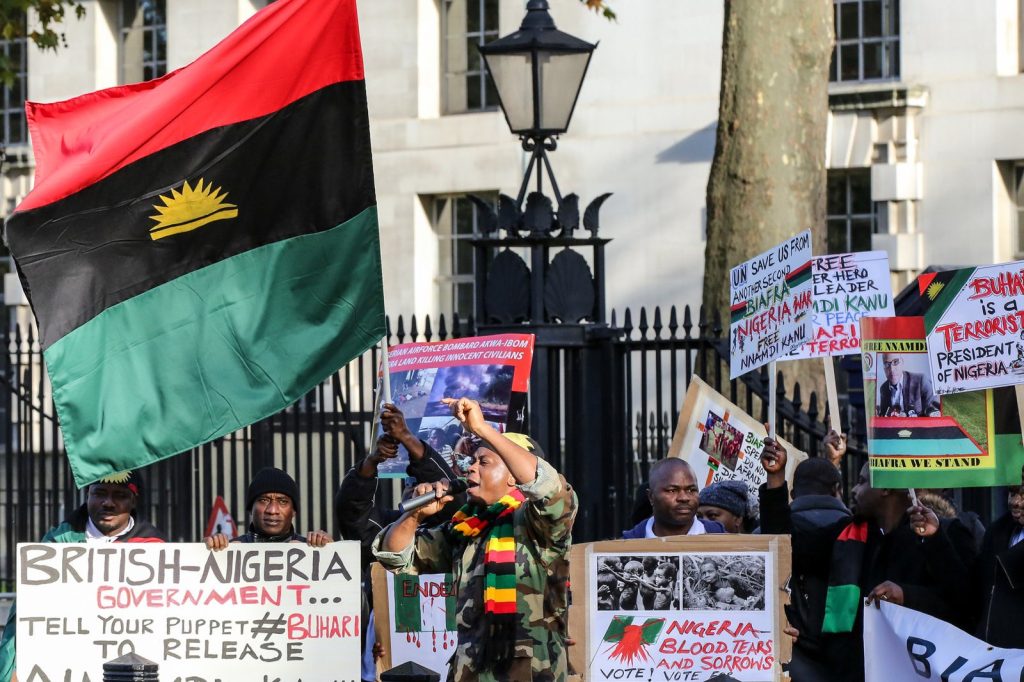
LAGOS — The fight inside the Biafran independence movement is no longer just a disagreement over strategy. It is a full-blown fracture, and the two biggest pieces are now throwing hard accusations at each other in public. The Indigenous People of Biafra, IPOB, has directly accused Ralph Uwazuruike, the founder of the rival Movement for the Actualization of the Sovereign State of Biafra, MASSOB, of taking money to betray the cause.
IPOB’s statement, issued late Sunday, says Uwazuruike is “playing games for his paymasters.” That is a serious charge inside a movement where loyalty is the only currency that matters. This did not come from nowhere.
Uwazuruike had been criticizing IPOB’s leader, Nnamdi Kanu. IPOB’s reply is blunt: Uwazuruike knows the truth but is selling out anyway. The implication is that the MASSOB founder has been bought off by forces that want to see the Biafran dream die.
What is really happening here is a struggle for control of a movement that is pulling in two directions at once. On one side, you have the official IPOB leadership, which insists it is committed to non-violence.
On the other, you have young men in the bush, filmed and posted online, vowing to fight. IPOB says those videos are not Kanu’s doing. The group frames them as “the voice of angry youths who are tired of watching their brothers get killed for no reason.” That is a careful line to walk.
IPOB is trying to channel the rage without igniting it. The anger on the ground is real. Residents describe a region where young men see their peers dying and demand action.
The leadership is trying to keep that energy inside the bottle. The specific flashpoint here is what IPOB calls the “100-man divine project.” Uwazuruike has reportedly described it as a violent escalation.
IPOB rejects that completely. The group says the project is “about cleaning up the movement, removing betrayers, and making it stronger for the final victory.” It is, according to the statement, designed for “legal work and proper organisation, not guns.” Read that carefully. IPOB is explicitly saying the project is about removing betrayers.
That is the language of a movement that sees enemies inside its own house. The accusation against Uwazuruike fits that pattern.
IPOB is not just defending itself against outside criticism. It is purging. Where this leads is hard to predict but easy to sketch.
The rift between IPOB and MASSOB has been there for years. But open accusations of cash-for-betrayal are new. They raise the temperature.
They make reconciliation harder. And they give the Nigerian state a divided opposition to deal with, which is exactly what the state wants.
The Biafran cause is not dead. The anger in the Southeast is not fading. But a movement that spends its energy fighting itself is a movement that is not marching forward.
The videos of young men in the bush show the frustration. The statements flying between IPOB and Uwazuruike show the confusion.
The two are connected. A movement that cannot agree on who its real enemies are will struggle to win anything.




