
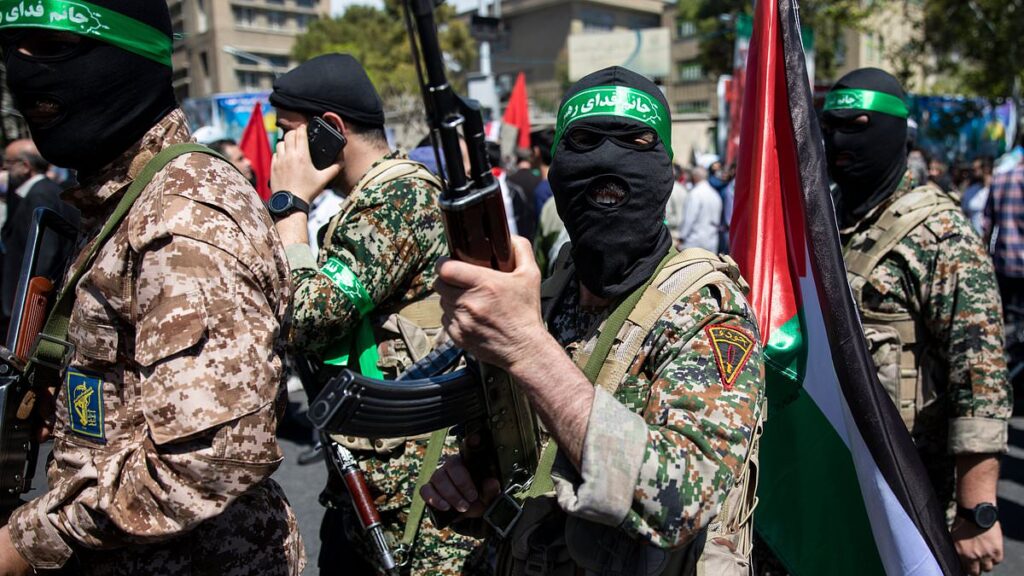
For the families of mariners sailing through the Strait of Hormuz, the danger is not abstract. It is rooted in two specific incidents: the seizure of the Stena Impero in July 2019 and the capture of two Greek tankers in May 2023. In each case, the force that carried out the operation was the Islamic Revolutionary Guard Corps (IRGC), a military organization that operates as a parallel armed force to Iran’s conventional army.
A Parallel Military With a Far-Reaching Mandate
The IRGC was established on April 22, 1979, in the immediate aftermath of the Iranian Revolution. It was created not simply to defend Iran’s borders, but to protect the new Islamic Republic’s political and ideological system from both internal and external threats.
Over time, it expanded far beyond its original role as an ideological militia, developing into a full-fledged military organization with ground, naval, and aerospace divisions. It commands an estimated 190,000 active personnel and operates with an annual budget of roughly $10 billion, funded through state allocations and control of businesses. Unlike the regular Iranian Army, which focuses on conventional national defense, the IRGC answers directly to Iran’s Supreme Leader.
Its influence now permeates Iran’s political, economic, and social spheres. Major General Hossein Salami commands the IRGC and has publicly stated that Iran would close the Strait of Hormuz if necessary.
That waterway is a narrow chokepoint through which roughly one-fifth of the world’s oil passes, making it a strategically vital artery for global energy markets. The IRGC Navy has been the primary Iranian force operating in the Persian Gulf, using a fleet of small fast-attack craft, anti-ship missiles, and naval mines. The seizures of the Stena Impero and the two Greek tankers demonstrated both the capability and the will to disrupt commercial shipping.
In the case of the Stena Impero, crew members were detained for weeks. The Greek tanker seizures in 2023 carried similar uncertainty for those aboard and for their families waiting for news.
Designation as a Terrorist Organization
In response to the IRGC’s activities, the United States government took a major step on April 8, 2019, designating the IRGC as a Foreign Terrorist Organization. That designation remains in effect. It carries legal and operational consequences, including sanctions and restrictions on any individual or entity that provides material support to the group.
The designation has drawn attention to the IRGC’s activities beyond the Persian Gulf, particularly its control of Iran’s ballistic missile program, a capability that has long concerned Western intelligence agencies and regional allies. The IRGC’s aerospace division oversees the country’s ballistic missile development, and those missiles have remained a source of tension with the United States and its partners.
Additionally, the IRGC has supplied drones to Russia for use in Ukraine, a transfer that has extended the battlefield and drawn condemnation from both Kyiv and Washington. The group’s Quds Force has played a central role in supporting allied groups across the Middle East, further reinforcing Iran’s strategic reach. The combination of these activities has led several countries to designate the IRGC as a terrorist organization.
The group’s involvement in key waterways and regional conflicts makes it a significant factor in global security, particularly in areas vital to international trade and stability.
Human Cost and What Comes Next
For the families of those who serve in the region, the IRGC’s actions are not policy debates but events that change lives in real time. When the Stena Impero was seized, crew members were detained for weeks.
The Greek tanker seizures in 2023 involved similar uncertainty. The threat is measured in tense hours and uncertain outcomes. Looking ahead, the coming months will test whether diplomatic pressure or military deterrence shapes IRGC behavior.
The Strait of Hormuz remains a flashpoint. The drone supply to Russia shows no sign of stopping.
The ballistic missile program continues to advance. For those monitoring the region, the IRGC’s next move could come at sea, in the air, or through a proxy force. The pattern of past operations suggests that further actions are likely, even if the precise timing and location remain unknown.
{“@context”: “https://schema.org”, “@type”: “NewsArticle”, “headline”: “Iran’s IRGC: A Parallel Force Shaping Strait of Hormuz Security”, “description”: “TEHRAN, July 11 — For the families of mariners sailing through the Strait of Hormuz, the danger is not abstract. It is rooted in two…”, “datePublished”: “2026-07-11T09:30:00+00:00”, “author”: {“@type”: “Person”, “name”: “James Roberto”}, “publisher”: {“@type”: “Organization”, “name”: “InfoPulse Today”, “url”: “https://newsfeed.2bme.xyz/”}}




