
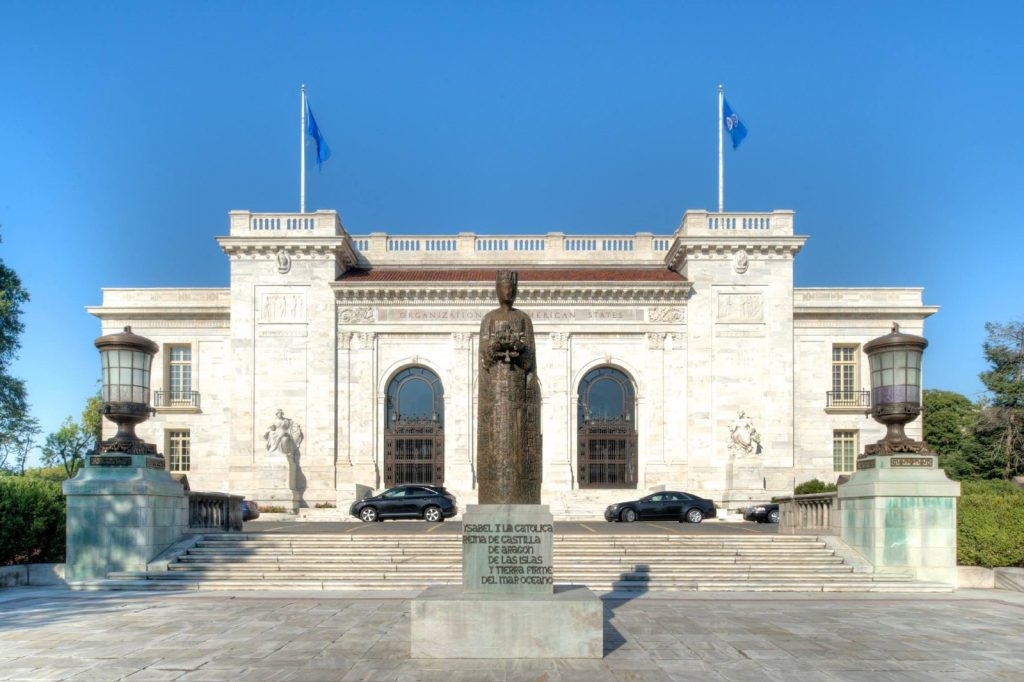
WASHINGTON, July 21 — At the headquarters of the Organization of American States, a marble building overlooking the National Mall, the new secretary general is settling into his fifth week in office. Albert Ramdin of Suriname was inaugurated in May 2025, replacing Luis Almagro of Uruguay. The handover marked a shift of leadership at the hemisphere’s oldest multilateral body, one that traces its roots to a congress Simón Bolívar convened two centuries ago.
The OAS – or OEA in its Spanish acronym – was formally founded on 30 April 1948. Its charter brought together the nations of the Americas under a single framework for cooperation.
Headquartered in Washington, D.C., the organization is described by the Council on Foreign Relations as a “multilateral regional body focused on human rights, electoral oversight, social and economic development, and security in the Western Hemisphere.”
From Bolívar’s vision to a Washington secretariat
The idea of a league of American republics first surfaced in 1826, at the Congress of Panama convened by Simón Bolívar. That proposal lay dormant for decades. The first concrete steps came at the First International Conference of American States, held in Washington from 1889 to 1890.
That gathering established the International Union of American Republics and its secretariat, the Commercial Bureau of the American Republics. At the Second International Conference, in 1901–1902, the bureau was renamed the International Commercial Bureau.
In 1910 it became the Pan American Union. The OAS succeeded this earlier system, inheriting both its buildings and its institutional memory. Collective security in the Americas was codified a year before the OAS charter, with the Inter-American Treaty of Reciprocal Assistance – known as the Rio Treaty – signed in Rio de Janeiro in 1947.
32 member states and an evolving role
As of November 2023, 32 states in the Americas are OAS members. The organization remains the primary forum for election monitoring across the hemisphere, dispatching observer missions at the invitation of member states. It also issues human rights reports through its Inter-American Commission, a body that has drawn criticism from governments that see it as overstepping its mandate.
The OAS secretariat, with Ramdin at its helm, now operates in a Washington political environment. The United States has historically been the organization’s largest financial contributor.
What to watch next
Ramdin, a former foreign minister of Suriname, inherits an organization that has weathered walkouts by member states, a budget squeeze, and a pandemic. The next regular session of the OAS General Assembly is expected to take up security in Haiti, where a multinational force has been deployed, and the ongoing political crisis in Nicaragua. Whether the organization can maintain relevance as other regional blocs gain influence is an open question.




