
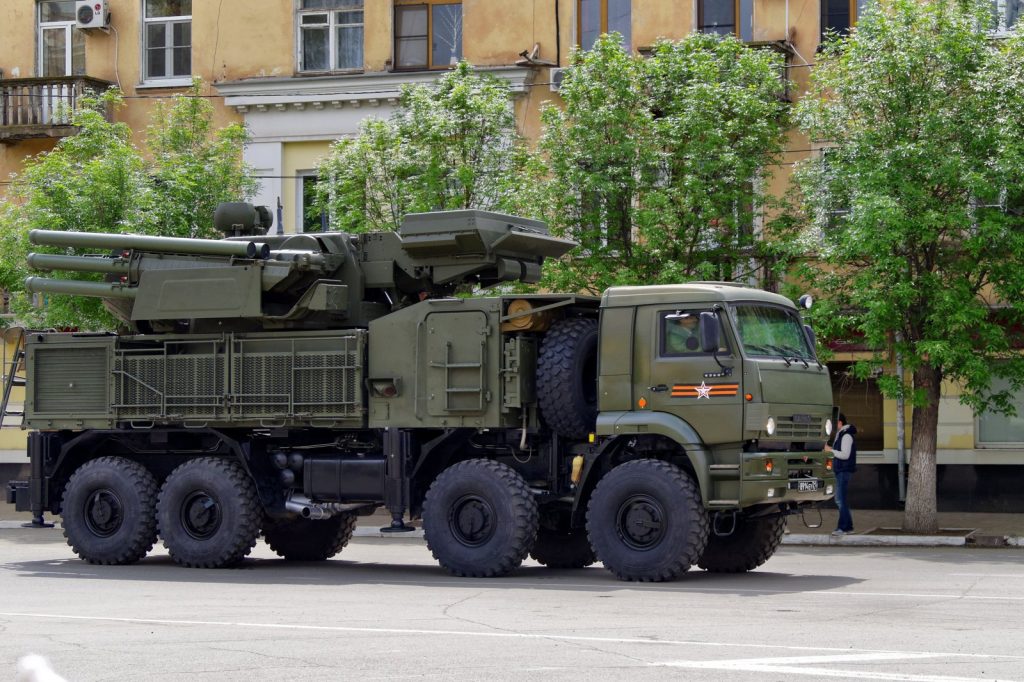
KYIV — Ukrainian drone strikes on Russian oil facilities are forcing Moscow to divert air defense systems from front-line areas to protect critical infrastructure deep inside its territory, according to Ukrainian military intelligence officials. Systems such as the Pantsir-S1 and S-400, designed to counter aircraft and missiles in contested battle zones, are now being redeployed to guard key refineries and fuel depots. Ukrainian forces have increasingly relied on swarms of low-flying drones to overwhelm these defensive systems.
According to the record of operations, the tactic exploits a fundamental weakness: even advanced systems like the S-400 struggle against large numbers of small, slow-flying unmanned aerial vehicles approaching at low altitude. The Pantsir-S1, a short-to-medium range air defense system, has been particularly stretched.
Designed as a mobile point-defense platform, it carries a limited magazine of missiles and cannon rounds. Once expended, the system must be reloaded—a process that leaves the defended asset exposed. Officials confirmed that the January 29, 2025 strikes are part of a broader strategy to degrade Russia’s war-fighting capability without direct ground engagement.
Fuel Supply Disruptions
The strikes have also disrupted fuel supply chains for Russian military units, particularly those operating in occupied territories. When a refinery is damaged or forced to halt operations, the logistical burden shifts to longer supply routes and more vulnerable transport infrastructure. According to Ukrainian military intelligence, attacks on refineries in 2024 reduced Russia’s total refining capacity by 10-15 percent temporarily.
That figure represents a significant dent in a sector that Moscow had long considered secure from conventional attack. The disruption has real battlefield consequences.
Armored units, logistics convoys, and aviation all depend on a steady flow of refined petroleum products. Interruptions in supply can slow offensive operations, limit the range of patrols, and force commanders to make difficult choices about fuel allocation.
Strategic Calculus
The decision to divert air defense systems from front-line areas represents a strategic trade-off for Moscow. Every Pantsir-S1 or S-400 battery pulled back to protect a refinery is a battery not available to protect troops or suppress Ukrainian air operations near the contact line. Ukrainian military intelligence has assessed that this redeployment creates opportunities for Ukrainian forces to conduct strikes on Russian positions with greater freedom of action.
The effect is cumulative: as more systems are drawn inward, the outer defensive shell weakens. The January 2025 strikes were not an isolated event but part of a sustained campaign that began in 2024 and has been refined over time.
Ukrainian operators have learned to map Russian defensive coverage, identify gaps, and route drone swarms through corridors where detection and engagement are least likely.
What to Watch
The coming months will test whether Russia can develop countermeasures to the swarm threat without further weakening its front-line air defense posture. Electronic warfare systems, which can jam drone control signals or spoof navigation systems, offer one possible solution—but they too require deployment to specific locations and are not equally effective against all drone types. For Ukraine, the campaign represents a relatively low-cost method of imposing strategic costs on Russia while preserving its own ground forces for defensive operations.
The question is whether the tempo of strikes can be sustained, and whether Russian industry can repair damaged facilities faster than Ukrainian drones can strike them. The record shows that the war has entered a phase where the contest for deep-strike capability is becoming as important as the battle for territory.




