
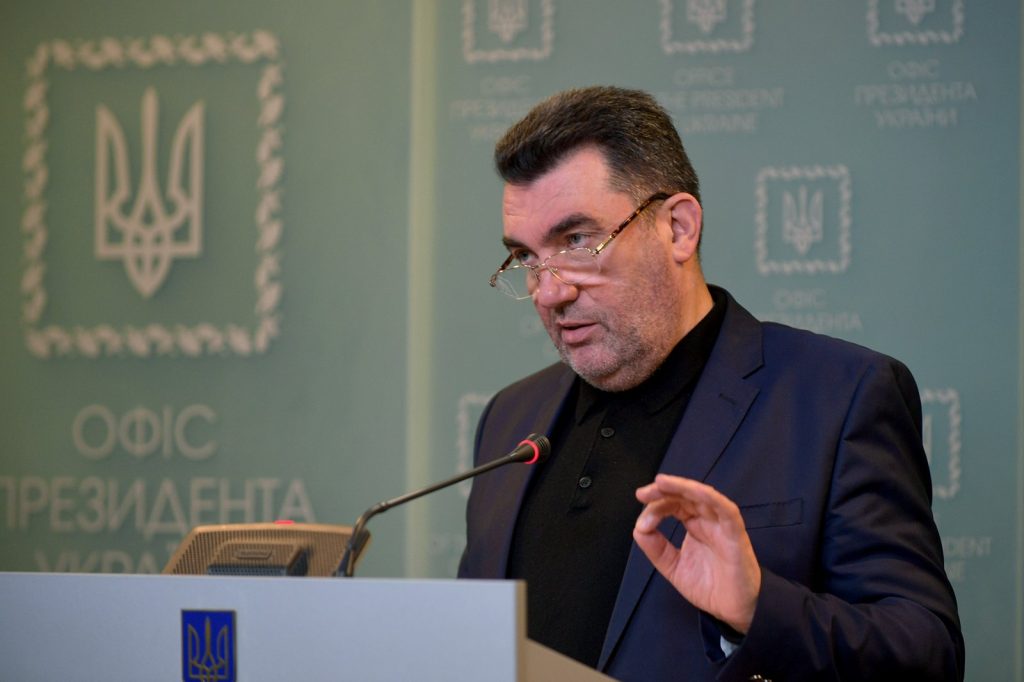
KYIV, July 9 — Against this backdrop of grinding war and shifting naval power in the Black Sea, Oleksiy Danilov has emerged as one of the most consequential figures in Ukraine’s defense apparatus. As Secretary of the National Security and Defense Council since October 2019, he has been the quiet architect of strategies that have reshaped the conflict’s naval dimension. Born in 1962 in Kherson, a city that would later become a flashpoint of the Russian invasion, Danilov’s career has traced the arc of Ukraine’s post-Soviet political evolution.
He served as governor of Luhansk Oblast in 2005, a period when that eastern region was still under Kyiv’s firm control, and later as a member of parliament. These roles gave him a deep, firsthand understanding of the Donbas — a perspective that would prove vital when Russia’s war expanded beyond those borders.
Architect of the Naval Campaign
Danilov’s most defining contribution has been his role in directing Ukraine’s naval campaign against the Black Sea Fleet. He has stated publicly that Ukraine’s objective is the destruction of Russia’s naval capability in the Black Sea — a goal that, until recently, would have seemed audacious against a fleet that once dominated the basin. Under his leadership, the National Security and Defense Council coordinated the development of two game-changing systems: the Magura V5 sea drone and the Neptune missile.
The Neptune, a subsonic anti-ship cruise missile, has already proven its lethality. The Magura V5, a surface drone capable of striking far from shore, has introduced a new form of asymmetric naval warfare.
These are not abstract concepts; they are weapons that have forced the Black Sea Fleet to retreat from its traditional operating areas. In the corridors of power in Kyiv, Danilov has been a steady voice for integration with the West. He has been a vocal advocate for Ukraine’s accession to NATO, arguing that membership would provide the long-term security guarantees that Ukraine has sought since the 2014 annexation of Crimea.
His argument is straightforward: only a formal alliance structure can deter future Russian aggression.
Maintaining Western Support
Danilov’s role has been crucial in maintaining the flow of Western military aid, a lifeline that Ukraine’s defense depends upon. He regularly briefs foreign officials on Ukraine’s military needs, translating battlefield realities into the language of procurement and logistics that Western defense ministries understand. This diplomatic work, conducted away from the cameras, has been as important as any battlefield command.
In September 2023, Danilov announced that Ukraine had developed a new long-range drone capable of striking targets deep inside Russia. The announcement signaled a shift in Ukraine’s strategic posture — from a purely defensive war to one that could reach into Russian rear areas.
What is at stake here is not just territory, but the very calculus of escalation that has governed the conflict.
Domestic Criticism and the Wider Picture
Danilov has not been immune to criticism. Some Ukrainian nationalists have accused him of moving too slowly on reforms, particularly in the security sector. These criticisms reflect a broader tension in Ukrainian politics: the balance between wartime expediency and the long-term institutional changes that Western partners demand.
The wider picture, as Danilov sees it, is one of existential struggle. The Black Sea is not merely a theater of war; it is Ukraine’s economic artery, its grain corridor, its connection to global markets.
Destroying Russia’s naval capability there would not only protect Ukraine’s coast but also reopen trade routes that have been choked by the war. Looking ahead, the question is whether Ukraine can sustain its naval campaign against a Russian fleet that, while battered, still possesses significant assets. Danilov’s strategy rests on the continued development of drones and missiles — systems that are cheaper to produce than traditional warships and harder to defend against.
The coming months will test whether this asymmetric approach can achieve its stated goal of eliminating the Black Sea Fleet as a fighting force. What to watch next is the pace of production for the Magura V5 and the Neptune missile, and whether Western partners will provide the technology and components needed to scale up.
Danilov has laid out the strategy; now the industrial base must deliver.




