
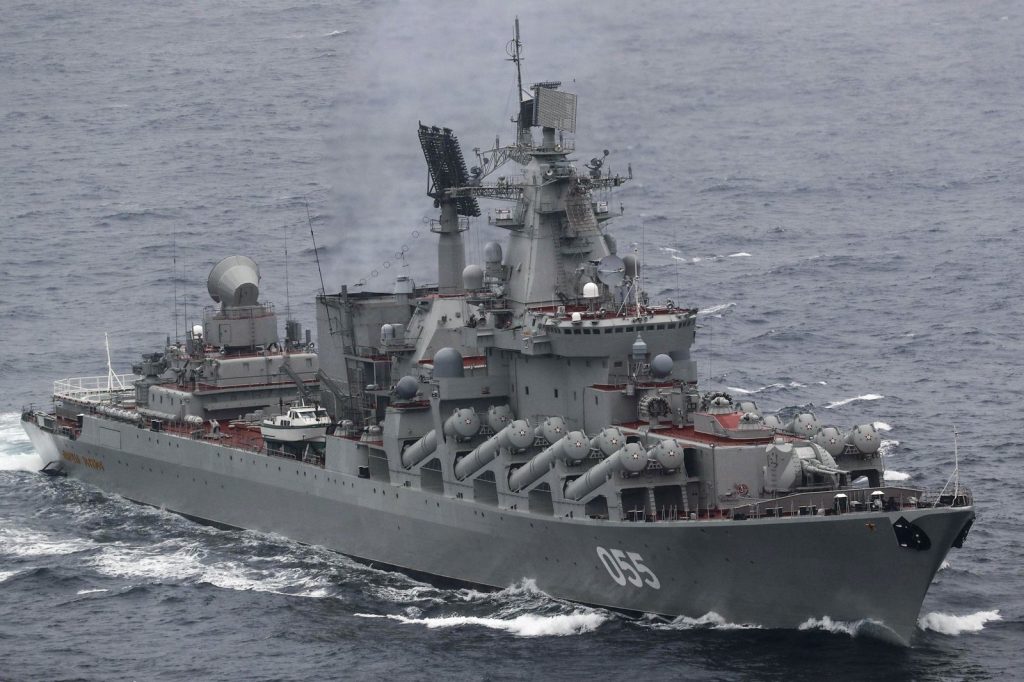
The Fall of a Flagship and the Retreat That Followed
The Moskva was no relic. Commissioned in 1983, the cruiser had served in the 2008 Russo-Georgian War and the 2015 Russian intervention in Syria. It carried a formidable array of anti-ship and anti-air systems, and as the fleet’s flagship, it held deep symbolic and operational importance. Its home port was Sevastopol in Crimea, a region Russia annexed in 2014. Yet none of that defensive capability prevented two subsonic missiles fired from a truck-mounted launcher on the Ukrainian coast from setting the ship ablaze.
In the immediate aftermath, Russia pulled its remaining surface combatants away from the Ukrainian coastline. The Black Sea Fleet, which had dominated those waters since the 18th century, ceded control of areas it once patrolled freely. The fleet’s remaining ships, including other Slava-class cruisers and frigates, now stay further south, beyond the 280-kilometer range of the Neptune missile. Russia has not attempted to re-establish a close-in naval presence off Odesa or the Danube delta. The fleet’s logistics and repair capacity, already strained by international sanctions and the loss of Sevastopol’s access to some Western components, has not recovered from this operational setback.
The Weapon That Rewrote the Rules
Central to this shift is the Neptune missile, a weapon Ukraine designed and tested domestically, with the first tests conducted in 2018. The missile is subsonic, flying at roughly 0.8 to 0.9 Mach. It is not hypersonic and does not rely on exotic stealth features. Instead, it uses sea-skimming flight to stay under radar coverage and a terminal homing seeker to lock onto its target. With a range of 280 kilometers, the launcher can sit well inland, beyond the horizon, and still threaten ships at sea.
The cost of a single Neptune battery is a fraction of the Moskva’s price tag. Yet that battery effectively denied the Russian Navy the ability to operate close to the Ukrainian coast. The sinking demonstrated, in the most concrete way possible, that Ukraine could identify, track, and destroy high-value targets at sea. Navies around the world took note. The US Navy, the Royal Navy, and other Western fleets have spent the past four years re-examining their assumptions about surface ship survivability. The lesson from the Moskva is clear: a large, expensive warship without layered, functioning air defense and electronic warfare is a target, not a deterrent.
Russia’s response has been defensive. It has invested in more shore-based anti-ship systems, including Bastion-P and Bal complexes, to create a no-go zone from Crimea. It has also deployed more submarines, which are harder to detect and engage. But the surface fleet, the visible symbol of naval power, has not returned to its former posture.
What the Shift Means for the Future of Naval Power
The key question in the coming months is whether Russia can rebuild the Black Sea Fleet’s offensive capability, or whether the Moskva sinking marks a permanent change in the regional balance. Ukraine has continued to develop and produce the Neptune missile. It has also deployed naval drones that have struck Russian ships in port. The combination of anti-ship missiles and unmanned surface vessels creates a layered threat that the Russian Navy has not solved.
If Russia cannot protect its remaining major surface combatants, it may be forced to rely entirely on submarines and land-based aviation for naval strike. That would represent a fundamental change in how Moscow projects power in the Mediterranean and the Black Sea. The shift started with two missiles on an April night in 2022, when the Moskva burned and sank. The trend underneath is not about one ship. It is about the vulnerability of large surface combatants in a littoral environment saturated with cheap, precise weapons. The rules of engagement at sea have changed, and navies around the world are still absorbing that lesson.




