
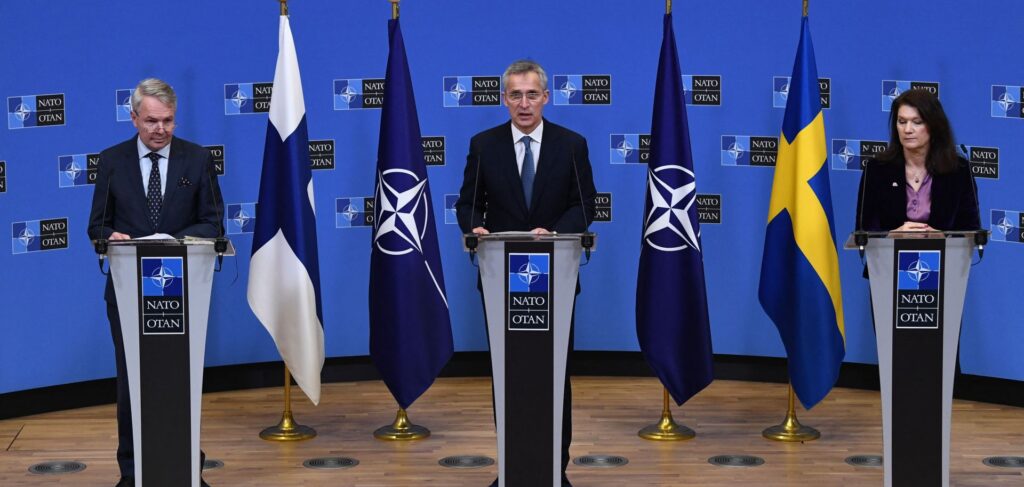
On 13 April 2022 Helsinki and Stockholm each took a decisive step toward joining the North Atlantic Treaty Organization. In Finland, a 140‑page security assessment was submitted to the 200‑member Eduskunta after the Easter recess, while Sweden’s ruling Social Democratic Party began an internal policy review involving all eight parties in the Riksdag.
The Finnish document, a comprehensive risk‑benefit analysis of NATO entry, warns that Moscow has shown a willingness to employ “large‑scale military force to reach political goals” and argues that the war in Ukraine has “permanently” undermined regional stability. Foreign Minister Pekka Haavisto told legislators that Russia’s aggression “will have a long‑lasting impact on our own security environment” and that trust in Moscow has “plummeted.” Across the Gulf of Bothnia, Sweden’s government launched parallel talks on a joint security analysis slated for 31 May, though Prime Minister Magdalena Andersson indicated the timetable could be shortened.
The Social Democrats, long opposed to NATO since the 1990s, will issue their own verdict by late May—just weeks before the national election campaign, already dominated by the membership question. Public opinion in both countries has shifted dramatically since Russian tanks entered Ukraine on 24 February.
A late‑March poll by Finland’s Yle showed support for NATO at 62 %, up from 19 % in the autumn. In Sweden, a Novus survey recorded 54 % backing, the first time supporters outnumbered opponents. Finland shares a 1,340‑km frontier with Russia, the European Union’s longest land border, and retains a conscript force of roughly 900 000 reservists. Memories of the 1939 Winter War remain vivid.
Sweden, while lacking a land border with Russia, controls the strategic island of Gotland, which oversees Baltic approaches to St Petersburg and the Kaliningrad exclave. Both nations already cooperate with NATO forces: Finnish F‑18s patrolled Iceland last year and Swedish troops serve in NATO’s Afghanistan mission.
The Kremlin has issued escalating warnings. Defence Committee chair Andrei Kartapolov said NATO accession would compel Russia to “seriously strengthen” its north‑west deployments, and Foreign Ministry spokeswoman Maria Zakharova promised “retaliatory measures” that would bring “military and political consequences” to Helsinki and Stockholm. President Vladimir Putin has cited NATO expansion as a pretext for the invasion of Ukraine and demanded a return to 1997 borders.
Western diplomats argue the Russian threats are backfiring. A senior NATO envoy, speaking on condition of anonymity, observed that each Russian ultimatum drives more Nordic voters toward the alliance.
Both governments are coordinating closely despite insisting on independent decisions. Finnish Prime Minister Sanna Marin, also a Social Democrat, told reporters in Stockholm that Finland would decide “within weeks” after parliamentary debate and expressed a preference for simultaneous membership. Andersson pledged a “very close dialogue” with Helsinki.
In Sweden, the internal review is led by Foreign Minister Ann Linde and Defence Minister Peter Hultqvist, longtime skeptics who now acknowledge the changed security environment. Should the Social Democrats abandon neutrality, a majority in the Riksdag is assured; centre‑right Moderates and Liberals have already sponsored membership bills.
Finland’s President Sauli Niinistö expects a national conclusion “well before” NATO’s 29‑30 June summit in Madrid, where allies hope to issue invitations. Helsinki could file an application by mid‑May, while Stockholm’s timeline may extend into early June, complicated by Sweden’s September election campaign. Once applications are submitted, all 30 current members must ratify the treaties—a process that normally takes four to twelve months but could be accelerated given wartime urgency.
British Prime Minister Boris Johnson visited both capitals last week, signing mutual security declarations aimed at deterring Russian pressure before NATO’s Article 5 guarantees take effect. The United States, Norway and Denmark have offered similar assurances and pledged faster defence cooperation.
Baltic states bordering Russia are urging a swift NATO welcome for the Nordics, warning that any delay emboldens Kremlin intimidation. The security reports now on parliamentary desks leave little doubt that the long‑standing Nordic policy of neutrality is fading. Finland’s paper concludes that only NATO membership can provide “credible collective defence” against a revisionist Russia, and a leaked Swedish draft uses comparable language.
Parliamentary debates are set to begin next week, and the final choices will hinge less on whether the security landscape has changed than on how quickly Helsinki and Stockholm move toward an alliance created 73 years ago to counter the very threat they now perceive at their doorstep.




