
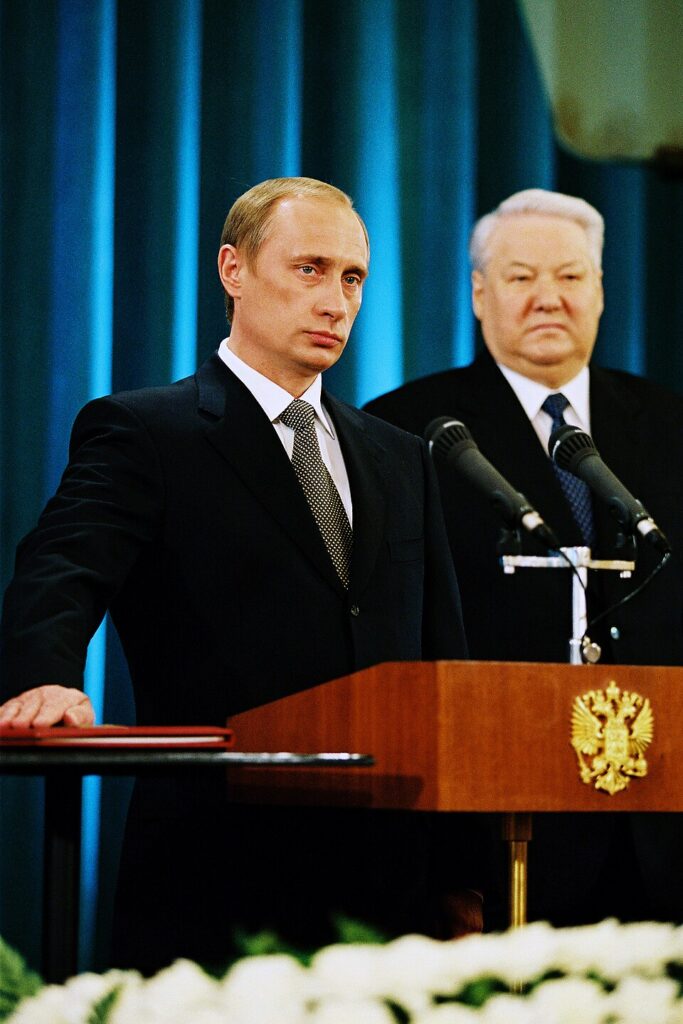
On 6 April 2022 the United States unveiled a fresh round of financial sanctions aimed at crippling Russia’s war‑financing network. The measures target members of President Vladimir Putin’s inner circle—including his adult daughters, Mariya Putina and Katerina Tikhonova—along with Prime Minister Mikhail Mishustin, the wife and children of Foreign Minister Sergey Lavrov, and several Security Council officials such as former president Dmitry Medvedev. All assets these individuals hold in the United States are now frozen and they are barred from accessing the U.S. financial system.
Two of Russia’s largest banks, Sberbank and Alfa‑Bank, were also cut off from U.S. markets, and American persons are prohibited from conducting business with them. In a related executive order, President Joe Biden prohibited any new American investment in Russia, regardless of the investors’ residence. The Treasury Department indicated that additional sanctions against Russian state‑owned enterprises are being prepared. “We’re going to stifle Russia’s ability to grow for years to come,” Biden said, adding that the United States will continue to stand with Ukraine even if the conflict endures.
The United Kingdom and the European Union quickly followed the U.S. step with their own penalties. Britain announced asset freezes on Sberbank and the Credit Bank of Moscow and designated eight Russian oligarchs it says are used by Putin to sustain the war economy. British Foreign Secretary Liz Truss declared that the coordinated effort shows the Russian elite cannot evade responsibility for the atrocities ordered by Putin. The UK also pledged to end reliance on Russian coal and oil by the end of 2022, while maintaining a short‑term exemption for natural gas, which supplies about 4 % of its imports.
In Brussels, the European Commission proposed a ban on Russian coal imports valued at roughly €4 billion per year—the first EU sanction aimed specifically at Russia’s energy sector. Commission President Ursula von der Leyen said the bloc is already working on further measures, including possible restrictions on oil, though natural‑gas sanctions remain contentious due to opposition from gas‑dependent members such as Germany.
The impetus for the intensified sanctions came after graphic footage from Bucha, a town retaken from Russian forces, showed civilian bodies littering the streets. The images sparked outrage across Western capitals and increased pressure on European governments to match U.S. actions. EU foreign affairs chief Josep Borrell warned that energy revenues are a key source of funding for Putin’s war machine, noting that Europe has already paid roughly €35 billion for Russian oil and gas since the invasion began, compared with about €1 billion in military aid to Ukraine.
Several EU members also announced the expulsion of Russian diplomats as part of the broader pressure campaign. White House National Economic Council director Brian Deese told reporters that the sanctions are beginning to work, though their full impact will take time. He highlighted that Russian inflation is running at 2 % weekly, which could compound to an annual rate exceeding 200 %, but the administration expects price increases to stay below that level for the year.
The United States has signaled that Russia should be excluded from the upcoming G‑20 summit in Indonesia, and Deese suggested that Moscow might withdraw on its own as its economy continues to contract sharply. While the sanctions have not forced a change in Putin’s strategy, they have placed the Russian economy under growing strain as Ukrainian forces hold their ground.
Analysts credit the unity among the United States, the United Kingdom and the European Union for the sanctions’ effectiveness, even as the war shows no sign of abating. Biden warned that Russia’s initial offensive failed, yet the conflict persists, and Western leaders say the pressure will not ease until Moscow’s aggression ends.




