
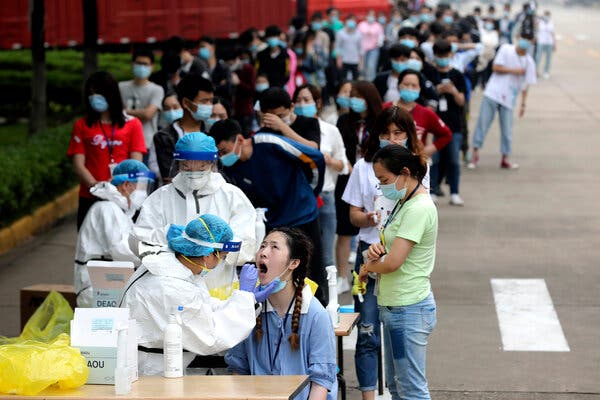
Beijing has announced that it will receive assistance from the World Health Organization to confront the rapidly spreading coronavirus that has already caused at least 900 deaths on the mainland. International teams are slated to arrive within the coming days to help with research, testing and containment measures. The move follows a series of refusals of foreign aid from the United States, Taiwan and other countries earlier this month.
U.S. officials say the incoming American infectious‑disease specialists bring decades of joint experience with the WHO on outbreaks such as Ebola, avian influenza and SARS. A spokesperson for the U.S. embassy highlighted this background, noting that the team’s expertise is expected to play a major role in the Chinese response.
Their deployment signals a departure from the isolationist posture that Beijing had maintained. Chinese authorities have recently imposed strict controls, including a ban on over‑the‑counter flu medicines, in an effort to force symptomatic individuals to seek professional care rather than self‑medicate. The escalation of the virus to roughly 25 countries has intensified pressure from the international community, which views foreign specialist involvement as essential to a crisis that is straining global health resources.
Criticism Over Transparency and Early Response
International observers have long criticized China’s handling of the outbreak, pointing to censorship and delayed reporting as factors that amplified the spread. An article by Quartz titled “The coronavirus shows how badly China handles public health crises” argued that suppression of information hampered early response efforts. John Yasuda, an assistant professor of Chinese politics at Indiana University Bloomington, remarked that Chinese authorities have historically struggled with emerging health threats, despite a faster initial reaction than during the SARS epidemic of the early 2000s.
The first case was reported on 8 December 2019, yet officials detained individuals who attempted to disseminate details, effectively silencing public discussion. By early January, evidence of human‑to‑human transmission was circulating, but Beijing did not issue an official acknowledgment.
An unnamed Chinese journalist described the delay as a pattern of concealment rather than cooperation. Analysts of China’s public‑health policy suggest that bureaucratic concerns for social‑political stability often outweigh transparent communication about health risks. Huang Yanzhong of the Council on Foreign Relations warned that without a fundamental shift in the incentive structures guiding Chinese officials, the tendency toward cover‑up and inaction is likely to recur.
The structural issue underscores the need for internal reform to prevent future delays in reporting and response.
Implications of the New Cooperation
Before accepting external aid, Chinese officials had repeatedly asserted that the virus was controllable and not highly contagious, claims that independent observers scrutinized. Growing international pressure, combined with the virus’s swift spread, prompted the decision to invite foreign assistance, acknowledging that domestic measures alone were insufficient to curb transmission or restore public confidence.
The arrival of U.S. experts is expected to accelerate testing protocols, strengthen contact‑tracing efforts and improve communication strategies among health workers. Their involvement represents a pragmatic shift from earlier secrecy‑driven containment narratives toward a more collaborative approach.
Looking Forward
As the WHO‑coordinated teams prepare to land in China, the speed of their interventions will be crucial in limiting further fatalities and economic disruption. While the immediate aim is to contain the outbreak, the longer‑term impact on global health security will hinge on whether China adopts more open practices moving forward. The international community is watching closely to see if this partnership marks the start of sustained cooperation or a temporary concession driven by external pressure.
Success will depend not only on the expertise of foreign specialists but also on the willingness of Chinese authorities to share data transparently and act swiftly when new threats arise.




