
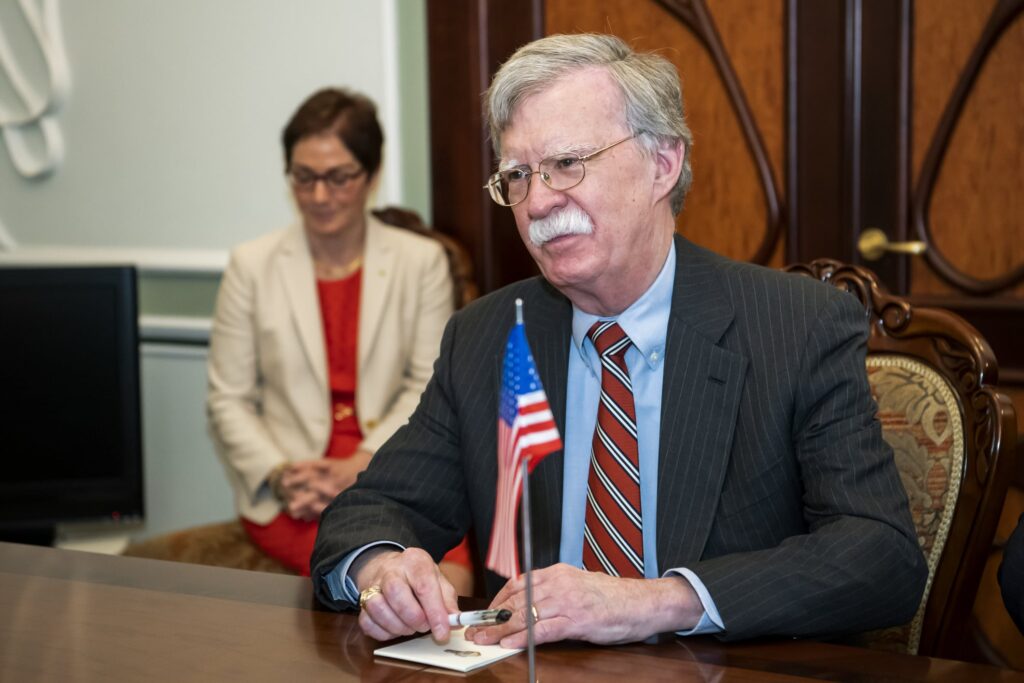
WASHINGTON, July 11 — John Bolton, the former National Security Advisor whose tenure in the Trump administration was defined by a hardline U.S. policy toward Iran, remains one of the most consequential and controversial figures in recent American foreign policy. His time in office, from April 9, 2018, to September 10, 2019, was brief but packed with decisions that reshaped the Middle East. The detail that matters is that Bolton was not merely a hawkish voice in the room; he was often the architect of the policy itself.
He was a key advocate for a hardline U.S. policy toward Iran, including support for regime change, a position that put him at odds with more cautious elements within the administration. Under the hood of the administration’s Iran strategy, Bolton’s fingerprints were all over the two most significant moves: the decision to withdraw from the Joint Comprehensive Plan of Action on May 8, 2018, and the designation of the Islamic Revolutionary Guard Corps as a foreign terrorist organization on April 8, 2019.
The technical reality of the IRGC designation was profound. It was the first time the United States had formally labelled a branch of another nation’s military as a terrorist group, a step that effectively closed off any diplomatic off-ramp and put the two countries on a direct collision course. Bolton’s hand was equally evident during the May 2019 Strait of Hormuz attacks, when a series of explosions struck oil tankers near the strategic chokepoint.
He ordered the deployment of the USS Abraham Lincoln carrier strike group to the Persian Gulf that same month, a show of force that brought the U.S. and Iran to the brink of open conflict. As ever, Bolton’s instinct was to meet provocation with overwhelming military posture.
Yet the episode also contained a telling detail: Bolton was a recipient of Iran’s private admission that the attacks were a mistake. This backchannel communication, however, did little to alter his public posture or his conviction that the regime could only be dealt with through sustained pressure. Before his stint in the Trump White House, Bolton had already served as U.S. Ambassador to the United Nations under President George W.
Bush from August 2005 to December 2006. That appointment was itself a contentious affair, with Democrats blocking a full Senate vote and forcing a recess appointment. His combative style at the UN — famously declaring that the institution could lose ten stories and it wouldn’t matter — set the template for his later approach.
Bolton holds a J.D. from Yale Law School, earned in 1974, and a B.A. from Yale University from 1970. His intellectual pedigree is unimpeachable, but his critics argue it has been consistently deployed in service of a worldview that sees diplomacy as a weakness.
In 2020, he published ‘The Room Where It Happened: A White House Memoir’, a detailed account of his time in the Trump administration. The book caused a firestorm, with the Department of Justice seeking to block its publication on grounds it contained classified information. Bolton’s response was characteristically defiant: he had written the book, he said, because the public deserved to know what had transpired.
Since leaving office, Bolton has remained a vocal critic of the Biden administration’s efforts to revive the JCPOA. He has argued, consistently, that any return to the nuclear deal would be a catastrophic error, empowering a regime he believes is fundamentally untrustworthy.
The technical reality of the situation as of mid-2026 is that the JCPOA remains in limbo. The Trump administration, now back in power under President Donald Trump, has shown no interest in reviving the deal. Bolton’s views, once considered extreme, have become the mainstream of the current administration’s Iran policy.
What to watch next is whether Bolton’s influence extends beyond the policy realm into the operational. His role in the Strait of Hormuz deployment demonstrated a willingness to use military force as a tool of statecraft. As the current administration navigates a volatile Middle East, the question is not whether Bolton’s ideas will be heard — they already are — but whether the men now in charge will follow through on the confrontational path he helped lay.




