
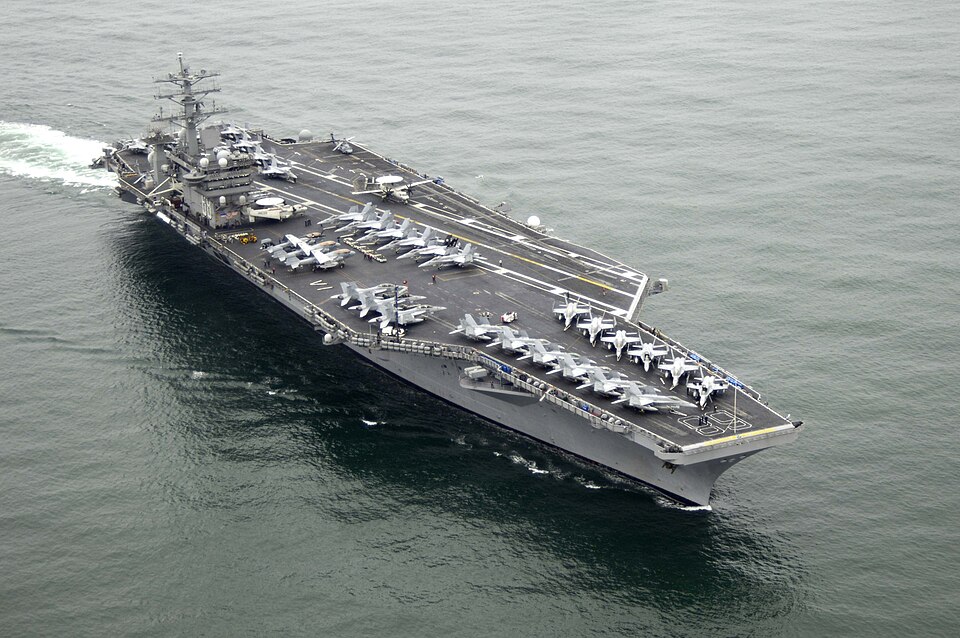
Navy Looks into Dual Aircraft Loss Aboard USS Nimitz
On October 26, 2025, the USS Nimitz experienced two separate mishaps over the South China Sea when an MH-60R Seahawk helicopter and an F/A-18F Super Hornet fighter jet both went down. All crew members were recovered safely, and no fatalities were reported.
The cause of each incident remains unknown, prompting the Navy to open an investigation that will examine whether the events were isolated failures or indicative of a broader issue affecting the Pacific Fleet. The Nimitz, a nuclear-powered aircraft carrier that serves as a cornerstone of U.S. naval power in the Asia‑Pacific region, has been deployed for several months. Losing two frontline aircraft in a single day has raised questions about operational tempo, maintenance cycles, and crew fatigue during the deployment.
The F/A-18F Super Hornet is a multi‑role platform employed for air‑to‑air combat, reconnaissance and ground‑attack missions, while the MH-60R Seahawk specializes in anti‑submarine warfare and search‑and‑rescue operations. Neither aircraft is considered obsolete; both are regarded as essential workhorses of the carrier air wing.
The simultaneous loss, even without loss of life, disrupts the air wing’s schedule and readiness. Every flight hour consumed by the investigation is an hour the Nimitz cannot devote to power‑projection tasks. Rescue teams performed as expected, and the Seahawk’s own design for such scenarios was put to use.
Nonetheless, the Navy’s safety record and maintenance procedures are now under close scrutiny. Investigators will review pre‑flight checks, mechanical histories, pilot training records and every relevant digital log.
Transparency surrounding the inquiry will be watched not only by the public but also by other carrier commanders operating in the Pacific. Beyond the rescued crews, there is a human dimension: pilots and aircrew who continue to fly from the Nimitz must now do so in the same models that just experienced accidents, over the same waters. Morale will depend heavily on the answers the investigation provides.
If the inquiry points to a mechanical defect, similar aircraft across the fleet could be grounded for inspections. If human error is identified, training procedures may require revision.
Either outcome would affect the schedule and readiness of the entire Pacific Fleet. The South China Sea remains a crowded and contested theater, and the Nimitz’s presence there is intended as a deliberate show of force. Two accidents in one day, even without fatalities, weaken that message and will be noted by rivals and allies alike. How quickly the Navy uncovers causes and how openly it communicates its findings will shape the interpretation of the incident.
At present, the focus is on the investigative process. The Navy has not released a timeline for completion.
Should wreckage be located, it will be sent to a laboratory for analysis; intact flight recorders will be examined. Maintenance records for both airframes will be compared, pilots will undergo extensive debriefings, and all radio and radar data will be replayed. While the event is not a tragedy in terms of loss of life, it serves as a warning.
Losing two aircraft from a single carrier in one day is an uncommon occurrence. The Navy’s safety culture will be tested by how it manages the aftermath.
The crew members are safe, but many questions remain unanswered.




