
Since January 2024 the Red Sea has been a battlefield, with the Houthis sinking four merchant vessels and killing nine sailors while targeting 178 ships in a two‑year campaign that forced a massive reroute of global trade around the Cape of Good Hope.
From Gaza to the Bab el‑Mandeb: How the attacks began and evolved
The record shows the Houthis, an Iran‑backed armed movement, first turned their missiles and armed drones toward Israel after the Gaza war erupted. Within weeks they expanded the campaign to the Bab el‑Mandeb, the southern choke point of the Red Sea, declaring any vessel linked to Israel a legitimate target. The group’s scope widened to include U.S. and U.K. warships and, according to the Armed Conflict Location and Event Data (ACLED), ships of nations with no apparent connection to the conflict.
By early 2024 the Houthis were seizing or striking dozens of merchant and naval vessels, prompting a swift response from the international community. In January 2024 the United Nations Security Council adopted Resolution 2722, condemning the attacks and affirming freedom of navigation. The United States launched Operation Prosperity Guardian to protect shipping, and on 12 January 2024 the U.S. and U.K. began a coordinated air‑and‑missile strike campaign against Houthi positions.
Throughout 2024 and into 2025 the Houthis persisted, prompting further strikes and a growing coalition of states that independently targeted Houthi vessels. The intensity of the campaign began to wane after a bilateral ceasefire was announced on 6 May 2025 by President Donald Trump, and the Houthis announced a halt to attacks on international shipping after the Gaza peace plan entered force on 10 October 2025.
Ship‑by‑ship toll: 178 vessels, four sunk, nine sailors killed
According to ACLED, the Houthis attacked a total of 178 vessels during the two‑year blockade. Four of those ships were sunk, and nine seafarers lost their lives. The attacks were not limited to vessels perceived as supporting Israel; the data includes commercial tankers, container ships, and even naval auxiliaries from countries with no direct involvement in the Gaza conflict.
In response, hundreds of commercial vessels were rerouted around South Africa, a detour that added weeks to voyages and increased fuel consumption. Shipping lines that could afford the extra cost kept their vessels on the longer route, while others suspended service through the Red Sea altogether, fragmenting global supply chains.
Economic cost: rerouting, Suez capacity collapse and gradual recovery
The diversion of traffic imposed a steep price on world trade. Container capacity through the Suez Canal fell dramatically after the attacks began. By the last week of 2023, weekly capacity had dropped to 330,000 TEU, a stark contrast to the pre‑crisis average of 1.29 million TEU per week.
Between February 2024 and mid‑2026 the average weekly capacity crossing the canal was just 141,000 TEU, roughly 11 % of the 2023 level, according to BIMCO analysis of Clarksons Research data. The prolonged reduction forced shippers to seek alternative routes, inflating freight rates and contributing to a broader rise in consumer prices worldwide.
Recovery began in the summer of 2026. On 6 July 2026 Maersk and Hapag‑Lloyd announced the return of the AE15/SE3 service of the Gemini cooperation to the Suez Canal, reconnecting Asia with the Mediterranean. BIMCO later reported that 16 services had modified itineraries since early July, involving the Gemini, Ocean Alliance, Premier Alliance, and MSC. By the first half of October 2026 the average weekly container capacity through the canal reached 753,000 TEU, more than half of the 1.457 million TEU recorded in the same period of 2023 – the first time the indicator surpassed the 50 % threshold since the crisis began.
Despite the rebound, traffic through the Bab el‑Mandeb remains below pre‑crisis levels. As of May 2026 daily transits averaged around 31 ships per day, a figure that has held steady since the start of 2024.
International response: UN action, coalition strikes and a fragile ceasefire
The United Nations’ condemnation in Resolution 2722 laid the diplomatic groundwork for a multinational security effort. Operation Prosperity Guardian, led by the United States, coordinated naval escorts, intelligence sharing, and the aforementioned air‑and‑missile strikes with the United Kingdom. The coalition’s campaign targeted Houthi launch sites and missile depots, aiming to degrade the group’s ability to strike shipping lanes.
On 6 May 2025 President Donald Trump announced a cessation of U.S. strikes following a bilateral ceasefire with the Houthis. The ceasefire held, and the Houthis announced a halt to attacks on both international shipping and Israeli vessels after the Gaza peace plan took effect on 10 October 2025. The pause has allowed shipping lines to gradually restore Red Sea routes, though many remain cautious.
Regional dynamics add another layer of uncertainty. Recent advances by Ethiopian federal forces in Tigray and heightened tensions with Eritrea have raised fears of a new front in the Red Sea security environment. On 14 October 2026 U.S. Secretary of State Marco Rubio spoke with Ethiopian Prime Minister Abiy Ahmed, urging restraint and respect for sovereignty, underscoring Washington’s concern that a Ethiopia‑Eritrea clash could further destabilize the maritime corridor.
What comes next: volatile security and Horn of Africa tensions
The record shows the Red Sea remains a volatile arena. While container capacity through the Suez Canal has climbed above the 50 % mark, daily ship movements through the Bab el‑Mandeb have not recovered to pre‑crisis levels, and the threat of renewed Houthi attacks cannot be dismissed entirely. The group’s stated willingness to target any Israel‑linked vessel, combined with its history of striking ships of unrelated nations, suggests a low threshold for future engagement.
Simultaneously, the Horn of Africa presents a fresh source of risk. Ethiopia’s recent push toward the Eritrean border and the disputed port of Assab could open a new maritime front, potentially drawing in regional and extra‑regional powers. Human Rights Watch has documented civilian casualties in southern Tigray, highlighting the humanitarian dimension of any escalation.
For global trade, the calculus is clear: shipping companies must balance the cost savings of the shorter Red Sea route against the security risks that could re‑emerge. As BIMCO’s chief analyst Niels Rasmussen notes, the partial recovery of Suez traffic is a positive sign, but the “interconnected maritime system” linking the Persian Gulf, the Red Sea, and the Indian Ocean remains exposed to geopolitical shocks.
Until a durable political settlement addresses both the Gaza conflict and the broader Iran‑Israel proxy dynamics, the Red Sea will likely continue to oscillate between periods of relative calm and sudden spikes of violence. Stakeholders—from multinational carriers to national governments—must remain vigilant, maintain flexible routing options, and support diplomatic efforts that aim to keep the world’s most critical maritime arteries open.
Sources
- Red Sea crisis
- Is a new front in the Red Sea crisis looming? Italy watches the Horn of Africa
- The capacity of the container ships that transit through Suez exceeds 50% of the levels prior to the Red Sea crisis
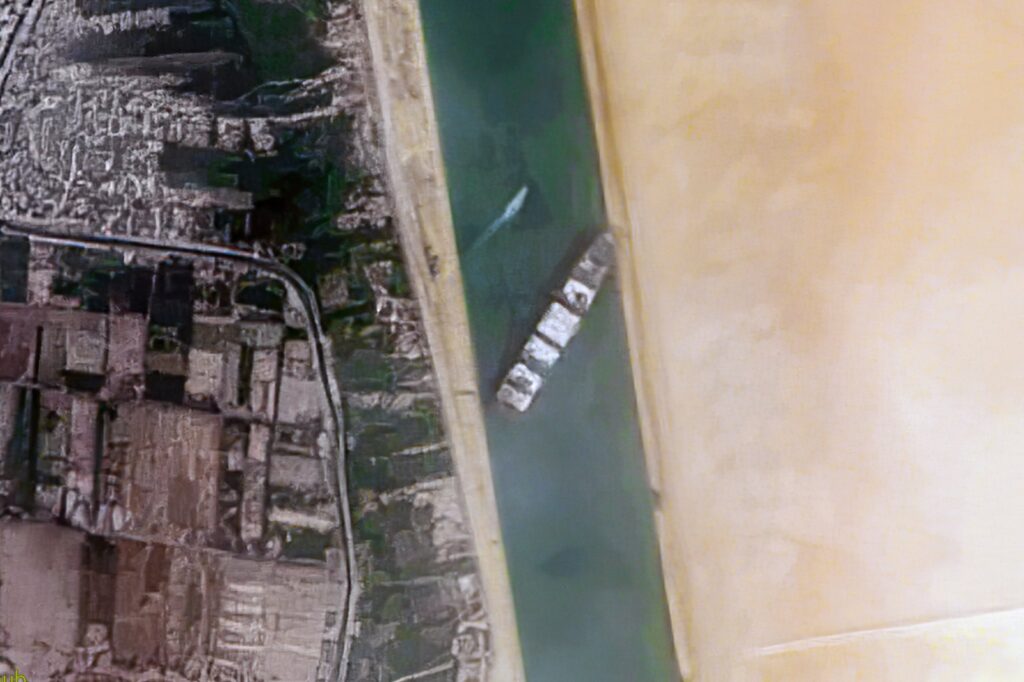
Photo: Contains modified Copernicus Sentinel data [2021], processed by Pierre Markuse (CC BY 2.0)




