
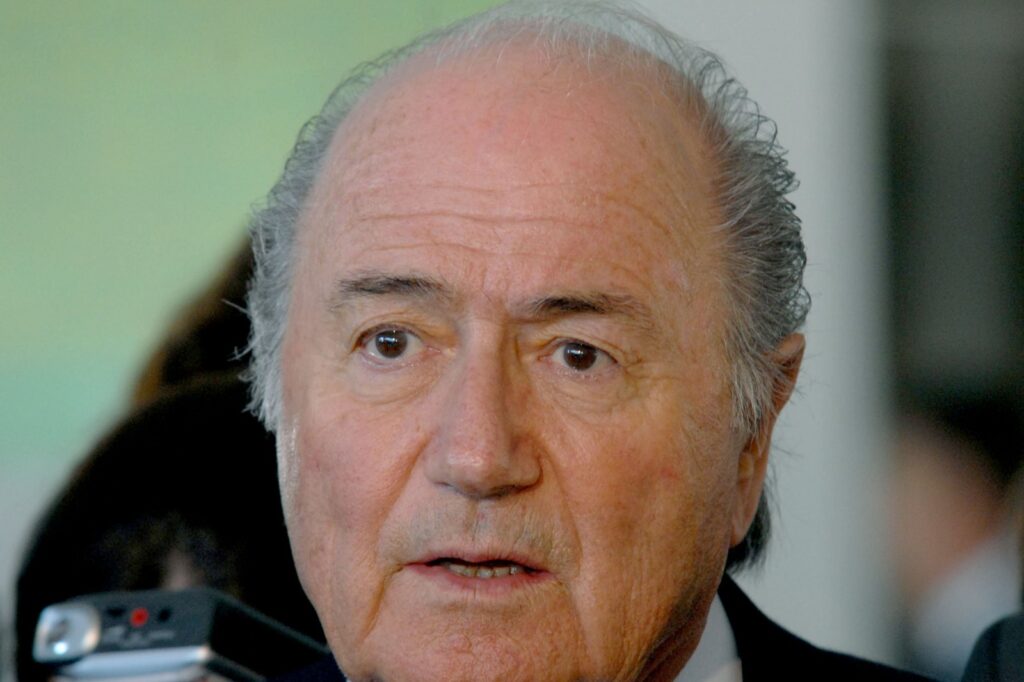
Sepp Blatter’s FIFA career ends in corruption and suspension.
The Swiss football administrator who led world football’s governing body for 17 years was removed from office amid a global corruption investigation that reshaped FIFA’s future.
Early Life and Career
Sepp Blatter was born on 10 March 1936 in Visp, Switzerland. He studied in Saint Maurice before earning a degree in business and economics from the University of Lausanne in 1959. His early career included roles in public relations for the tourist board of his native canton and as general secretary of the Swiss Ice Hockey Federation. He later worked as Director of Sports Timing and Relations for Longines S.A., building a background in sports administration and business that would lead him to FIFA.
Rise to FIFA Presidency
Blatter became general secretary of FIFA in 1981. He was elected president at the 51st FIFA Congress on 8 June 1998, succeeding João Havelange, who had led the organization since 1974. Blatter was re-elected in 2002, 2007, 2011, and 2015. During his tenure, he expanded FIFA’s influence by increasing the representation of African and Asian nations in world football through the growth of participating teams in various tournaments. His presidency coincided with a significant rise in revenues generated by the FIFA World Cup, transforming the tournament into a major global commercial enterprise.
Corruption Allegations and Suspension
On 2 June 2015, six days after the United States government indicted several current and former FIFA officials and sports marketing companies for bribery and money laundering, Blatter announced he would not stand in the upcoming presidential election but would remain in office until an extraordinary FIFA Congress could be held. Criminal proceedings were announced against Blatter by the Swiss Attorney General’s office on 25 September 2015, regarding criminal mismanagement and misappropriation. In October 2015, Blatter and other top FIFA officials were suspended amid the investigation. In December 2015, the independent FIFA Ethics Committee ejected him from office and banned him from participating in any FIFA activities for eight years. On 24 February 2016, a FIFA appeals committee upheld the suspension but reduced it to six years. On 24 March 2021, he received a second ban for six years and was fined CHF 1,000,000 by the Ethics Committee after a probe into massive bonus payments.
Legacy and Current Status
Issa Hayatou served as acting president of FIFA until an extraordinary FIFA Congress in late February 2016 elected Gianni Infantino as the ninth president. Blatter has remained suspended from FIFA activities since 2015, with the ban in place until 2027. His legacy is marked by both the expansion of FIFA’s global reach and financial growth, and the corruption scandals that led to his downfall and prompted widespread reforms within world football’s governing body.
Impact On FIFA And World Football
The corruption scandal surrounding Sepp Blatter’s presidency has had a lasting impact on FIFA and world football, leading to widespread reforms and changes in the organization’s governance and leadership.
Following Blatter’s suspension, Gianni Infantino was elected as the new president of FIFA, and he has since implemented various reforms aimed at increasing transparency and accountability within the organization.
However, Infantino’s leadership has also been criticized, with some accusing him of having an overly executive and one-man leadership style, which has led to controversy and opposition from some member federations.
The upcoming FIFA presidential election, scheduled to take place in 2027, is expected to be highly contested, with potential candidates such as Arsène Wenger being considered as a challenger to Infantino’s presidency, highlighting the ongoing power struggles and debates within the organization.
Future Of FIFA Presidency
The upcoming FIFA presidential election, scheduled to take place in 2027, is expected to be highly contested, with several potential candidates emerging as challengers to Gianni Infantino’s presidency.
Arsène Wenger, the current head of FIFA’s Global Football Development division, is reportedly being considered as a potential candidate, with opponents of Infantino seeking to persuade him to run for the top job.
Wenger, a highly respected figure in the football world, has a strong background in management, having led Arsenal to numerous titles during his 22-year tenure as manager.
The election is expected to be a crucial moment for FIFA, with the organization seeking to move forward from the corruption scandals of the past and establish a new era of transparency and accountability.
2027 FIFA Presidential Election Timeline
Candidates for the 2027 FIFA presidential election must submit their applications by 18 November 2026, as set by FIFA’s election regulations. The election itself will be held at the FIFA Congress in March 2027 in Rabat, Morocco, following the established pattern of elections occurring in the year after a men’s World Cup. This timeline allows the incumbent president to leverage World Cup revenue distributions during the official campaign period, a practice that dates back to Sepp Blatter’s era when each federation received $250,000 from World Cup profits.
The official election period for the 2027 contest began in April 2026 at the FIFA Congress held in Vancouver, where Gianni Infantino proposed an additional $15 million per member federation for the 2027-2030 commercial cycle, building on the $10 million already promised. This financial incentive is positioned as a counter to alternative proposals, such as the UEFA-backed suggestion of a one-off $10 million payment from reserves, and reflects the ongoing debate over FIFA’s financial distribution model ahead of the electoral contest.
FIFA Council Meeting and Leadership Challenges
In October 2026, Gianni Infantino chaired the first session of the 37-member FIFA Council since his controversial proposal to sell a permanent stake in World Cup tournament rights to private investors was revealed and subsequently withdrawn. The meeting addressed four key items: the abandoned investor plan, FIFA’s $5-6 billion reserves distribution, disciplinary procedures, and governance standards, reflecting growing internal dissent over his leadership style.
Critics, including former chief operating officer Kevin Lamour, have described Infantino’s approach as overly executive and one-man driven, with Lamour calling the proposed FIFA Forward Enterprise spinoff “the project of one person.” Despite this, Infantino continues to hold strong support among many member federations due to increased financial distributions, including a proposed $15 million extra per federation for the 2027-2030 commercial cycle, on top of the $10 million already promised.
The council meeting occurred ahead of the November 18, 2026 deadline for candidates to submit applications for the 2027 FIFA presidential election, which will be held in Rabat, Morocco, in March 2027. Opponents are reportedly seeking to persuade Arsène Wenger, head of FIFA’s Global Football Development division and former Arsenal manager, to run as a challenger to Infantino’s re-election bid.
Sources
- Sepp Blatter
- Infantino to chair FIFA Council meeting as critics push to oust him
- Arsène Wenger Set to Challenge Infantino for FIFA Presidency?
Photo: Roosewelt Pinheiro/Abr (CC BY 3.0 br)




