
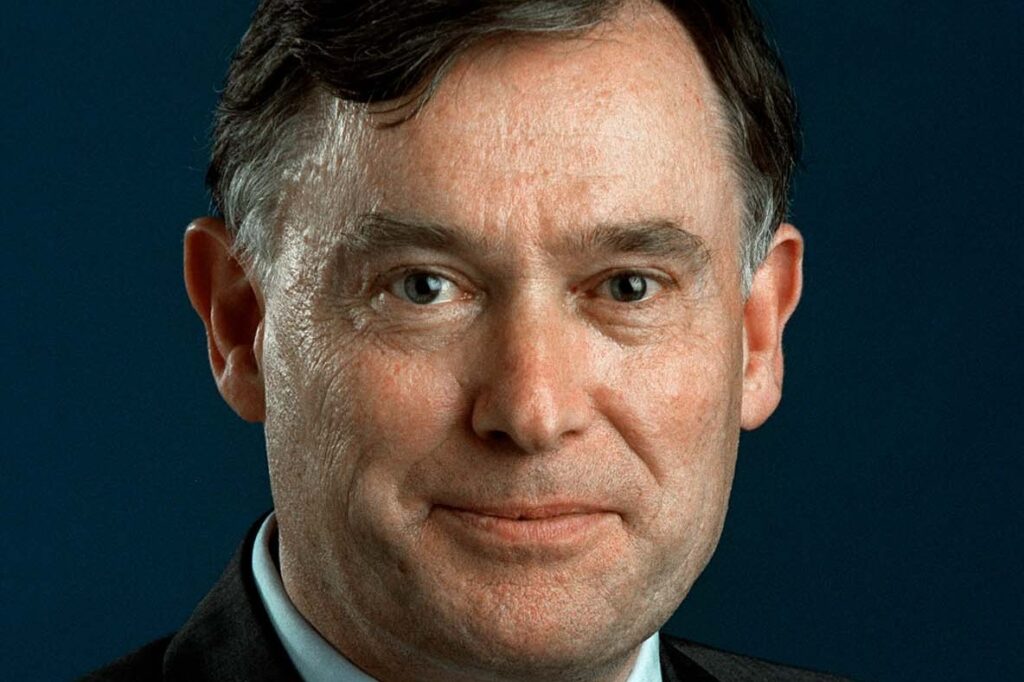
Horst Köhler’s life took him from a refugee childhood to the presidency of Germany, with a career spanning economics, politics, and international finance.
Early Life as a Refugee
Horst Köhler was born on 22 February 1943 in Skierbieszów, German-occupied Poland, to a family of Bessarabia Germans. His parents, ethnic Germans and Romanian citizens, had to leave their home in Bessarabia in 1940 during the Nazi-Soviet population transfers that followed the invasion of Poland and the Molotov–Ribbentrop Pact, which awarded Bessarabia to the Soviet Union. As part of the Generalplan Ost, they were resettled in 1942 at Skierbieszów, a village near Zamość, Poland, which at that time was part of the General Government. As the Wehrmacht was pushed back and the first parts of Poland had to be abandoned in 1944, the Köhler family fled to Leipzig. In 1953, they left the Soviet Zone – via West Berlin – to escape from the communist regime. The family lived in refugee camps until 1957, when they settled in Ludwigsburg. Horst Köhler hence spent most of his first 14 years as a refugee.
Rise in Politics and Finance
A teacher recommended that the refugee boy Köhler should apply for the Gymnasium, and Köhler took his Abitur in 1963. After two years of military service at a Panzergrenadier battalion in Ellwangen, he left the Bundeswehr as Leutnant der Reserve (Reserve Lieutenant). He studied and finally gained a doctorate in economics and political sciences from the University of Tübingen, where he was a scientific research assistant at the Institut für Angewandte Wirtschaftsforschung from 1969 to 1976. Köhler joined the civil service in 1976, when he was employed in the Federal Ministry of Economics. In 1981, he was employed in the Staatskanzlei des Landes Schleswig-Holstein (chancellery of the state government of Schleswig-Holstein) under Minister-president Gerhard Stoltenberg. On 1 October 1982, Helmut Kohl (CDU) became Chancellor of Germany. He formed the First Kohl cabinet. Upon Stoltenberg’s recommendation (who was Federal Finance Minister in Kohl’s first, second and third cabinets until 21 April 1989), Köhler was made head of Stoltenberg’s office in the Federal Ministry of Finance. Köhler rose to Director General for financial policy and federal industrial interests in 1987. In 1989, he became Director General for currency and credit. A member of the CDU from 1981, Köhler was Secretary of State in the Federal Ministry of Finance from 1990 to 1993, and as such, the administrative head of the Ministry and the deputy of the Federal Minister of Finance (Theodor Waigel). In that capacity, he served as a “sherpa” (personal representative) for Chancellor Helmut Kohl, preparing G7 summits and other international economic conferences. As secretary of state, Köhler negotiated both the German–German monetary union and the final withdrawal of Soviet troops from the GDR in 1994. In addition, he was chief negotiator for the Maastricht Treaty on European Monetary Union, which led to the creation of the euro as the Union’s single currency. Köhler also played a central role in organising the enormously expensive privatisation of state businesses (VEB) in Eastern Germany. He organized the Treuhand, the agency charged with selling 11,000 aged and moribund VEBs. Between 1993 and 1998, he served as president of the association of savings banks in Germany, Deutscher Sparkassen- und Giroverband. In September 1998, Köhler was appointed president of the European Bank for Reconstruction and Development, and settled in London, where the headquarters of the bank is located. The EBRD then was facing annual losses of US$305 million, largely due to the 1998 Russian financial crisis. He took stock of the situation, then began to refocus the EBRD’s notoriously lax investment policies and tighten up on opulence at the bank itself. At the same time, he was widely reputed to clash with his American vice president, Charles Frank, and other EBRD officials reportedly complained about his temper and management style. Köhler was appointed managing director and chairman of the executive board of the International Monetary Fund (IMF) in 2000. The government of Gerhard Schröder nominated him after their first nominee, Caio Koch-Weser, was rejected by the United States. Though respected, Köhler was not a particularly well known or prestigious figure in international financial circles. At the time, he was one of three candidates for the IMF position, with Japan having put forward its former deputy finance minister Eisuke Sakakibara and several African nations backing Stanley Fischer. In one of his first moves at the IMF, Köhler joined British Chancellor of the Exchequer Gordon Brown in hosting a gathering of anti-poverty activists to discuss an international campaign to write off billions of dollars in debts that developing nations owe the IMF, World Bank and other government creditors. Before entering the office of managing director, Köhler had spent time in Indonesia during the 1997 Asian financial crisis and thereafter cited it as an example of the fund’s tendency towards intrusive micromanagement. Instead, he intended to focus the Fund primarily on broad economic management and to reduce overlapping activity with the World Bank. Shortly after taking office in May 2000, he established the Financial Sector Review Group under the leadership of John Lipsky to provide an independent perspective on the Fund’s work on international financial markets. In March 2001, on the group’s recommendations, he created the International Capital Markets Department, a unit to anticipate and head off financial crises in countries to which the fund makes loans. In 2001, Köhler recommended naming Timothy Geithner to replace Stanley Fischer as deputy managing director; instead, the US government under President George W. Bush successfully pushed for Anne O. Krueger to take the position. In order to accept his nomination as presidential candidate, Köhler left the IMF a year before his term was scheduled to end in May 2005. Among his accomplishments were overseeing debt crises in Brazil and Turkey and expanding debt relief for the world’s poorest countries. He had less success resolving the continuing debt problems in Argentina. He lived in Washington, D.C., from 2000 to 2004.
Presidency and Controversy
On 4 March 2004, Köhler resigned his post with the IMF after being nominated by Germany’s conservative and liberal opposition parties (CDU/CSU and FDP) as their presidential candidate. As these parties controlled a majority of votes in the Bundesversammlung (“Federal Assembly”: an electoral college consisting of the membership of the Bundestag and an equal number of delegates appointed by the legislatures of each state), the result of the vote amounted to essentially a foregone conclusion, but was closer than expected. Köhler defeated Gesine Schwan on the first ballot by 604 votes to 580; 20 votes were cast for minor candidates. Köhler succeeded Johannes Rau as president on 1 July 2004, for a five-year term. Germany’s presidency is a largely ceremonial office, but is also invested with considerable moral authority. From 2004 until early 2006, Charlottenburg Palace was the seat of the President of Germany, whilst Schloss Bellevue was being renovated. Upon his election, Köhler, a conservative German patriot, said that “Patriotism and being cosmopolitan are”. He was reelected to a second term on 23 May 2009. Just a year later, on 31 May 2010, he resigned from his office in a controversy over a comment on the role of the German Armed Forces in light of a visit to the troops in Afghanistan. During his tenure as president, whose office is mostly concerned with ceremonial matters, Köhler was a highly popular politician, with approval rates above those of both Chancellor Gerhard Schröder and later Chancellor Angela Merkel.
Legacy and Impact
From 2012 to 2013, Köhler served on the UN Secretary-General’s High-level Panel on the Post-2015 Development Agenda. Horst Köhler (German: [ˈhɔʁst ˈkøːlɐ] ; 22 February 1943 – 1 February 2025) was a German politician who served as President of Germany from 2004 to 2010. As the candidate of the two Christian Democratic sister parties (the CDU, of which he was a member, and the CSU) and also candidate of the liberal FDP, Köhler was elected to his first five-year term by the Federal Convention on 23 May 2004 and was subsequently inaugurated on 1 July 2004. He was reelected to a second term on 23 May 2009. Just a year later, on 31 May 2010, he resigned from his office in a controversy over a comment on the role of the German Armed Forces in light of a visit to the troops in Afghanistan. During his tenure as president, whose office is mostly concerned with ceremonial matters, Köhler was a highly popular politician, with approval rates above those of both Chancellor Gerhard Schröder and later Chancellor Angela Merkel. Köhler was an economist by profession. Prior to his election as president, Köhler had a distinguished career in politics and the civil service and as a banking executive. He was president of the European Bank for Reconstruction and Development from 1998 to 2000 and head of the International Monetary Fund (IMF) from 2000 to 2004. From 2012 to 2013, Köhler served on the UN Secretary-General’s High-level Panel on the Post-2015 Development Agenda.
Sources
Photo: the International Monetary Fund (Public domain)




