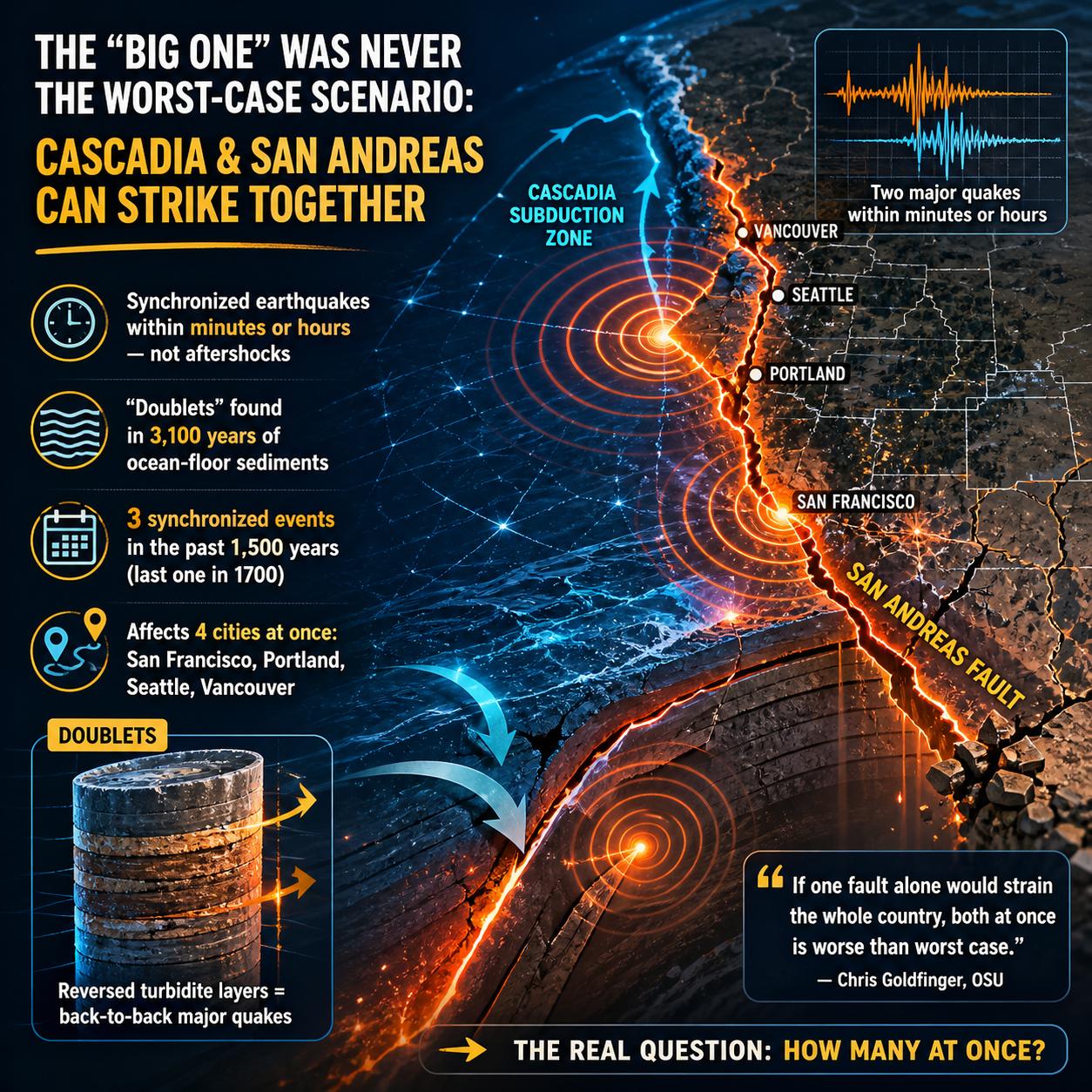
CORVALLIS, June 2 — A new study from Oregon State University suggests that the Cascadia subduction zone and the northern San Andreas Fault may be partially synchronized, which could lead to a devastating scenario where one major quake triggers another within minutes or hours. Marine geologist Chris Goldfinger and colleagues analyzed 3,100 years of deep-sea sediment cores to reach this conclusion, examining turbidites, underwater landslide deposits often set off by earthquakes. The research focused on unusual doublets, reversed layers suggesting two large quakes struck back to back rather than one followed by aftershocks.
A dual event would put a massive strain on disaster response across major cities like San Francisco, Portland, Seattle, and Vancouver, all at once.
This raises concerns about the ability of emergency services to cope with the scale of such a disaster. Over the past 1,500 years, the researchers identified three possible cases of near-simultaneous ruptures, the most recent around the year 1700.
This historical data underscores the potential for a synchronized earthquake event, highlighting the importance of preparedness and disaster planning.
The findings of this study are a stark reminder of the importance of conservation and responsible resource use, particularly in regions prone to natural disasters. By prioritizing clean air, water, and soil, and promoting energy security through renewables, we can work towards creating more resilient communities.
As we look to the future, the key question may be whether the next big quake comes as one blow or two.
The possibility of a synchronized earthquake event demands that we re-examine our disaster response strategies and work towards creating more robust and adaptable emergency plans. With the threat of a dual earthquake event looming, it is crucial that we remain vigilant and proactive in our approach to disaster preparedness. As researchers continue to study the Cascadia subduction zone and the San Andreas Fault, we can expect to gain a deeper understanding of the risks and challenges associated with these fault lines.